Flash (Fiction) in a Pan

Last month at MileHiCon in Denver, I got drafted into the “flash fiction chopped” competition after a couple of scheduled contestants pulled no-shows.
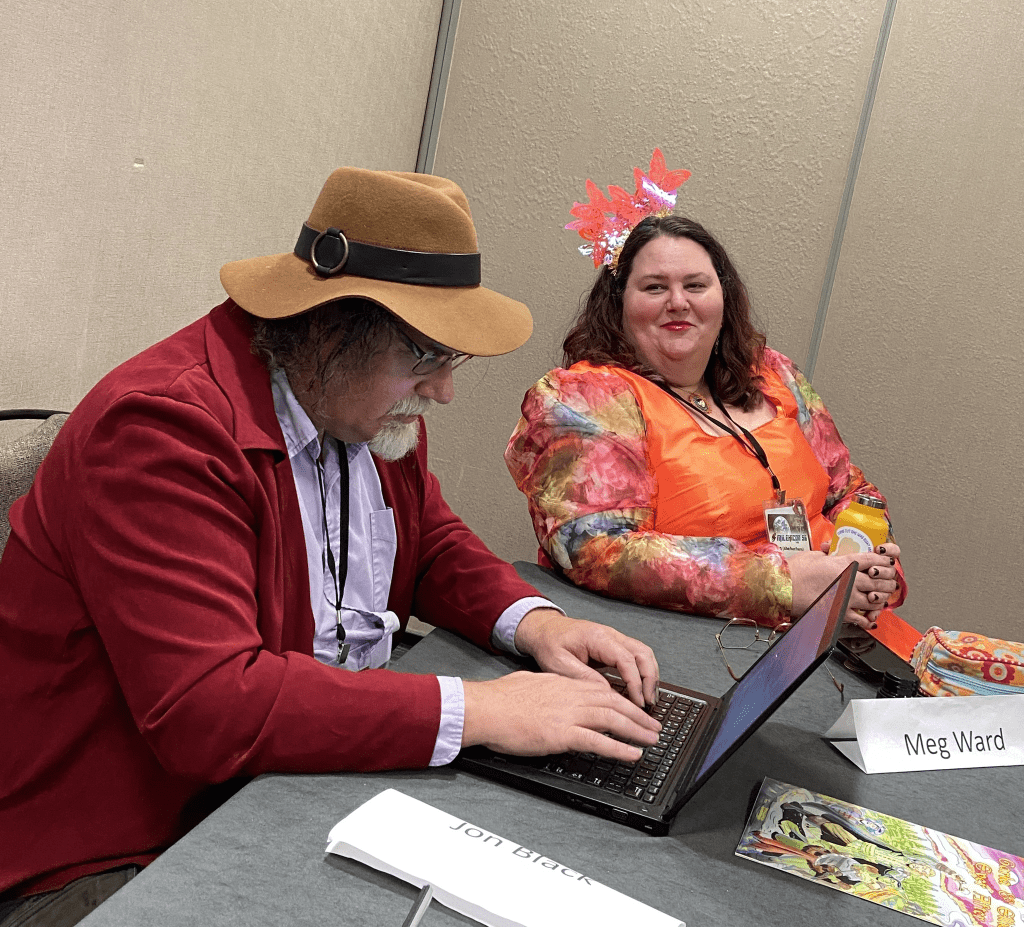
Action Shot: Me, mid-story, chronicling a romance between a dog and a lighthouse…as you do (Photo: HC Werner)

The rules were simple. The audience, improve-style, supplied the contestants with a protagonist, a location, and a complication. The competing authors then had eight minutes to write a story incorporating those elements. Afterward, each author read their story aloud and the audience voted one of the authors “off the island.” Lather, rinse, repeat until only one author remained.

As it turns out, I was that author.

I’ve gotten way more interest on social media about this than I expected, so I thought I’d share my flash fic compositions with anyone who was interested enough in the initial post to check them out. [In the interest of full disclosure, I have done some very basic clean-up on the selections to correct spelling, punctuation, and the occasional omitted article.]

To give this all a pretense of substance, I’ve also added a short section at the end, discussing some of the lessons I’ve taken away from this session which may be useful to those of you who find yourselves in similar competitions.

(CAVEAT: For those of you who may be encountering my writing for the first time through this post, these selections are not representative of my published writing)

ROUND ONE

Protagonist: The Haunted Woman

Location: Evergreen, Colorado

Complication: Stuck in Traffic
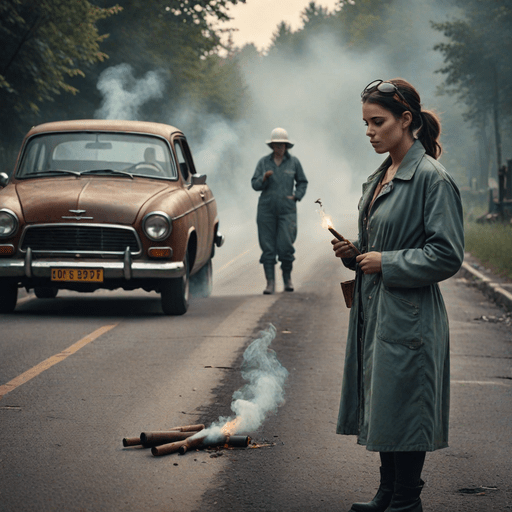
Julia, the haunted woman, presumably (Image: Not HotPot AI’s best work).

Julia had gotten use to ghosts. She had seen them childhood, since an unfortunate accident involving a vending machine and a tarot deck. But ghostly road construction, outside was something new. Up ahead, just outside of Evergreen, Colorado, she could see the construction workers, or rather see through them, as the road was shut down and a truck loaded with used furniture and a VW microbus idled in front of her.

The other drivers were freaked out, their reactions ranging from catatonia to panic and praying. But Julia was the haunted woman. This being old hat, she flagged down the ghost who seems to be in charge. “What’s going on” she asked?

“Road ghosts,” the ghost in charge explained, as it that explained everything.

“Road ghosts?” Julia repeated.

“What did I call them when I was alive?” the ghost took the ghostly cigar out of his mouth, and looked thoughtful. “Pot holes. He paused. “Think about it, pot holes are basically the ghosts of a road. They have their own stories, their own lives, their own pathways to becoming to ghosts.”

“That’s great,” Julia said, “but I’m really trying to get to some town in Colorado the author has heard of.” And then, because the author hadn’t finished his story, a giant machine came out of the sky moved Julia and the rest of the cars past the construction.

ROUND TWO

Protagonist: A sentient attack drone

Location: A deserted beach

Complication: Too many spiders.

BOB (Big Old Bomb) talks with The Spiders. (Image: HotPot AI)

Big Old Bomb, BOB for short, the sentient attack drone, was enjoying its first vacation since the supreme court (not our currently supreme court, obviously,) ruled that AI entities, devices, automata and machines were covered by the same labor laws, including a minimum of two week’s vacation, as everyone else.

A standard query search had indicated humans often liked to vacation on beaches, so BOB thought it would start there. The same search indicated that the combined presence of red tide and medical waste would reduce prices. That seemed to have worked, the prices were low. And the beach was restful. It was, in fact, deserted. BOB had taken long walks by itself. It had read Sartre. It had argued with strangers, including other sentient attack drones, on the internet.

By the fourth day, BOB was bored. It decided to checked out the small beach-side cabaret, the only other place that seemed to be inhabited. A jazz quartet was followed by a flamenco dancer, who was followed by a woman playing the euphonium while reciting limericks in dead languages. The compere then announced the headliner, a rock act. The singer had spiky orange-ish hair, pale skin, and elaborate face makeup. His backup band, the Spiders, were nowhere to be found. “But where are the spiders?” BOB asked and went to go look for them,

He found them all behind the cabaret smoking. The Spiders, too many Spiders, an excess of Spiders, in fact. “Why aren’t you at the gig?” BOB asked.

“Our singer is impossible,” one of the Spiders said, “Always making love with his ego.” So BOB became the Spiders’ new lead singer. And the rest, as they say, is rock ‘n’ roll history.

ROUND THREE

Protagonist: A dog

Location: A lonely lighthouse.

Complication: a burnt bundt cake

A love story for the ages (Image: HotPot AI)

It was the kind of love story you remember you entire life, a classic love story, between a dog who happened to be a conductor of the Philadelphia Philharmonic orchestra and a lonely light house. Of course the lighthouse was lonely, it was a lighthouse, it’s hard to meet people when you’re a lighthouse. Except lighthouse keepers, but they’re the bad boys of recluse and hermit set, all moroseness, all tragedy and posturing … no long walks on the beach, no poetry.

So the light house decided to put its presence out there, like a beacon. Its profile, its dating profile, was very visible, especially to ships traversing the coast at night. But it also reached the wall of the living room of the room where the dog lived. The dog barked out its response, but the lighthouse could not hear. The only people who could hear were the dog’s owners. Damn it, Princess. Go to sleep! they said.

The beacon returned, again the dog professed its love. Again, came the cry, Damn it, Princess go to sleep!!

Again, the beacon returned. Again the dog professed its love. Damn it, Princess go outside!!!

And so her owners let Princess outside. The dog ran, in obligatory slow motion, with soft lighting, a wind machine blowing its fur. You know the scene, you’ve seen it a million times. You can even hear the sound track, take a moment, in your mind, to pick out the perfect song.

“Shit!” the author said, his authorial voice full of conflict, “there was supposed to be a burned bundt cake in here somewhere.”

So, what did I learn?

I want to be clear, I don’t think I won “flash fiction chopped” because I was churning out the highest quality prose at the front table. In fact, I think this was distinctly not the case. In that case, why did I win? What was I doing that put me over the top of competitors who were actually putting out better writing? What can you learn from my experience that might help you if you find yourself in a similar situation? I think there are three things to note here.

Read the Room

Sitting down at my laptop, my impression was that we had an audience in the mood for goofy fun rather than stirring prose. This seemed confirmed when, after the first round, the audience voted to eliminate the author who had written (in my opinion) the best, tightest story but one that was played absolutely straight. If you want to win, write what your judges want.

Performance Matters

Something I realized, which I think some of my competitors missed, is that those four words, “read your selections aloud,” changed everything. That made the competition at least as much about showmanship as authorship.

A Weak Ending is Better Than No Ending

The first thing I did, after writing the opening paragraph, was to write a conclusion. I think having an ending, even if not a very good or even germane one, made my stories feel tighter than some others that were actually better written but stopped abruptly when our eight minutes were up.

Drac is Back: The Holmwood Foundation Podcast

Few projects in recent years have excited me as much as the found footage horror-fiction podcast, The Holmwood Foundation. Let’s be honest, it’s hard to resist a podcast with the tagline “A secretive organisation. Two antagonistic work colleagues. Dracula’s severed head…” Or a pilot episode combining the Gothic essence of Dracula with the quirky fun of X-Files or Warehouse 13. Or the biographies of the cast, crew, and creators behind the podcast.

The Holmwood Foundation is in a sprint to meet their Kickstarter goals by November 14. My friends, this is a top-tier project. The team behind Holmwood is being reasonable, even frugal, but top-tier comes with a price tag. I am putting my website in their service to share my excitement with readers (and, hopefully, convey what a loss it would be if this project doesn’t make).

Holmwood is the brainchild of Georgia Cook and Fio Trethewey, with a script-editing touch by Katharine Armitage, all speculative fiction veterans with sterling credentials in horror, the Whoverse (since my website sometimes veers into weird areas, I should clarify that is Who as in “Doctor” not “Horton hears a” or “Live at Leeds”) and other strange, wonderful corners of speculative fiction. To bring their vision to life, they’ve assembled a stellar cast and crew with some very big credits under the belt.

Co-creator Fio Trethewey was good enough to give me some of his time at this very busy moment and answer a few questions I had about the project. It turns out Holmwood is, simultaneously, an idea both years and months in the making.

Fio Trethewey

So, Georgia [Cook] is a massive horror fan, and I’m more a dark fantasy guy – but Dracula was something I loved ever since I was a teenager, and when we met and became good friends it was Dracula and the book that we bonded over. Over time, we talked about what we might do if we had the reigns on Dracula (we became friends during the era where Dracula 2020 graced our TV screens), and as such, the characters of Jeremy and Maddie were born, but we weren’t sure exactly what to do with them. If we needed to make them something original, away from Dracula, that was totally on the cards.

Then, back in May, Georgia was asked to watch a found-footage Horror Film called Grave Encounters for a review podcast. It’s about a ghost-hunting TV show entering a haunted asylum and everything going very wrong from there. It’s a lot of fun, and while sitting at a convention table the following week, we suddenly wondered if our Holmwood concept would work as an audio drama.

We wrote out a few scenes, and we realised it would—and now here we are seven months later with a pilot and a crowdfunding campaign for the full season!”

Set in the present day, in narrative continuity with Bram Stoker’s Dracula, Holmwood pulls back the curtain on the events of Stoker’s novel to reveal that, in the actual version of events, Dracula survived, or at least his head did (functioning, at least in the pilot episode, as a macabre MacGuffin for our protagonists).

After the events of Dracula, and Jonathan’s death, Mina and Arthur Godalming established an organization, the eponymous Holmwood Foundation. While presenting a public face of a philanthropic organization dedicated to the study and treatment of rare blood disorders, the foundation’s true purpose, while no less altruistic, is of necessity, the antithesis of public facing: protecting an unsuspecting world from Dracula and his minions.

Bram Stoker, ally of The Holmwood Foundation

I very much appreciate Holmwood’s metatextual wink and nod of making Stoker an early ally of the Foundation, charged with the essential task of preserving cautionary tales about the undead while also obscuring the horrid reality behind such tales by transforming Dracula himself into an allegedly fictional figure of funhouse horror.

Trethewey shared what he liked about Stoker’s Dracula and wanted to channel for The Holmwood Foundation and, conversely, what he wanted to move away from or update with new elements.

Adaptions of Dracula often point at Dracula as this malevolent-yet-alluring villain that you’re supposed to be seduced by, particularly alluding to Mina and Lucy being corrupted by and desiring him, which is not what we took away from the book at all.

In our version, we were certain we did not want Dracula as a potential love interest. And instead wanted to explore him as more of an eldritch horror.

Also, The Crew of Light, our central protagonists of the novel, are usually merged, altered, or repainted in an unflattering light, in order to serve the aforementioned transformation of Dracula into an alluring figure. It’s something we would like to explore more in the coming seasons, particularly characters like Arthur and Quincey, whose characters are rarely given the chance to shine. Jonathan Harker is also very often sidelined, becoming the stuffy rival for Mina’s affections when Dracula becomes the central character – which is disappointing when Jonathan’s love for Mina, and what he would do for her, is such a vital part of his character journey, and the book.

“Lastly, there’s a lot of queer reading around Dracula that doesn’t often get explored in its adaptions, which we wanted to shed some light on – as queer writers with a queer cast!”

Sorry, Dracula, hearts are for staking not throbbing.

While there is certainly a place for Dracula-as-heartthrob, I admit I enjoy takes on the Count, such as Holmwood’s, which either cleave closer to the original Slavic folklore or embrace the conventions of eldritch horror. As a Texan, I am also very curious to see what Holmwood does with the character of Quincey Morris. Perhaps this is just me rooting for the hometown boy, but as a character with so much potential, I find Quincey almost criminally underutilized in the Dracula stories.

A Short Review of the Pilot Episode

Holmwood has a stellar pitch. But the devil or, in this case, the vampire, is in the details. Looking beyond the pitch and listening to its pilot episode: not only does The Holmwood Foundation live up to its description, it actually delivers more than it promises.

Whitby 2024: Ground Zero for Horror.

Listeners are dropped right into the action, after things have gone pear shaped, very pear shaped, at a foundation safe house in the Yorkshire seaside town of Whitby (sound familiar, Dracula fans?). More than simply an action sequence, the pilot episode is an adrenaline-fueled chase as the protagonists, pursued by Dracula’s thralls, reluctantly settle upon a dangerous cross-country journey to foundation offices in London to avoid putting innocent people in harm’s way. Along the journey, exposition unfolds in a fashion that feels integral and authentic to the chase.

We quickly meet our two sets of protagonists. The first are Maddie, junior archivist for the foundation, and Jeremy, a foundation executive. The second are … Mina and Jonathan Harker … through mechanisms not yet understood, periodically inhabiting the bodies of Maddie and Jeremy. That’s the kind of narrative device that is wonderful when it goes right, but is so easy to get wrong.

In the pilot episode, I was very impressed by Holmwood’s deft handling of this. It creates an emotional tension in which Jonathan and Mina, separated by death for over a century, never directly interact with each other but can hear each other’s voices and leave messages for each other on Maddie’s voice recorder. This is something which could easily skew into cornball or maudlin territory. It is to the credit of the podcast’s writers and actors that it never does, and instead comes across with genuine and earnest emotion.

This “four protagonists, two bodies” approach is also used to quickly and organically set up the “rules of the world,” essential for any form of speculative fiction, via exchanges between the modern protagonists and their 19th century counterparts.

NOT indistinguishable from magic.

As someone who primarily writes historical fiction (and is often aghast at how some of my colleagues portray people in the past), I was very gladdened by Holmwood’s presentation of Mina and Jonathan as intelligent, capable individuals who quickly grasp the operation and possibilities of technology such as audio recorders and mobile phones.

Episode One also reveals a layer to The Holmwood Foundation I did not expect. Beyond all its yummy Modern Gothic is some real crunch, pathos, feels — call it what you will. Holmwood is a story about people, relationships, and self-identity. And, if the writing and acting in Episode One is any indication, that may prove the most memorable aspect of what promises to be a very memorable series.

After a fair bit of wheedling, cajoling, and pleading, I convinced Trethewey to give us a tiny reveal about Episode Two. I’ll call it an exclusive, even if that isn’t, strictly speaking, accurate:

Episode Two, huh? Well, Jeremy and Maddie still have some emotions to battle through after the end of Episode One, and there might be a train journey involved. Also, we’ve yet to say goodbye to the horrors from the Whitby Westenra building.”

To discover more about The Holmwood Foundation, check out their website and Kickstarter. And don’t forget to listen to the pilot episode.

The Holmwood Foundation Cast & Crew

Cast

Rebecca Root: Maddie Townsend/Mina Harker

Seán Carlsen: Jeremy Larkin/Jonathan Harker

Sam Clemens: Arthur Jones

Becky Wright: thralls/phone voice

Jessica Carroll: newsreader

Attila Puskas: Dracula

Luke Condor: Robert Swales

Crew

Georgia Cook: writer/producer

Fio Trethewey: writer/producer

Katharine Armitage: script editor

Sam Clemens: episode director

Benji Clifford: sound engineer/editor

Duncan Muggleton: composer