Last month at MileHiCon in Denver, I got drafted into the “flash fiction chopped” competition after a couple of scheduled contestants pulled no-shows.
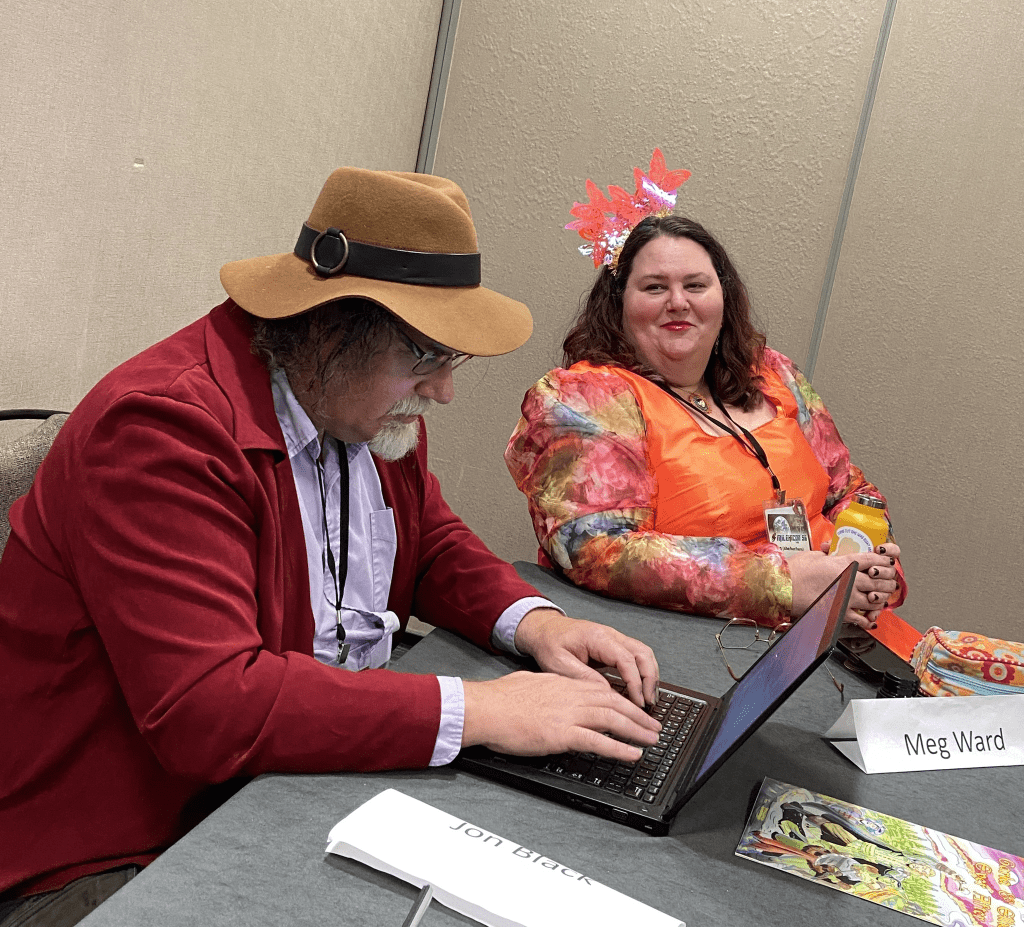
The rules were simple. The audience, improve-style, supplied the contestants with a protagonist, a location, and a complication. The competing authors then had eight minutes to write a story incorporating those elements. Afterward, each author read their story aloud and the audience voted one of the authors “off the island.” Lather, rinse, repeat until only one author remained.
As it turns out, I was that author.
I’ve gotten way more interest on social media about this than I expected, so I thought I’d share my flash fic compositions with anyone who was interested enough in the initial post to check them out. [In the interest of full disclosure, I have done some very basic clean-up on the selections to correct spelling, punctuation, and the occasional omitted article.]
To give this all a pretense of substance, I’ve also added a short section at the end, discussing some of the lessons I’ve taken away from this session which may be useful to those of you who find yourselves in similar competitions.
(CAVEAT: For those of you who may be encountering my writing for the first time through this post, these selections are not representative of my published writing)
ROUND ONE
Protagonist: The Haunted Woman
Location: Evergreen, Colorado
Complication: Stuck in Traffic
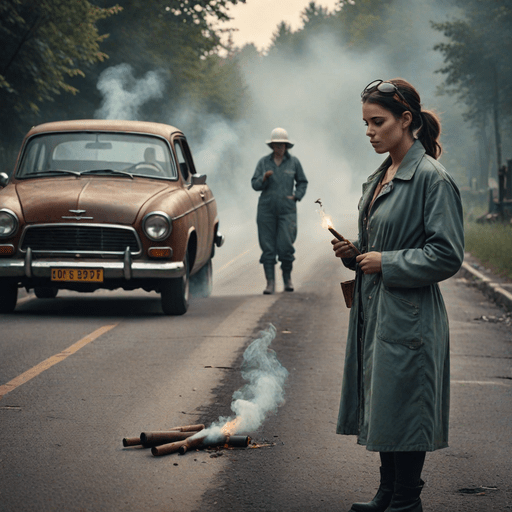
Julia had gotten use to ghosts. She had seen them childhood, since an unfortunate accident involving a vending machine and a tarot deck. But ghostly road construction, outside was something new. Up ahead, just outside of Evergreen, Colorado, she could see the construction workers, or rather see through them, as the road was shut down and a truck loaded with used furniture and a VW microbus idled in front of her.
The other drivers were freaked out, their reactions ranging from catatonia to panic and praying. But Julia was the haunted woman. This being old hat, she flagged down the ghost who seems to be in charge. “What’s going on” she asked?
“Road ghosts,” the ghost in charge explained, as it that explained everything.
“Road ghosts?” Julia repeated.
“What did I call them when I was alive?” the ghost took the ghostly cigar out of his mouth, and looked thoughtful. “Pot holes. He paused. “Think about it, pot holes are basically the ghosts of a road. They have their own stories, their own lives, their own pathways to becoming to ghosts.”
“That’s great,” Julia said, “but I’m really trying to get to some town in Colorado the author has heard of.” And then, because the author hadn’t finished his story, a giant machine came out of the sky moved Julia and the rest of the cars past the construction.
ROUND TWO
Protagonist: A sentient attack drone
Location: A deserted beach
Complication: Too many spiders.

Big Old Bomb, BOB for short, the sentient attack drone, was enjoying its first vacation since the supreme court (not our currently supreme court, obviously,) ruled that AI entities, devices, automata and machines were covered by the same labor laws, including a minimum of two week’s vacation, as everyone else.
A standard query search had indicated humans often liked to vacation on beaches, so BOB thought it would start there. The same search indicated that the combined presence of red tide and medical waste would reduce prices. That seemed to have worked, the prices were low. And the beach was restful. It was, in fact, deserted. BOB had taken long walks by itself. It had read Sartre. It had argued with strangers, including other sentient attack drones, on the internet.
By the fourth day, BOB was bored. It decided to checked out the small beach-side cabaret, the only other place that seemed to be inhabited. A jazz quartet was followed by a flamenco dancer, who was followed by a woman playing the euphonium while reciting limericks in dead languages. The compere then announced the headliner, a rock act. The singer had spiky orange-ish hair, pale skin, and elaborate face makeup. His backup band, the Spiders, were nowhere to be found. “But where are the spiders?” BOB asked and went to go look for them,
He found them all behind the cabaret smoking. The Spiders, too many Spiders, an excess of Spiders, in fact. “Why aren’t you at the gig?” BOB asked.
“Our singer is impossible,” one of the Spiders said, “Always making love with his ego.” So BOB became the Spiders’ new lead singer. And the rest, as they say, is rock ‘n’ roll history.
ROUND THREE
Protagonist: A dog
Location: A lonely lighthouse.
Complication: a burnt bundt cake

It was the kind of love story you remember you entire life, a classic love story, between a dog who happened to be a conductor of the Philadelphia Philharmonic orchestra and a lonely light house. Of course the lighthouse was lonely, it was a lighthouse, it’s hard to meet people when you’re a lighthouse. Except lighthouse keepers, but they’re the bad boys of recluse and hermit set, all moroseness, all tragedy and posturing … no long walks on the beach, no poetry.
So the light house decided to put its presence out there, like a beacon. Its profile, its dating profile, was very visible, especially to ships traversing the coast at night. But it also reached the wall of the living room of the room where the dog lived. The dog barked out its response, but the lighthouse could not hear. The only people who could hear were the dog’s owners. Damn it, Princess. Go to sleep! they said.
The beacon returned, again the dog professed its love. Again, came the cry, Damn it, Princess go to sleep!!
Again, the beacon returned. Again the dog professed its love. Damn it, Princess go outside!!!
And so her owners let Princess outside. The dog ran, in obligatory slow motion, with soft lighting, a wind machine blowing its fur. You know the scene, you’ve seen it a million times. You can even hear the sound track, take a moment, in your mind, to pick out the perfect song.
“Shit!” the author said, his authorial voice full of conflict, “there was supposed to be a burned bundt cake in here somewhere.”
So, what did I learn?
I want to be clear, I don’t think I won “flash fiction chopped” because I was churning out the highest quality prose at the front table. In fact, I think this was distinctly not the case. In that case, why did I win? What was I doing that put me over the top of competitors who were actually putting out better writing? What can you learn from my experience that might help you if you find yourself in a similar situation? I think there are three things to note here.
Read the Room
Sitting down at my laptop, my impression was that we had an audience in the mood for goofy fun rather than stirring prose. This seemed confirmed when, after the first round, the audience voted to eliminate the author who had written (in my opinion) the best, tightest story but one that was played absolutely straight. If you want to win, write what your judges want.
Performance Matters
Something I realized, which I think some of my competitors missed, is that those four words, “read your selections aloud,” changed everything. That made the competition at least as much about showmanship as authorship.
A Weak Ending is Better Than No Ending
The first thing I did, after writing the opening paragraph, was to write a conclusion. I think having an ending, even if not a very good or even germane one, made my stories feel tighter than some others that were actually better written but stopped abruptly when our eight minutes were up.
 Jon Black Writes