Essential to the Mythos: Robert Bloch & Mysteries of the Worm

What are we talking about when we imagine a Mythos with no Cultes de Goules or De Vermis Mysteriis? Where Nyarlathotep is just one more faceless, alien outer god – not a singularly sinister entity that truly sees humanity and, at times, seems almost human itself? We are talking about a Mythos without Robert Bloch.

Despite having considered myself “into the Mythos” for more than 30 years now, Robert Bloch was not an author I had read much of or knew much about (see “A Little More on Robert Bloch” below). Recently, at my local used book store, I picked up a copy of the 2nd edition of Mysteries of the Worm, Chaosium’s collection of Bloch’s cosmic horror and Mythos stories. Those stories sufficiently impressed me to do a deeper research and reflection drive. That, in turn, left me sufficiently impressed to put together review of Mysteries of the Worm combined with a short essay on Bloch and his contributions to the Mythos.

Most of the stories in Mysteries of the Worm qualify as Lovecraft Pastiche. That term, “pastiche” (and especially “Lovecraft Pastiche”) is typically used dismissively. Here, that is not my intent. These are stories that are both excellent and enjoyable, but executed in imitative homage to Lovecraft, rather than what we came to know as Bloch’s genuine authorial voice.

It is true that Bloch lacks the raw, weird power of Lovecraft’s imagination. At the same time, for all the idiosyncratic charm of Lovecraft’s writing, though it may be heresy, I argue Bloch is better than Lovecraft at constructing stories and using words. If this collection is pastiche, it is delightful pastiche. That being said, the most memorable stories in Mysteries of the Worm tend to be ones where, among the homage, we can still occasionally hear Bloch speaking as Bloch.

A Little More on Robert Bloch

“Mysteries of the Worm”-era Robert Bloch hard at work.

Robert Bloch (1917-1994) is familiar to most Mythos readers for two reasons:

First, he wrote the novel Psycho upon which Hitchcock’s movie was based (not, as is sometimes reported, the screenplay itself). This launched a successful Hollywood career and made Bloch one of the few early Mythos authors to enjoy mainstream success during his lifetime. This recognition included (and, yes, I totally cribbed this from Wikipedia) the Hugo, Bram Stoker, and World Fantasy awards. He served as president of Mystery Writers of America and was a member of the Academy of Motion Picture Arts and Sciences.

Secondly, Bloch was the author of the well-known “Shambler from the Stars” a 1935 tale in which, with Lovecraft’s permission, a New England “mystic” clearly intended to be Lovecraft, meets a gruesome end. Lovecraft returned the favor in 1936’s “The Haunter of the Dark,” killing off the story’s protagonist Robert Blake. Dedicated to Bloch, “Haunter” is the only story Lovecraft ever dedicated to a specific individual. Both “Shambler” and the third story in this cycle, Bloch’s 1950 “The Shadow from the Steeple,” are included in Mysteries of the Worm. “Shadow” ties up loose ends from Lovecraft’s “Haunter” while giving readers a chilling glimpse of what Outer God Nyarlathotep is up to in the atomic age.

Through teenage explorations of Weird Tales magazine, Bloch became a great fan of Lovecraft and the two began corresponding in 1933. As he did for many others, Lovecraft became a mentor to Bloch in both the craft of writing and the business of writing.

As an author, cosmic horror in a Lovecraftian vein is something to which Bloch would periodically return throughout his life. But, beginning about the time of Lovecraft’s death in 1937 (a loss which hit the young Bloch very hard) he began moving away from cosmic horror, especially Mythos horror, as a staple of his output. This process was largely complete by the mid-1940s. Among the many kinds of tales Bloch spun in a career spanning more than half a century, he excelled at, and indeed helped establish, the genre of crime horror. While Psycho arguably meets the criteria of crime horror it is “Yours Truly, Jack the Ripper” which is Bloch’s superlative accomplishment in this regard.

To consider Bloch, as a complete person, a “Mythos author” requires squinting and looking from exactly the right angle. Bloch was not a Mythos author or, more precisely, not only a Mythos author. But Mysteries of the Worm shows why an understanding of the Mythos, especially a literary history of the Mythos, is incomplete without a working knowledge of Bloch’s work and contributions.

Essential Contributions

Mysteries of the Worm certainly can be approached and enjoyed simply as a collection of Mythos and cosmic horror. But for scholars, completionists, and serious fans, the collection has additional value. Mysteries of the Worm highlights exactly how extensive Bloch’s contributions to the Mythos are.

Of the multitude of Mythos tomes, there are four I consider tier-one both for their evocative power and for their ubiquitous and enduring presence in Mythos fiction over the decades: The Necronomicon (of course), Cultes de Goules, De Vermis Mysteriis, and Unaussprechlichen Kulten. We can thank Lovecraft for the first of those, and Howard for the last. The other two, however, are Bloch’s creations.

Prop De Vermis Mysteriis used in the film Doctor Glamour, built by Rev. Marx.

De Vermis Mysteriis (“Mysteries of the Worm”) and its diabolic author, Ludvig Prinn, first appear in Bloch’s story “The Secret in the Tomb.” Cultes des Goules makes it first appearance in “The Suicide in the Study,” and comes with a much more interesting backstory. The tome’s author, Comte d’Erlette, is not entirely fictional. Rather he is a Tuckerization and alter-ego of fellow Lovecraft Circle member August Derleth (Derleth/d’Erlette).

Depending on who is telling the tale, the unhinged Comte was either a gentle or not-so-gentle dig at Derleth’s rather aristocratic airs. While, strictly speaking, beyond the scope of this article, I can’t resist running down the rabbit hole of the Comte’s literary history a little further. Lin Carter later doubled-down on Bloch’s Tuckerization by ascribing to the Comte the same controversial “war in the heavens” division among Mythos entities utilized by Derleth himself. Derleth, however, may have had the last laugh by using his alter ego in two stories of his own, “Adventure of the Six Silver Spiders” and “The Black Island.”

Nephren-Ka (Image: Miskatonic University, really)

Traditionally, creation of Nephren-Ka, the cursed Pharaoh of Ancient Egypt, whose name was struck from monuments by the priesthoods of his more benign successors, has been ascribed to Lovecraft’s “The Haunter of the Dark” Lin Carter tells us this is not exactly so. According to Carter, Bloch’s story “Fane of the Black Pharaoh,” though not published until 1938, had been written prior to “Haunter in the Dark” and that Lovecraft had already seen, and been impressed by, Bloch’s manuscript prior to writing “Haunter.”

It is Bloch’s extensive use of the Pharaoh which solidifies the connection between Nephren-Ka and Nyarlathotep. Some have interpreted Nephren-Ka as a worshiper or even high priest of Nyarlathotep. Others have seen the Pharaoh as nothing less than an avatar of the Outer God. (I wonder how a greater awareness of Bloch’s take on Nephren-Ka might have influenced my own borrowing of the Pharaoh for my novella “The Dreamquest Beast,” had I been more cognisant of the connection at the time I was writing).

Nyarlathotep, from the 2001 short film of the same name (based on the Lovecraft story of the same name).

Nyarlathotep is, in several ways, distinct among the Outer Gods of the Mythos. First, he is the only one consistently presented as having a mind and personality in the sense that humans understand those concepts. Second, he is the only Outer God with a genuine and specific interest in humanity, albeit a perverse and malefic one. A case can be made that these unique aspects of Nyarlathotep begin with Bloch’s connection of Nyarlathotep and Nephren-Ka.

About the Collection

It’s ghouls a go-go in Robert Bloch (Image: HotPot AI)

Every author has their pet elements which they return to again and again, whether they are consciously aware of it or not. As Mysteries of the Worm makes plain, Bloch is no exception. He is clearly fascinated by Ancient Egypt. Egypt at the time of the Pharaohs, or its trappings transported to other times and places, feature in six stories in the collection, including some of those aforementioned stories which have been so essential in creating Nyarlathotep as we know him. It also seems, of all Lovecraft’s core creations, the idea of ghouls really grabbed Bloch’s imagination. Three tales in Mysteries of the Worm feature ghouls, or creatures so like ghouls as to make no difference.

Many of the collection’s stories feature the elements or flavor of pulp coexisting alongside cosmic horror. These pulp elements are not as pronounced as with Robert E. Howard or Clark Ashton Smith, but sound a frequent beat in Mysteries of the Worm nonetheless.

One thing which separates Bloch’s Lovecraft pastiche from the genuine article is the greater diversity in backgrounds and personalities of the protagonists present in Bloch’s work. This is to the collection’s benefit, helping stories feel more individual and distinct and less like copy/paste templates.

I have not endeavored to comment on every story included in Mysteries of Worm. Rather, I have singled out for mention those which either help illustrate broader trends and patterns in Bloch’s work or are singularly notable for their own merits (or, in one case, lack thereof).

“The Grinning Ghoul” in June 1936 Weird Tales.

The collection’s beginning is dominated by those tales which are the most strongly Lovecraft pastiche. As discussed earlier, this is not necessarily to their detriment. For the most part, this is good pastiche. The strongest examples, however, serve up their homage with at least a slight twist. “The Faceless God” feels like a Bloch doing a pulpy riff on “Under the Pyramids.” For all its essential Nyarlathotep lore, it is less of a Mythos story than dark pulp with a Mythos macguffin. “The Grinning Ghoul” is very much in the vein of “The Statement of Randolph Carter.” If Carter had the stones to follow Harley Warren into the depths. “The Brood of Bubastis” has the shape and feel of Lovecraft’s “The Rats in the Walls,” but combines an Egyptian twist with outre ideas of prehistoric population migrations which even Robert E. Howard would have envied.
“Creeper” in July 1937 Weird Tales.

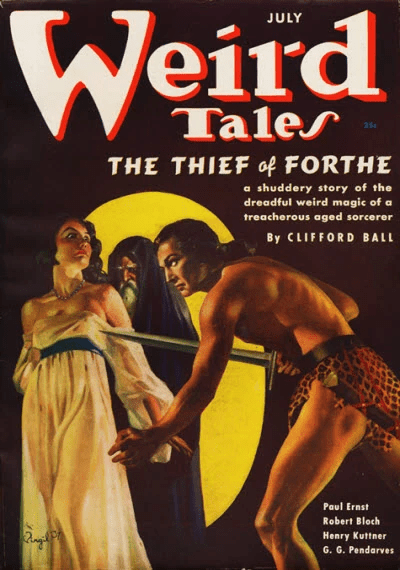
If I had to pick one story in this collection to ‘vote off the island,’ it would be “The Creeper in the Crypt.” There is so much not to love here. A ghoul story that is less effective than Bloch’s similar offerings. A flat and weak point-of-view character who is mostly a passive observer to the story’s events. An ineffective homage to Lovecraft by setting the story in an Arkham that feels nothing like Arkham. Some unfortunate ethnic stereotypes (while common enough in the Lovecraft Circle, something Bloch usually manages to avoid). Yet the story is not without interest as an early example of Bloch’s combining crime fiction with horror, even if not a particularly successful one.


Two stories in Mysteries of the Worm stood out to me for feeling ‘out of time’ with their publication date (coincidentally, in both cases, 1937).
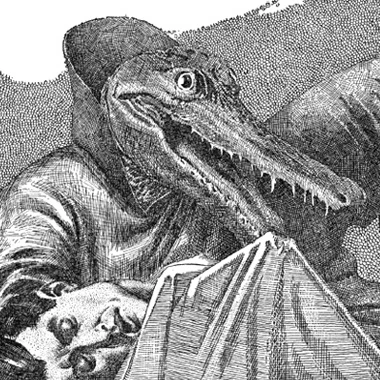
Sebek, by classic pulp illustrator Virgil Finlay.

“The Secret of Sebek” is another of Bloch’s Pharaonic Egypt-adjacent tales. This time, however, the setting in New Orleans during Mardi Gras and a secretive masquerade ball of rich weirdos which, of course, conceals a far darker purpose. “Secret” feels far more modern than its publication date. In fact, it feels tailor-made for adaptation as a 1970s giallo film.

“The Mannikin” is a curious story which, at once, looks both forward and back from its 1937 publication date. The set pieces put into place at the story’s beginning are pure Gothic, far more Poe than Lovecraft. The story’s ultimate resolution, however, is very modern. Strip away those set-dressing elements I mentioned, and it is easy to imagine “The Mannikin” as an X-Files episode. Indeed, at the risk of some oblique spoilers, it has significant commonalities with the well-known second-season X-Files episode, “Humbug.”

Mysteries of the Worm presents two of Bloch’s most celebrated short stories, “The Shadow from the Steeple” and “Notebook Found in a Deserted House.”

“Steelple’s” Shining Trapezohedron by Red-Vanguard on DeviantArt.

“Shadow from the Steeple” completes the trilogy begun by Bloch with “The Shambler of the Stars” and then answered by Lovecraft’s “The Haunter of the Dark.” Bloch’s final installment, however, postdates the first two offerings by a decade and half. Published in 1950, it takes classic cosmic horror, very unsettlingly, into the world of nuclear power and the military-industrial complex. Its presentation of a disturbingly human Nyarlathotep, eagerly using those tools and others to bring maximum woe to humanity, is a further example of how much Bloch has influenced our perception of this Outer God.

“Notebook found in a Deserted House,” channels the paranoia and uncertainty of an isolated protagonist as the agents of the Mythos slowly circle in, epitomized in Lovecraft’s “Whisperer in Darkness,” better than almost any cosmic horror story, save the aforementioned HPL tale. Bloch’s literary device of writing in the style of his protagonist, an uneducated farm boy named Willie Osbourn, has been widely acclaimed. Here I admit to being in the minority, I find it distracting (in much the way I find Lovecraft’s occasional attempts at ‘rustic’ dialogue and accents distracting). That may diminish the tale’s impact for me, but certainly does not dissipate it.

Mysteries of the Worm also contains three standout stories which are not as well known as “Notebook” or “Shadow.”

“The Unspeakable Betrothal” is a shining jewel in this collection. Therefore, it is remarkable that Bloch himself considered the story something of a disappointment. For me, “Unspeakable Betrothal” stands out for two reasons. First, excepting Robert E. Howard, it is one of the few examples of a member of the Lovecraft Circle writing a strong, compelling woman with agency (and the protagonist, to boot). Second, it intriguingly explores the questions “What if the otherworldly entities of the Mythos aren’t truly evil or malevolent, what if they are simply alien in the most profound sense of the word?” and “What what if those alien entities tried tried to form a genuine connection with an, admittedly very unusual, human?”

Sure, AF #9 had “Unspeakable,” one of Bloch’s best stories … but it’s really hard to compete with whatever’s going on with that cover.
But is it Cosmic Horror? A man with cameras.

I’ve seen more than a few stories by multiple authors attempting to explore the intersection of photography with the Mythos. Excepting one unfinished, unpublished story shown to me by its author, I had found all of them unsatisfying. Until Bloch’s “The Sorcerer’s Jewel,” which explores that theme with a heavy dose of pulp added to its cosmic horror. Bloch manages to pack in a rich backstory and some truly memorable secondary characters in a fairly short story. I think it is this ability to both sell the reader on the world and make them care about the characters that allows “The Sorcerer’s Jewel” to succeed where so many other stories built around the same premise have failed.
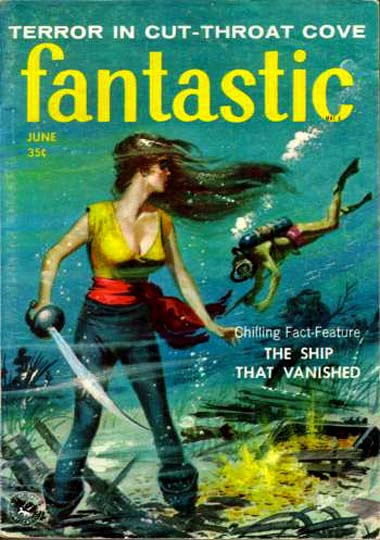
Making the Cover: “Terror in Cut-Throat Cove” in the June 1959 Fantastic.

“Terror in Cut-Throat Cove,” the collection’s true stand-out, is also its final selection as well as one of its longest. It delivers Cosmic horror wrapped in pulp that, if not precisely crime horror, is most certainly noir horror. In every way, “Terror” plays to Bloch’s strengths. Unlike some of the other selections in Mysteries of the Worm, in “Terror” Bloch has selected a protagonist which allows the author’s intelligence and broad knowledge to shine through. Originally published in 1959, at a time when Bloch’s career as a screenwriter was still a couple years in the future, nevertheless all those skills enabling Bloch to find success in Hollywood are admirably displayed in “Terror.” Reading the story, it is impossible not to see the screen adaptation unfolding in your mind. “Terror’s” three principal characters are incredibly well detailed, with their interactions and conversation as much character-driven as story-driven (sadly, a rarity even in the best Mythos fiction) and reeking (in the best possible way) of noir rather than cosmic horror. Yet, “Terror” is undeniably cosmic horror. But unlike the Lovecraft pastiche which dominates the collection’s early selections, with “Terror in Cut-Throat Cove,” Mysteries of the Worm concludes with cosmic horror in Bloch’s own voice.

(As a note to interested readers, Chaosium has since released a third edition of Mysteries of the Worm, expanded to include tales not present in the two previous editions)

Flash (Fiction) in a Pan

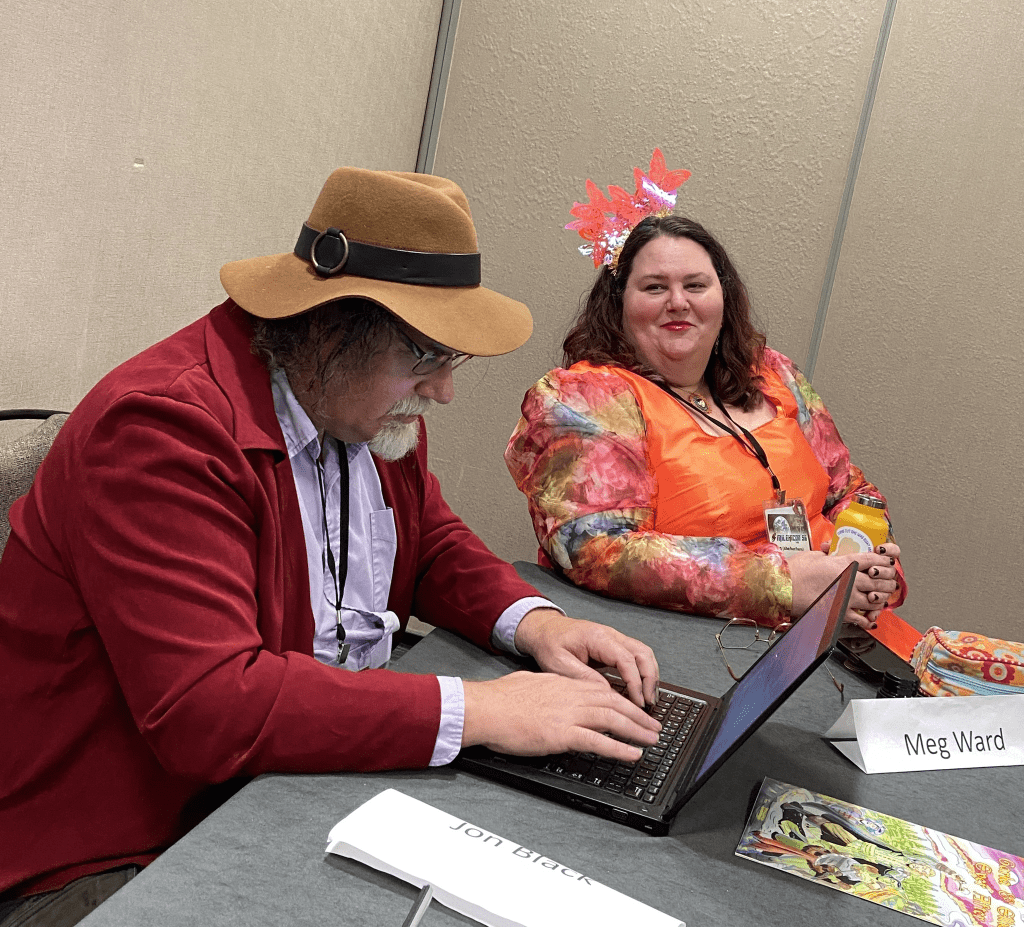
Last month at MileHiCon in Denver, I got drafted into the “flash fiction chopped” competition after a couple of scheduled contestants pulled no-shows.

Action Shot: Me, mid-story, chronicling a romance between a dog and a lighthouse…as you do (Photo: HC Werner)

The rules were simple. The audience, improve-style, supplied the contestants with a protagonist, a location, and a complication. The competing authors then had eight minutes to write a story incorporating those elements. Afterward, each author read their story aloud and the audience voted one of the authors “off the island.” Lather, rinse, repeat until only one author remained.

As it turns out, I was that author.

I’ve gotten way more interest on social media about this than I expected, so I thought I’d share my flash fic compositions with anyone who was interested enough in the initial post to check them out. [In the interest of full disclosure, I have done some very basic clean-up on the selections to correct spelling, punctuation, and the occasional omitted article.]

To give this all a pretense of substance, I’ve also added a short section at the end, discussing some of the lessons I’ve taken away from this session which may be useful to those of you who find yourselves in similar competitions.

(CAVEAT: For those of you who may be encountering my writing for the first time through this post, these selections are not representative of my published writing)

ROUND ONE

Protagonist: The Haunted Woman

Location: Evergreen, Colorado

Complication: Stuck in Traffic

Julia, the haunted woman, presumably (Image: Not HotPot AI’s best work).

Julia had gotten use to ghosts. She had seen them childhood, since an unfortunate accident involving a vending machine and a tarot deck. But ghostly road construction, outside was something new. Up ahead, just outside of Evergreen, Colorado, she could see the construction workers, or rather see through them, as the road was shut down and a truck loaded with used furniture and a VW microbus idled in front of her.

The other drivers were freaked out, their reactions ranging from catatonia to panic and praying. But Julia was the haunted woman. This being old hat, she flagged down the ghost who seems to be in charge. “What’s going on” she asked?

“Road ghosts,” the ghost in charge explained, as it that explained everything.

“Road ghosts?” Julia repeated.

“What did I call them when I was alive?” the ghost took the ghostly cigar out of his mouth, and looked thoughtful. “Pot holes. He paused. “Think about it, pot holes are basically the ghosts of a road. They have their own stories, their own lives, their own pathways to becoming to ghosts.”

“That’s great,” Julia said, “but I’m really trying to get to some town in Colorado the author has heard of.” And then, because the author hadn’t finished his story, a giant machine came out of the sky moved Julia and the rest of the cars past the construction.

ROUND TWO

Protagonist: A sentient attack drone

Location: A deserted beach

Complication: Too many spiders.

BOB (Big Old Bomb) talks with The Spiders. (Image: HotPot AI)

Big Old Bomb, BOB for short, the sentient attack drone, was enjoying its first vacation since the supreme court (not our currently supreme court, obviously,) ruled that AI entities, devices, automata and machines were covered by the same labor laws, including a minimum of two week’s vacation, as everyone else.

A standard query search had indicated humans often liked to vacation on beaches, so BOB thought it would start there. The same search indicated that the combined presence of red tide and medical waste would reduce prices. That seemed to have worked, the prices were low. And the beach was restful. It was, in fact, deserted. BOB had taken long walks by itself. It had read Sartre. It had argued with strangers, including other sentient attack drones, on the internet.

By the fourth day, BOB was bored. It decided to checked out the small beach-side cabaret, the only other place that seemed to be inhabited. A jazz quartet was followed by a flamenco dancer, who was followed by a woman playing the euphonium while reciting limericks in dead languages. The compere then announced the headliner, a rock act. The singer had spiky orange-ish hair, pale skin, and elaborate face makeup. His backup band, the Spiders, were nowhere to be found. “But where are the spiders?” BOB asked and went to go look for them,

He found them all behind the cabaret smoking. The Spiders, too many Spiders, an excess of Spiders, in fact. “Why aren’t you at the gig?” BOB asked.

“Our singer is impossible,” one of the Spiders said, “Always making love with his ego.” So BOB became the Spiders’ new lead singer. And the rest, as they say, is rock ‘n’ roll history.

ROUND THREE

Protagonist: A dog

Location: A lonely lighthouse.

Complication: a burnt bundt cake

A love story for the ages (Image: HotPot AI)

It was the kind of love story you remember you entire life, a classic love story, between a dog who happened to be a conductor of the Philadelphia Philharmonic orchestra and a lonely light house. Of course the lighthouse was lonely, it was a lighthouse, it’s hard to meet people when you’re a lighthouse. Except lighthouse keepers, but they’re the bad boys of recluse and hermit set, all moroseness, all tragedy and posturing … no long walks on the beach, no poetry.

So the light house decided to put its presence out there, like a beacon. Its profile, its dating profile, was very visible, especially to ships traversing the coast at night. But it also reached the wall of the living room of the room where the dog lived. The dog barked out its response, but the lighthouse could not hear. The only people who could hear were the dog’s owners. Damn it, Princess. Go to sleep! they said.

The beacon returned, again the dog professed its love. Again, came the cry, Damn it, Princess go to sleep!!

Again, the beacon returned. Again the dog professed its love. Damn it, Princess go outside!!!

And so her owners let Princess outside. The dog ran, in obligatory slow motion, with soft lighting, a wind machine blowing its fur. You know the scene, you’ve seen it a million times. You can even hear the sound track, take a moment, in your mind, to pick out the perfect song.

“Shit!” the author said, his authorial voice full of conflict, “there was supposed to be a burned bundt cake in here somewhere.”

So, what did I learn?

I want to be clear, I don’t think I won “flash fiction chopped” because I was churning out the highest quality prose at the front table. In fact, I think this was distinctly not the case. In that case, why did I win? What was I doing that put me over the top of competitors who were actually putting out better writing? What can you learn from my experience that might help you if you find yourself in a similar situation? I think there are three things to note here.

Read the Room

Sitting down at my laptop, my impression was that we had an audience in the mood for goofy fun rather than stirring prose. This seemed confirmed when, after the first round, the audience voted to eliminate the author who had written (in my opinion) the best, tightest story but one that was played absolutely straight. If you want to win, write what your judges want.

Performance Matters

Something I realized, which I think some of my competitors missed, is that those four words, “read your selections aloud,” changed everything. That made the competition at least as much about showmanship as authorship.

A Weak Ending is Better Than No Ending

The first thing I did, after writing the opening paragraph, was to write a conclusion. I think having an ending, even if not a very good or even germane one, made my stories feel tighter than some others that were actually better written but stopped abruptly when our eight minutes were up.

The Not-So-Secret Secrets of Willis Conover

Most people know Willis Conover (1920 – 1996), if they know him at all, as one of the great impresarios of jazz: co-founder of the Newport Folk Festival, jazz DJ on the Voice of America for decades (and one of the reasons Eastern Europe’s vibrant jazz scene managed to survive the Cold War), a collector who owned more than 60,000 (no, there’s not an extra zero in there) recordings at the time of his death.

Even when I was writing a lot of music journalism, jazz was never a special passion of mine (oh sure, enough of a passion for me to bring that enthusiasm to Gabriel’s Trumpet, but not the kind of visceral connection I have with blues, country, or punk). So why, you might rightly ask, is Willis Conover showing up on this blog?

Before of all of that, Willis Conover had another life. As a teenager in 1930s Maryland, he got into science fiction (or “scientifiction,” a portmanteau of Gernsback’s still in wide use at the time) and, to a lesser extent, fantasy (then spelled with a “ph” as often as an “f”). Deeply into. With the same methodical thoroughness he would later apply to studying jazz and collecting jazz records, he began studying science fiction and collecting both pulps and fan magazines. At the age of 16, he began publishing a fan magazine of his own, The Science Fantasy Correspondent. In an era when many fan magazines made modern ‘zines look like papers-of-record, Correspondent stood out for the quality of both its production and content.

In fact, Correspondent drew the attention of a certain Weird Fiction author from Providence who contacted Conover, telling him how much he liked the publication. The ensuing correspondence between Conover and Lovecraft would continue throughout the rest of Lovecraft’s life and has been compiled into Lovecraft at Last: The Master of Horror is His Own Words, a complete (or nearly so) collection of their letters. Lovecraft’s friendship and patronage opened doors for Conover to correspondence and friendship with other authors, publishers, and major figures of 1930s fandom.

The public aspects of Conover’s enthusiasm for science fiction and fantasy faded after a couple of years, excluding a secondary period of activity in the 1970s, as his focus turned toward his meritorious service to jazz. He never, however, ceased his correspondence or collecting.

So, why am telling you this?

Unsurprisingly, Conover’s papers ended up at the University of North Texas, one of the country’s better jazz schools (yes, really, look it up), which happens to be located in the town where I live. Among that collection’s 300 boxes, primarily of Conover’s jazz records, interviews, correspondence with musicians, and so forth, are 30 boxes, more or less, connected to his earlier enthusiasm.

Even with briefest examinations of some of those boxes, I am left wondering to quote Pinhead (“We have such sights to show you.”) or Roy Batty (“I’ve seen things you people wouldn’t believe”).

To give a little teaser, inside one obscure Lovecraft volume in the Conover collection, I found the following inscription:

(Photo: Jess Tucker)


To Willis – so you can complete your collection of Lovecraftiana!
All the best –

Arthur Clarke

I had no idea Arthur C. Clarke was even a fan of Lovecraft. Compared with that, For Willis Conover, with the hope that we may have an immersive moment or two. Cordially, August Derleth, seems rather prosaic.

Over the coming months, and even years, I expect many of my posts here to focus on things I’ve encountered (I hate the phrase “discovered” when used in connection with archives. The items were, after all, there all along – often listed plainly on the finding aid) in that collection. Things that have inspired me, surprised me, or broadened my horizons. Hell, I might even do some actual research.

One of the SF fan magazines from Conover’s collection.

I’ve spent the past week scrutinizing two boxes containing 175 discrete issues of 46 different science fiction and fantasy fan magazines from the 1930s — full of fiction from names you know, editorials and non-fiction from names you should know, and amazing art that while not always masterful is powerful and evocative — as well as related materials. I would expect my next few Conover-related posts to focus on those.

And just so nobody goes away disappointed, Willis Conover did have a few secrets. One of the first things I encountered was a letter from a young woman who wrote to Conover while both of them were in the army during Word War Two. Her salutation to him was “Daddy Dear,” and the letter gets more interesting from there. It’s not the only thing like that I’ve found…

(Special thanks to Maristella Feustle, Music Special Collections Librarian, and Jess Tucker, University Archivist, both at the University of North Texas, for facilitating my access to the Willis Conover collection)

Caper Crusaders: The Caper/Heist in Sci-Fi, Fantasy & Beyond

I recently participated in a panel on Cross-Genre Capers: A Discussion of Capers and Heists in Fantasy and Science Fiction at ArmadilloCon. I had the honor of joining Mark Finn, Marina Lostetter and Marshall Ryan Maresca for a discussion, moderated by Lauren Teffeau.

Of course, there is never enough time on a panel to get out everything you want to say (unless you’re willing to risk becoming one of those panelists), so I thought I’d put some of my extra thoughts into a piece here.

Silver Screen Sleuths, featuring “A Scandal in Hollywood”

While capers are not my bread and butter, I do have a toe in the genre. My novelette, “A Scandal in Hollywood” is a counter-caper (see terminology, below) featuring actor Basil Rathbone stepping into the shoes of his most famous role, Sherlock Holmes, to thwart an existential threat to 1940s Tinsel Town. “Scandal” is a tongue-in-cheek love letter to Holmes and Doyle that was voted “Best Short Story of 2018 (all other genres)” in the P&E Readers Choice Poll. You can find it in the anthology Silver Screen Sleuths from 18th Wall Productions.

Speaking more to the panel’s focus, I’ve written a Weird West/light steampunk caper novella, The Clash at Crush (which my publisher assures me will be out any day now). Set against the backdrop of H.G. Wells’ War of the Words, “Clash” indulges my fondness for historical cameos with three historical figures among the caper crew and introduces an atypica wrinkle when Martian tripods inconveniently show up as the caper reaches its climax.

Obligatory Note on Terminology

It’s the Italian Job … but it is an Italian Heist or an Italian Caper?

The terms caper and heist are often used interchangeably. But is there a difference? And if so, what is it? Mark Finn posits the difference between the two is that humor is a key element of capers but mostly absent in heists. That’s a division I find both intriguing and useful, and one I continue to ponder. But the one I have used and, at least to this point, continue to use is that in a heist, the target is always a tangible object and material and the crew’s plans emphasize the physical and technological. A heist is, in essence, always a burglary – no matter how fancy. In a caper, however, the crew’s ultimate goal may or may not be a something physical, and elements of social engineering (Con jobs, impersonation, blackmail, whatever.) play a much larger role.

There is also the counter-caper story, where the antagonists are planning and executing the caper and it falls to the heroes to foil them. While one could technically subdivide this into counter-caper and counter-heist categories, I will use counter-caper to serve for both.

My Favorite SF/F Caper Canon (and Horror, too!)

There is arguably a streak of sci-fi even to many capers set in what is ostensibly the modern, mundane world. These stories often involve very-near-future, clearly-on-the-horizon technology or deploy existing technology in creative ways which sometimes stretches credibility. With so many capers showcasing talents, expertise, or technology that stretches the believable, it’s only a short hop to introducing magic and technology.

Cyberpunk’s persistent shadow economy of highly skilled experts is perfect for capers/heists.

That been said, many classic caper/heist stories explicitly fall under science fiction or fantasy:

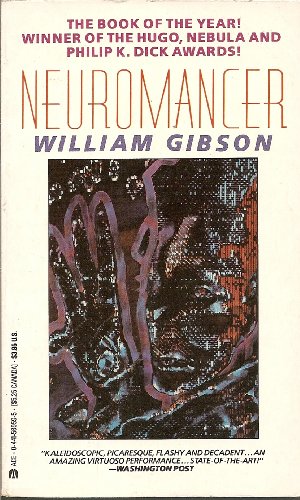
Going all the way back to that foundational classic of the genre, Neuromancer (an assembled crew of criminals and other experts on the margins of society steal the hardcopy of downloaded consciousness), it would be difficult to find a cyberpunk story where a credible case cannot be made for it being a caper/heist.

But Sci-fi capers are not limited to the near future or the morally ambiguous confines of cyberpunk. A New Hope is rife with caper/heist elements: escaping Tatooine, helping Leia escape the Death Star, and the off-screen caper of Bothan spies acquiring plans for the Death Star (which, of course, makes Rogue One a caper story as well – and, while it may not be a great Star Wars story, it’s a good caper story).

Star Trek IV may be one of the most unique caper stories in any genre. Not only does it piggyback time travel on top of science fiction, but its heist object (a pair of humpback whales) is as distinctive as it is unforgettable.  

Star Trek IV: 60 tons of McGuffin

Speaking of Star Trek, the normally straight-laced, goody-goody Next Generation bangs out an incredibly smart, funny caper story with a healthy dose of meta in the season two episode “The Royale:” [Oversimplification Alert] The crew of The Enterprise becomes trapped in a pocket universe created by aliens based on a (fictional) caper novel also called “The Royale.” As their only sample of human culture, the aliens are under the mistaken impression that the third-rate novel reflects humanity’s preferred lifestyle. Ultimately, to escape the pocket universe, the away- team has to successfully pull off the caper referenced in the novel.

Heist Crew, Hyperborean style.

Fantasy takes to caper/heist stories very early in its history. Many of Fritz Leiber’s stories of Fafhard and The Gray Mouser revolve around capers or heists. Especially notable in this regard are “Ill Met in Lankhmar, “Jewels in the Forest,” and “Bazaar of the Bizarre.” Similar tropes can be found in Howard’s Conan stories. These are on full display with the 1982 pastiche film adaptation of Howard’s most famous creation, Conan the Barbarian, as Conan’s party (crew?) sneaks into the Snake Tower to steal a legendary jewel and then penetrates Thulsa Doom’s temple complex.

Caper Crew, Florin style.

Conan isn’t the only overlap of fantasy and caper among 80’s cinema classics. The Princess Bride is an excellent caper story (and one of the best and most endearing examples anywhere of how “assembling the crew” can become an adventure in its own right). The same, of course, can be said of William Goldmann’s original novel, though I would argue the caper flavor is more explicit in the movie than the book.  

Horror also offers us at least one noteworthy entry. Lovecraft’s “The Curious Case of Charles Dexter Ward” is a classic counter-caper narrative with diabolic antagonists Joseph Curwen and crew engaged in multiple capers: their body-snatching and necromancy ring as well as their efforts to keep the Curwen’s resurrection a secret and return him to his former glory.  Conversely, the protagonists, led by Marinus Bicknell Willet are trying to thwart those plots (at which they are ultimately successful) and preserve young Charles Dexter Ward’s life (at which they are not).

The Lord of the Stings

The author of a famous caper story?

More than a few people have argued for The Hobbit as a caper story. I respectfully disagree. True, the whole segment at the Lonely Mountain with Smaug is definitely a caper/heist. However, while that is the company’s ultimate goal, it is only a small part of the story as measured both by page count and emotional journey. It would be like a version of Oceans 11 where the main characters spend the first 90 minutes driving to the casino.

On the other hand, I see a much stronger case for Lord of the Rings as a caper story: the crew spreads out across Middle Earth using stealth, guile, magic (gadgets), and the occasional bit of muscle with the ultimate goal of sneaking the McGuffin of Power through Mordor to Mount Doom.

(Somehow, I suspect the notion that he might have written a caper story would send Tolkien spinning in this grave).

Meanwhile Back in Our World

And, because it doesn’t really seem to fit anywhere else, two my favorite non-SFF caper stories are both from the world of 90s cinema. A third comes from prime time cartoons.

“All he’s asking for is peace on earth and goodwill toward men,” Martin Bishop, Sneakers.

Sneakers (1992) has a cast that has to be seen to be believed: Robert Redford, Sydney Poitier, Ben Kingsley, Dan Aykroyd, River Phoenix, and Stephen Tobolowsky (you might know him as Ned … Rhyerson!).

Hudson Hawk (1991) is admittedly a tough one to classify. It does have hints of magic (or at least alchemy) and miracles alongside a dose of clock-punk, but takes such a light touch with them that I feel it round up to a real-world, if very cinematic, reality. While technically a ‘90s film, Hudson Hawk, in all its glorious cheese, actually has more of an ‘80s aesthetic.

Two decades later, in 23rd season of The Simpsons, the episode “The Book Job” sees a motley collection of Springfield residents collaborate on a get-rich-quick scheme to publish a young adult novel, which turns into a caper when the group is screwed over by their publisher. An appearance by Neil Gaiman, playing himself as the crew’s Ringer, transforms an already strong story into something truly special.  

Why Do We Love Caper Stories (And Why Do I)? The Big Picture

At their most fundamental, caper stories are underdog stories. Crews run the gamut from lovable rogues with hearts of gold to full-blown anti-heroes in all their amoral glory. Exposition sets up social contexts in which there are perceived winners and losers, in groups and out groups, enforcers and renegades, underdogs and overlords. But caper stories play with the ambiguity and fuzzy corners of those worlds. With the right crew, a good plan, and a little bit of luck, the underdogs can come out on top. 

Definitely Underdogs and Outsider (Lock, Stock, and Two Smoking Barrels)

Caper stories further endear themselves to us because, rather than brawn or superior resources, in capers the underdogs almost always triumph by being cleverer than their opponents. Most of us don’t have phenomenal strength or martial prowess among our assets, but we like to think of ourselves as clever. It’s enjoyable to see a little of ourselves in the caper crew and wonder “hey, could we do that?”

A final part of the genre’s appeal is the humor which permeates so many of these stories. This emphasis on humor serves several roles: it diffuses tension, it showcases the close relationship between members of the crew, and it gives further evidence of that all-important “cleverness.” It also underscores the underdog and “loveable rogue” nature of protagonists.

Why Do We Love Caper Stories (And Why Do I)? The Details

One of the reasons we all love Caper/Heist stories is that we know them, their tropes, their characters. But that doesn’t mean that every one of those aspects resonates with each personal equally.

For me, the most exciting part of caper stories is assembling the crew, with its rich spiderweb different and sometimes conflicting experiences, backstories, and assumptions somehow all coming together to pull off “the job.” In terms of my personal enjoyment of caper stories, the completion of crew feels like the climax of the story. Everything else is just denouement.

Another joy for me are the social interactions between the caper crew and the forces of law (order, the establishment, whatever you want to call them). That’s one reason I tend to favor caper stories with heavy social engineering/con aspect to them.

But we’re talking specifically about Capers/Heists in science fiction and fantasy. In those genres, on a meta-level, I enjoy seeing how exposition is handled (and sometimes mishandled).

When a caper/heist is set in the mundane present day, or even a well understood historical period, a lot of exposition can be omitted. Readers/viewers already understand the technology, the traps, the weapons, law enforcement, and the social and economic relationships well enough to fill in the gaps. But when the caper is sci-fi or fantasy, all those axiomatic elements are now up in the air. What does magic allow? What does new technology allow? How do law enforcement and the legal system work? What are the social and economic relationships informing the caper?

This is a challenging tightrope for authors to walk. We have to explain how all the caper tropes apply to the world in question so that the plot points feel earned and twists believable … without throwing up giant “Chekov’s Gun” red flags while doing so.

To illustrate that point by going a little ad absurdum, if an author informs us that “the three-headed hounds of Gnarr are the realm’s most fearsome guard animals but, when both moons are full in twain, the hounds are afraid of flying shrews,” the reader can safely assume that’s going to come up later. The challenge is seeding that information so that, when the crew uses the musk of flying shrews to bypass the evil Duke’s three-headed hound, it was not obvious ahead of time but still feels earned when it occurs.

On Gadgets

Gadgets are not only a major trope of caper/heist stories, they are huge part of their fun. Unless a caper story is very strong in other areas, the lack of any sort of gadgetry, technical wizardry, or Rube Goldberg-esque silliness is going to be keenly felt. However, for science fiction and fantasy capers, the challenges of exposition go double for gadgets.

More broadly, creators need to balance the sense of wonder gadgets create in a reader/viewer without leaning on them to heavily for support. I would hesitate to utilize more than one major gadget or two or three minor ones in the course of a story. The more heavily a story features gadgets, the more important it becomes to balance the narrative scales a bit. Perhaps the forces of the establishment have gadgets of their own to throw at the crew. Or maybe one of the crew’s gadgets fails, possibly in a spectacular fashion.

So … you need a gadget?

Thoughts on Writing Capers

First, to support the genre’s tropes and conventions, a certain level of social complexity and technological development in the world is required – say at least equivalent to earth’s Bronze Age. Don’t get me wrong, I’m not saying there’s no way to write a Neolithic heist or a caper story involving egalitarian hunter-gatherers, but I’d love to read it, because I don’t know how you’d do it. (As I’m typing this, I’m realizing that Quest for Fire is basically a fantasy Neolithic heist story, with fire as the heist object. So maybe treat my preceding statement as a loose guideline).

As with any form of genre fiction, don’t bust your ass trying to come up with something nobody’s ever seen before, because its an almost impossible task. Rather, spend that time thinking about combining the elements you love in fresh and exciting ways. Don’t be afraid of tropes, they’re not necessarily your enemy. After all, those tropes are at the heart of the comforting feel that people seem to like about capers/heists. We know these stories and that’s a big part of why we love them.

With advanced technology and other areas of niche expertise playing such a strong role in caper stories, many authors anguish over the appropriate level of detail, research, and accuracy needed. These are valid questions but, as with so many aspects of writing, don’t let the perfect become the enemy of the good. Write to the level you’re comfortable with. If you’re already published, you know the level your audience will enjoy. If you are not yet published, write to the level of the audience you want.

I cannot stress this enough: Unless you are a world-class expert in cryptography, information security, digital intrusion, etc., no matter how much legwork you do, you are not going to be write to a level that will satisfy every reader. If you try, you’re going to lose a lot of the people you really want, so steel yourself and ignore the handful who will never be satisfied.

Where are Capers Going?

In moderating the panel, Lauren Taffeau made there interesting observation that:

We’re going through a period in history right now where it feels like espionage and other crimes are happening right out in the open instead of all the cloak and dagger from an earlier age.

In light of those developments, Tafffeau posed the question

How have current events changed expectations for writing capers?

This is an interesting and important question, and one where I admit to not having much in the way of concrete answers. We may very well see that kind of open, smarmy malfeasance reflected in the kinds of targets caper crews go up against, using classic caper skills to hit those targets on the back end. On the other hand, it’s possible we may see crews engaging more openly as well. We could see the emergency of the “spin doctor” as a variation on the traditional “face” archetype in crews (for a rather prescient foretaste of what this could look like, check out the antihero crew of the 1997 dark comedy Wag the Dog).