If you’re a fan of scifi, fantasy, horror, mystery, or any other corner of speculative fiction/genre fiction, don’ forget to vote in the annual Critters Readers Poll – a reckoning from fandom of the most interesting, most exciting, or just plain best offering from indie publishers during calendar year 2023.
VOTING ENDS 6:00 a.m. (Eastern USA time) MONDAY, JANUARY 15. WHAT ARE YOU WAITING FOR?
A great honor for me
I’m a little sad that, because of publishing schedules, I didn’t have any eligible titles come out in 2023 (hold on to your proverbial hats, 2024 should more than make up for that). My successes in the Critters’ Poll over the years have been very important for establishing my career as a writer, both critically and commercially. But, even without yours truly, some amazing works have received nominations this year.
As a way to get really easy blog content, I thought I’d talk about some of the nominees I vote for (and why).
For Best Mystery Novel:Radcliffe by Madeleine D’Este, from Deadset Press. If you’re someone I talk about books with or if you follow my blog (where she’s a regular guest poster, including the excellent “official playlists” for her titles), you’re already familiar with Madeleine. She writes Australian-focused fiction, often with a supernatural element, and has true gift for stories exploring the intersection of quirky personalities and bizarre locations. Radcliffe, the story of eccentric residents of a lonely apartment on the outskirts of Melbourne, is her superlative work in that regard. (She’s also an upcoming 18thWall Productions author!)
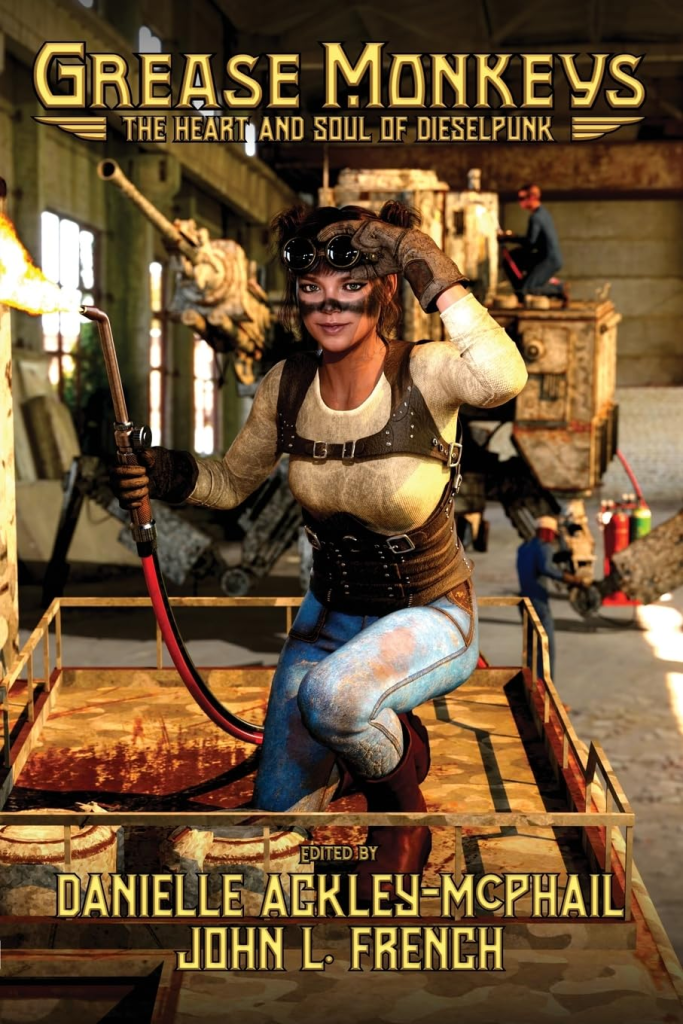
For Best Steampunk Short Story: “The Falcon and The Goose” by David Lee Summers, in the anthology Grease Monkeys: The Heart and Soul of Dieselpunk from eSpec Books. Summers is southwestern author whose work does several things I adore: including weaving historical events into his fiction and using historical figures in cameos or even not-so-cameos. “The Falcon & The Goose” pits one of the turn-of-the-last-century’s greatest rail engineers against two of its most notorious outlaws in a life-or-death rail vs. airship race.
For Best Anthology: the aforementioned Grease Monkeys: The Heart and Soul of Dieselpunk from eSpec Books. Among all the various [x]punk genres, Cyberpunk and steampunk are favorites (and I may have some interesting things to say about clockpunk in a year or two), but Dieselpunk has a special place in my heart. But, like all the other [x]punks, Dieselpunk has style-over-substance problem. By focusing on the folks who make the technology go, “Grease Monkeys” sidesteps that problem and delivers an anthology of solid stories about the nuts, bolts, and grease of a different reality.
Additionally, all other things being equal, anything from Third Flatiron Publishing is usually going to have both the quality and the spin to get my vote.
Anyway, those are my thoughts. Go vote! And I’ll see you on the nomination list next year. 😉
NOTE FROM JB: Yeah, I’m always happy to temporarily turn my blog over to someone and get good content on someone else’s dime (hey, I am a writer after all). But it is always a true pleasure to have a guest post from Madeleine D’ Este. There are few writers active today whose work I enjoy as much. If you asked me to reduce to a single sentence what appeals to me about her writing, if I’m going to eschew “because it’s really cool,” I will have to go with “She has a unique gift for crafting tales which explore the intersection of eccentric characters and eccentric locations.” Never has that talent been as remarkably on display as it is with her latest offering, Radcliffe.
Madeleine knows about my passion for music. And I know, every time she has a new release, I can look forward to having an “official soundtrack” for the piece dropped in my inbox. I knew her soundtrack for Radcliffe would be something really special. I was not disappointed.
RADCLIFFE PLAYLIST
…a weird apartment building full of weird women…
My new novella Radcliffe was released in August 2023 from Deadset Press.
A three-storey ramshackle house in North Melbourne is full of secrets. Tamsin is led to the building by a voice inside her head – a voice that tells her ‘Death is Coming’. With no respite from the eternal summer heat, can Tamsin find out who death is coming for and solve the riddle of Radcliffe?
Radcliffe is a gothic tale about a weird apartment building full of weird women. Meet the characters and their songs; Bunty, Defne, Cecily, Riko and Tamsin.
BUNTY
The longest resident of Radcliffe, Bunty is an octogenarian ex-ballerina always has a tale from her days on the stage.
‘A Night on Bare Mountain’ – Mussorgsky, Berlin Orchestra
A Night on Bare Mountain features in a compilation produced by the V&A ‘Diaghilev and the Golden Age of the Ballets Russes 1909-1929’ accompanied many hours of editing Radcliffe.
DEFNE
Defne is a late-blooming photographer with a penchant for the grotesque. Growing up in the 90s, Alanis would have rocked Defne’s suburban world.
You Oughta Know – Alanis Morrissette
Curiously, this is an example of how characters are not autobiographical, because I’ve never been a fan of this song and yet it’s perfect for Defne.
CECILY
The twenty-something psychology student Cecily is fascinated with the human condition and diagnoses everyone she meets.
Only Human – Rag n Bone Man
This song was also often playing in my dodgy 24-hr gym when I escaped from editing.
RIKO
Riko is a twenty-something industrial musician and DJ.
Corporate Slave – Snog
This song is from the grandfather of Australian industrial music, David Thrussel aka Snog. While I imagine Riko’s music to be more abrasive, something like Snog would have lit her original fire. I saw Snog live in 2022, supporting Pop Will Eat Itself in Melbourne. The show was amazing and bonkers.
GAIL
Gail is a reclusive writer with a dark past.
Red Right Hand – Nick Cave & The Bad Seeds
How could I do Australian gothic without Nick Cave? Needless to say, writer Gail has some anger issues as well as a way with words.
TAMSIN
The main character Tamsin is a tax accountant and auditory psychic.
Love is a Losing Game – Amy Winehouse
Life has been a little unfair to Tamsin and she would have spent many nights singing along with Amy’s pain.
RADCLIFFE
The first song I thought of when Jon asked me to put this post together. A weird apartment building full of weird women? A gothic tale?
Happy House – Siouxsie and the Banshees
Madeleine D’Este
Madeleine D’Este is a writer of dark mysteries. Growing up in Tasmania and studying law (but never practising), she lives in inner city Melbourne surrounded by books. When not writing, D’Este enjoys podcasts, knitting, forteana, indie films, kettle bells and coffee as ‘black as midnight on a moonless night’.
Mark Finn delivers Blood & Thunder to the Dallas Historical Society.
Last week, I had the privilege of attending “Blood & Thunder,” author and scholar Mark Finn’s presentation on Robert E. Howard for the Dallas Historical Society, an in-person treatment of Finn’s identically-titled seminal biography of Howard. Finn makes a compelling case not only for Howard’s inclusion in the top tier of Texas authors but also the essential Texan-ness of much of Howard’s work, including Conan.
A little bit of background, if you are unfamiliar with Howard (though, if you are unfamiliar with Howard, I’m also curious as to how you found my website):
The classic photo of Robert E. Howard
Robert Ervin Howard was born in 1906 in the tiny north Texas town of Peaster but was raised and spent the majority of his life in Cross Plains, a place where central, north, and west Texas come together not just geographically but culturally and historically. By Howard’s late teens, the West Texas oil boom had rolled over Cross Plains like a black wave, significantly impacting not only Howard’s life but also his work.
While best known for Conan and a certain style of action-heavy, hyperbolic tale, Howard’s literary scope was vast including poetry, drama, and many forms of fiction. While Howard himself traveled relatively little in his brief life, he had far-reaching intellectual horizons and maintained correspondence with many authors of his day including H.P. Lovecraft and his associates, eventually becoming a member of that circle.
Howard’s life was seldom an easy one and he died by suicide at the age of thirty.
Cross Plains during the oil boom. (SOURCE: Portal to Texas History)
Finn sets the scene for the Blood and Thunder lecture by narrating a hypothetical, or rather composite, moment in Howard’s youth, surrounded by Cross Plains’ oilfield roughnecks and reverends, housewives and boxers.
Initially, Finn focuses on Conan’s evolution from a creature of pulp magazines to a cultural icon so ubiquitous that “Conan” has become conversational shorthand for a particular personality type and specific kind of tale.
Conan’s first appearance in the Dec 1932 issue of Weird Tales.
Finn’s ultimate point to this chronology of Conan is that the barbarian’s success has generally come at the expense of Howard’s. Both because of Conan has sucked the air out of Howard’s many other creations and because of the stigma attached to genre fiction until relatively recently, Conan has played a large part in keeping Howard from a status that Finn believes should place him in same ranks as Texas authors like such as Larry McMurtry, Cormac McCarthy, and J. Frank Dobie.
That is a Texas-sized assertion, but Finn proceeds to deliver the receipts. These include Howard’s many creations beyond Conan: his Steve Costigan stories, his boxing fiction, his prodigious correspondence with other authors, even an expansive collection of poetry. The cornerstone of Finn’s argument, however, is the framing of Howard as perhaps the ultimate practitioner of the art of the tall tale. A distinctive narrative form with its own hallmarks and conventions, the tall tale holds a special place in the broader context of Western (in the sense of the American West) literature. These conventions: humor, hyperbole, unreliable narrators, and physical comedy, flow so naturally from Howard that a reader is often not conscious of their use. Finn points to Breckinridge Elkins, an absurdist exaggeration and caricature of the rustic mountain man archetype, as the pinnacle of Howard’s creations in this regard.
The Tallest of Tall Tales: Breckinridge Elkins whoops some ass in the August 1934 issue of Action Stories (illustration by Rudolph Belarski)
I’ve always had a soft spot for Howard. In fact, a throwaway line in my Bel Nemeton series may imply that Howard is co-protagonist’s Jake Booker’s grandfather (Howard had no children that we know of but that’s okay, Bel Nemeton was already something of an alt-history after I apparently decided the druids of Anglesey should hang on a few centuries longer than they did our world).
Howard was obsessed with Texas, its history, its landscape, and its rough-and-tumble oil patch society in which he lived. The final part of Finn’s presentation is devoted to showing the linkages between that love and the essential Texan-ness of so much of Howard’s work. Yes, even Conan.
I love an underdog and, with popular memory leaving him playing second fiddle to Lovecraft in weird tales and to Tolkien in fantasy, Howard is definitely an underdog. Finn helps make the case that this relegation is unfair. His soft spot for Howard runs even deeper than mine does. So, if you want to know more, pick up Blood & Thunder.
(For fans and friends voting in the Critters Readers Poll, you can scroll down to instructions at the bottom of the post)
Discover the story behind the strange obsession of Camelot’s strangest knight.
Two volumes of “Camelot vs. Cthulhu?” You know you want it.
As an author, the two things I hang my proverbial hat on are Arthurian mythology (via my Bel Nemeton series) and Mythos-infused historical fiction. So, when 18th Wall Productions put out a call for “Camelot vs. Cthulhu” stories for an upcoming anthology, I knew I had to be involved.
As it turns out, 18th Wall got so many quality submissions that the resulting anthology, Shadows Over Avalon, encompasses two volumes, both edited by the ever superb Nicole Petit. Volume I focus on tales of traditional Lovecraftian cosmic horror, and it’s filled with names who do not disappoint, such as Simon Bucher-Jones, Edward Erdelac, and Josh Reynolds. Volume IIchannels Lovecraft’s other side, stories of shifting perceptions and realities, fantastical journeys, and dreams. There, you will find my novella “The Dreamquest Beast” along with stories by worthy authors such as Georgia Cook, Kara Dennison, Lukasz Furmaniak, Sophie Iles, and C.L. Werner.
“The Dreamquest Beast” is a non-canonical story set in my Bel Nemeton universe (leading my beloved wife to observe “So, you’re writing your own fanfic now?”).
Taking place a generation before the start of Bel Nemeton, when Arthur is an infant and Merlin still known as “The Wanderer,” northern Britain bakes under an unending drought unlike any in memory. As brave warriors and shield maidens take up the quest to discover what afflicts the land and set matters to right, the would-be champions invariably fail and fall. After the quest claims his much loved older brother, Prince Pelinyr (or “Pellinore” in more contemporary renderings) of Damnonia becomes the unlucky 13th to take up the challenge.
“So, you’re writing your own fanfic now?”
My wife (who, and I say this not only because it’s true but also because she may be reading this, is my biggest fan)
On the surface an unlikely hero, Pelinyr has all his life been plagued by nightmares and strange occurrences surrounding his dreams. In this desperate endeavor, he is joined by his friends: the gregarious Prince Cynfarch of Gorre, the clever Prince Tuadel of Alclud, and Jana, Pelinyr’s childhood playmate, now a shunned sorcerer and seer haunting a cursed Roman amphitheater. Together, the four will cross the wild frontier into the kingdoms of the dreaded Saxons before descending through a black tower without name or builder into the land of dreams themselves.
Once in the Dreamlands, the challenges and dangers only grow. The company will meet gods, battle monsters, take caravans into deadly jungles and endless deserts, pour over tablets written in unearthly tongues, and solve riddles that are a matter of life of death for the companions and for millions back in the waking world.
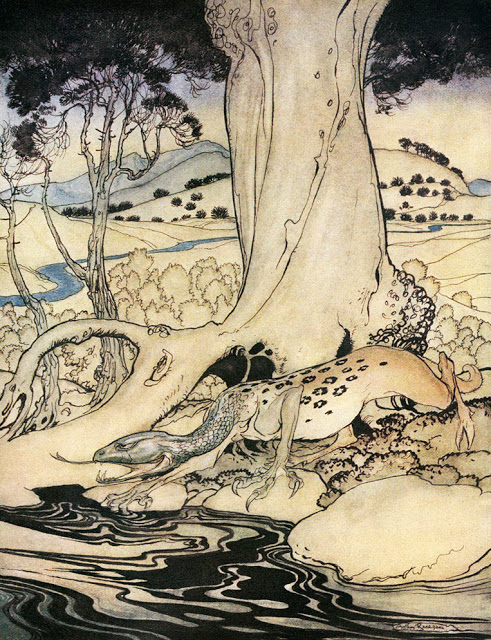
The Questing Beast drinks from a river (perhaps the good, strong Adamandara) – illustration by Arthur Rackham (1917)
Pelinyr has always been one of my favorite members of the Round Table as well as, to me, one of the most fascinating. Along with Galahad and Percival, he is one of the knights that is “touched” in a way Arthuriana usually reserves for its Druids/Magicians/Whatever you want to call them. For Galahad and Percival, that mania is clearly religious in nature. With Pelinyr, however, its source is never clearly defined. Certainly, it seems to be connected with the “Questing Beast,” the strange creature which he is sworn to follow but which only he can see – but whether the beast is a cause or effect of Pelinyr’s madness is unknown.
This characterization of Pelinyr is surprisingly consistent throughout Arthuriana: from Malory’s Le Morte d’Arthur, where it is implied he is afflicted by his relation to the Fisher King, to the eccentric and slightly senile figure of T.E. White’s Once and Future King.
This aspect of Pelinyr has been incorporated into my Bel Nemeton series. Pelinyr is a minor yet significant figure in the second book, Caledfwlch. The book opens with a friendly duel between Arthur and Pelinyr, as Merlin looks on and frets about Pelinyr’s instability manifesting during the combat. And Caledflwch ends with, in a fit of inspiration, Pelinyr being the one who finds the true name of Arthur’s new blade and becoming the first significant British noble to pledge fealty to Arthur.
So, the idea of “Dreamquest Beast” (a kind of titular portmanteau of Arthuriana’s “Questing Beast” and Lovecraft’s “Dream Quest of Unknown Kadath”) as a thought-experiment exploring how Bel Nemeton’s Pelinyr “got that way” and the origins of the Questing Beast was extremely appealing. Like many previous authors, scholars, and artists, I connect the Questing Beast with the mythical creature known as the camelopardus or camelopardalis. Additionally, I thought it would fun to take two of the foils from Caledfwlch (both based on historical 6th century British rulers), make them Pelinyr’s boon companions in “Dreamquest,” and explore the roots of their own transitions from friend to foil.
I am Cameleopardus From the Serpent, Master of Cunning, comes my Head. From the Leopard, Lord of Fleetness, is taken my Body From the Lion, King of Bravery, are drawn my Haunches From the Hart, Emperor of Virtue, are given my Feet. And from Sacrifice, I take Breath and Mind and Life
The Riddle of the Questing Beast, from “Dreamquest Beast”
As a writer, I’ve dropped elements of Lovecraft and the Mythos into my stories dozens of times. Doing it with “Dreamquest,” perhaps because I was cutting from the whole cloth of the Dreamlands rather than picking and choosing an element or two for what was essentially my own world, was different. I felt a tremendous sense of pressure, even obligation, to be “good enough” and “get it right.” For all that, it was enormously exciting, one of the most exciting things I’ve done as an author, both to be able to use my favorite elements of the Dreamlands and to add more than a few things of my own.
I also peppered “Dreamquest Beast” with Easter eggs, weaving in nods and shout-outs to stories, myths, and legends from Herodotus to Jim Henson, which also play with the dreamlike, the surreal, or the radically fantastic. Likewise, I endeavored to keep things fresh by occasionally using established Mythos creatures without naming them or renaming them in accordance with cultures involved in the stories (such as using the Saxon “barrow wights” for Lovecraft’s ghouls).
Play along at home! Use this card to track the Easter eggs, shout outs, and obscure references I’ve tucked into “Dreamquest Beast.”
As part of giving “Dreamquest Beast” a distinctive and appropriate atmosphere, I also played with the language of the story. For those of you familiar with my other work, no part of “Dreamquest” is quite in my usual authorial voice. In the first and third acts, taking place in the waking world of 6th century Britain, I have leaned hard into the conventions of epic poetry. For the second act, occuring in the Dreamlands, I have attempted to channel the distinctive language Lovecraft used in the Dream Cycle.
I am very gratified that “Dreamquest,” despite only being released in December, has already been nominated for “Best Science Fiction or Fantasy Short Story of 2022” in the Critters Readers Poll. For fans and friends interesting in supporting me, I’ve included directions for voting below:
TL;DL:Writers in the Field, a unique, outdoor hands-on event for writers, is October 8 & 9 in the Dallas area. Click links for schedule (see also stations) and tickets. I’ll see you there.
“A grown-up field trip” for authors
Writers know that the best kind of research is hands-on experience. Something that you have actually done is much easier to viscerally and authentically convey to a reader than something you have only read or watched videos about. Almost as good as doing it yourself is being able to talk face-to-face with an expert. Unfortunately, not everything lends itself to easily acquiring hands-on experience and it is a rare author who has an expert for everything on speed dial.
Enter Writers in the Field (WitF) … a unique two-day event providing us with the hands-on experiences and access to helpful experts that allows us to bring these activities and lifestyles vividly and credibly to life in our work. “It’s a one-of-a-kind outdoor, grown-up field trip filled with experts, new information, and tons of inspiration,” explained Kathryn McClatchy, vice-president of WORD (Writers Organizations ‘Round Dallas), who handles promotions and media for WitF.
Firing black powder weapons at Writers in the Field 2019 (photo: Jon Black}
After two years off because of COVID, the WitF team is overflowing with energy and enthusiasm for 2022. “It feels like we’re a bit out of practice,” McClatchy admits. “But we’re so happy to reconnect with our community of writers and experts. It is also very exciting to have new members of the team bringing fresh life and new skill sets to the event.”
Programming for 2022 reflects of mix of popular favorites and exciting new opportunities. Some of this year’s highlights, old and new, include:
Becky Burkheart on Horseback Writing (all things equestrian for authors) as well as session on soap making
Genevieve Dodd of Tea Punk Teas on Historical Moments in Tea
Detective RJ Hanson on Criminal Investigation: Details and Dummies
Tex Tompson on forensic lock-smithing, lock picking and breaking and entering
“I always think of Writers in the Field as a buffet of skilled professionals,” said presenter and author RJ Hanson. Digging deeply into his law enforcement/investigation career for the Criminal Investigation class, Hanson says the tagline for his presentation should be “Crime and murder, you’re doing it wrong.” He looks forward to sharing aspects of a few real-word cases with attendees and taking questions to help authors with particular issues they’re having . But Hanson isn’t going to let them go without showing they’ve learned something. “I will hand out a statement from an actual kidnapping case, quiz them on it, and show them the technique I used to prove its veracity.”
Writers in the Field also includes sessions on the craft and business of writing. Among this year’s options are “Publishing Wide” by Adam D. Jones, “Scene and Structure” by Keith Goodnight, “Villain Character Development” by Amanda Arista, “Writing in Vivid Color” by Lisa Bell, and “You Got Science in My Fiction” by Rhonda Eudaly.
Tex Thompson shows the noobs a thing or two about locks, Writers in the Field 2019 (photo: Jon Black)
While there are a few indoor classrooms on site, most of Writers in the Field (as the name suggests) occurs outdoors. In 2022, the event is returning to its traditional location at the Steampunk November grounds in Mansfield, Texas (on the southern edge of Dallas-Ft. Worth metropolitan area). Camping is available ($25 for the entire weekend, payable at registration) and the weather is supposed to be beautiful (I’m a writer, not a weather god) partly cloudy with highs in low 80s and lows in upper 50s.
If camping is a bit too much “field” in your “Writers in the Field” don’t worry, there are a variety of hotel and AirBnB options nearby.
AT A GLANCE: WRITERS IN THE FIELD
WHAT: Two days of hands-on activities and demonstrations on topics handled (and often mishandled) in fiction.
Of course, there is never enough time on a panel to get out everything you want to say (unless you’re willing to risk becoming one of those panelists), so I thought I’d put some of my extra thoughts into a piece here.
While capers are not my bread and butter, I do have a toe in the genre. My novelette, “A Scandal in Hollywood” is a counter-caper (see terminology, below) featuring actor Basil Rathbone stepping into the shoes of his most famous role, Sherlock Holmes, to thwart an existential threat to 1940s Tinsel Town. “Scandal” is a tongue-in-cheek love letter to Holmes and Doyle that was voted “Best Short Story of 2018 (all other genres)” in the P&E Readers Choice Poll. You can find it in the anthology Silver Screen Sleuths from 18th Wall Productions.
Speaking more to the panel’s focus, I’ve written a Weird West/light steampunk caper novella, The Clash at Crush (which my publisher assures me will be out any day now). Set against the backdrop of H.G. Wells’ War of the Words, “Clash” indulges my fondness for historical cameos with three historical figures among the caper crew and introduces an atypica wrinkle when Martian tripods inconveniently show up as the caper reaches its climax.
Obligatory Note on Terminology
It’s the Italian Job … but it is an Italian Heist or an Italian Caper?
The terms caper and heist are often used interchangeably. But is there a difference? And if so, what is it? Mark Finn posits the difference between the two is that humor is a key element of capers but mostly absent in heists. That’s a division I find both intriguing and useful, and one I continue to ponder. But the one I have used and, at least to this point, continue to use is that in a heist, the target is always a tangible object and material and the crew’s plans emphasize the physical and technological. A heist is, in essence, always a burglary – no matter how fancy. In a caper, however, the crew’s ultimate goal may or may not be a something physical, and elements of social engineering (Con jobs, impersonation, blackmail, whatever.) play a much larger role.
There is also the counter-caper story, where the antagonists are planning and executing the caper and it falls to the heroes to foil them. While one could technically subdivide this into counter-caper and counter-heist categories, I will use counter-caper to serve for both.
My Favorite SF/F Caper Canon (and Horror, too!)
There is arguably a streak of sci-fi even to many capers set in what is ostensibly the modern, mundane world. These stories often involve very-near-future, clearly-on-the-horizon technology or deploy existing technology in creative ways which sometimes stretches credibility. With so many capers showcasing talents, expertise, or technology that stretches the believable, it’s only a short hop to introducing magic and technology.
Cyberpunk’s persistent shadow economy of highly skilled experts is perfect for capers/heists.
That been said, many classic caper/heist stories explicitly fall under science fiction or fantasy:
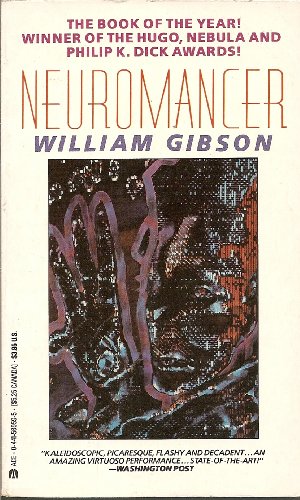
Going all the way back to that foundational classic of the genre, Neuromancer (an assembled crew of criminals and other experts on the margins of society steal the hardcopy of downloaded consciousness), it would be difficult to find a cyberpunk story where a credible case cannot be made for it being a caper/heist.
But Sci-fi capers are not limited to the near future or the morally ambiguous confines of cyberpunk. A New Hope is rife with caper/heist elements: escaping Tatooine, helping Leia escape the Death Star, and the off-screen caper of Bothan spies acquiring plans for the Death Star (which, of course, makes Rogue One a caper story as well – and, while it may not be a great Star Wars story, it’s a good caper story).
Star Trek IV may be one of the most unique caper stories in any genre. Not only does it piggyback time travel on top of science fiction, but its heist object (a pair of humpback whales) is as distinctive as it is unforgettable.
Speaking of Star Trek, the normally straight-laced, goody-goody Next Generation bangs out an incredibly smart, funny caper story with a healthy dose of meta in the season two episode “The Royale:” [Oversimplification Alert] The crew of The Enterprise becomes trapped in a pocket universe created by aliens based on a (fictional) caper novel also called “The Royale.” As their only sample of human culture, the aliens are under the mistaken impression that the third-rate novel reflects humanity’s preferred lifestyle. Ultimately, to escape the pocket universe, the away- team has to successfully pull off the caper referenced in the novel.
Heist Crew, Hyperborean style.
Fantasy takes to caper/heist stories very early in its history. Many of Fritz Leiber’s stories of Fafhard and The Gray Mouser revolve around capers or heists. Especially notable in this regard are “Ill Met in Lankhmar, “Jewels in the Forest,” and “Bazaar of the Bizarre.” Similar tropes can be found in Howard’s Conan stories. These are on full display with the 1982 pastiche film adaptation of Howard’s most famous creation, Conan the Barbarian, as Conan’s party (crew?) sneaks into the Snake Tower to steal a legendary jewel and then penetrates Thulsa Doom’s temple complex.
Caper Crew, Florin style.
Conan isn’t the only overlap of fantasy and caper among 80’s cinema classics. The Princess Bride is an excellent caper story (and one of the best and most endearing examples anywhere of how “assembling the crew” can become an adventure in its own right). The same, of course, can be said of William Goldmann’s original novel, though I would argue the caper flavor is more explicit in the movie than the book.
Horror also offers us at least one noteworthy entry. Lovecraft’s “The Curious Case of Charles Dexter Ward” is a classic counter-caper narrative with diabolic antagonists Joseph Curwen and crew engaged in multiple capers: their body-snatching and necromancy ring as well as their efforts to keep the Curwen’s resurrection a secret and return him to his former glory. Conversely, the protagonists, led by Marinus Bicknell Willet are trying to thwart those plots (at which they are ultimately successful) and preserve young Charles Dexter Ward’s life (at which they are not).
The Lord of the Stings
The author of a famous caper story?
More than a few people have argued for The Hobbit as a caper story. I respectfully disagree. True, the whole segment at the Lonely Mountain with Smaug is definitely a caper/heist. However, while that is the company’s ultimate goal, it is only a small part of the story as measured both by page count and emotional journey. It would be like a version of Oceans 11 where the main characters spend the first 90 minutes driving to the casino.
On the other hand, I see a much stronger case for Lord of the Rings as a caper story: the crew spreads out across Middle Earth using stealth, guile, magic (gadgets), and the occasional bit of muscle with the ultimate goal of sneaking the McGuffin of Power through Mordor to Mount Doom.
(Somehow, I suspect the notion that he might have written a caper story would send Tolkien spinning in this grave).
Meanwhile Back in Our World
And, because it doesn’t really seem to fit anywhere else, two my favorite non-SFF caper stories are both from the world of 90s cinema. A third comes from prime time cartoons.
“All he’s asking for is peace on earth and goodwill toward men,” Martin Bishop, Sneakers.
Sneakers (1992) has a cast that has to be seen to be believed: Robert Redford, Sydney Poitier, Ben Kingsley, Dan Aykroyd, River Phoenix, and Stephen Tobolowsky (you might know him as Ned … Rhyerson!).
Hudson Hawk (1991) is admittedly a tough one to classify. It does have hints of magic (or at least alchemy) and miracles alongside a dose of clock-punk, but takes such a light touch with them that I feel it round up to a real-world, if very cinematic, reality. While technically a ‘90s film, Hudson Hawk, in all its glorious cheese, actually has more of an ‘80s aesthetic.
Two decades later, in 23rd season of The Simpsons, the episode “The Book Job” sees a motley collection of Springfield residents collaborate on a get-rich-quick scheme to publish a young adult novel, which turns into a caper when the group is screwed over by their publisher. An appearance by Neil Gaiman, playing himself as the crew’s Ringer, transforms an already strong story into something truly special.
Why Do We Love Caper Stories (And Why Do I)? The Big Picture
At their most fundamental, caper stories are underdog stories. Crews run the gamut from lovable rogues with hearts of gold to full-blown anti-heroes in all their amoral glory. Exposition sets up social contexts in which there are perceived winners and losers, in groups and out groups, enforcers and renegades, underdogs and overlords. But caper stories play with the ambiguity and fuzzy corners of those worlds. With the right crew, a good plan, and a little bit of luck, the underdogs can come out on top.
Definitely Underdogs and Outsider (Lock, Stock, and Two Smoking Barrels)
Caper stories further endear themselves to us because, rather than brawn or superior resources, in capers the underdogs almost always triumph by being cleverer than their opponents. Most of us don’t have phenomenal strength or martial prowess among our assets, but we like to think of ourselves as clever. It’s enjoyable to see a little of ourselves in the caper crew and wonder “hey, could we do that?”
A final part of the genre’s appeal is the humor which permeates so many of these stories. This emphasis on humor serves several roles: it diffuses tension, it showcases the close relationship between members of the crew, and it gives further evidence of that all-important “cleverness.” It also underscores the underdog and “loveable rogue” nature of protagonists.
Why Do We Love Caper Stories (And Why Do I)? The Details
One of the reasons we all love Caper/Heist stories is that we know them, their tropes, their characters. But that doesn’t mean that every one of those aspects resonates with each personal equally.
For me, the most exciting part of caper stories is assembling the crew, with its rich spiderweb different and sometimes conflicting experiences, backstories, and assumptions somehow all coming together to pull off “the job.” In terms of my personal enjoyment of caper stories, the completion of crew feels like the climax of the story. Everything else is just denouement.
Another joy for me are the social interactions between the caper crew and the forces of law (order, the establishment, whatever you want to call them). That’s one reason I tend to favor caper stories with heavy social engineering/con aspect to them.
But we’re talking specifically about Capers/Heists in science fiction and fantasy. In those genres, on a meta-level, I enjoy seeing how exposition is handled (and sometimes mishandled).
When a caper/heist is set in the mundane present day, or even a well understood historical period, a lot of exposition can be omitted. Readers/viewers already understand the technology, the traps, the weapons, law enforcement, and the social and economic relationships well enough to fill in the gaps. But when the caper is sci-fi or fantasy, all those axiomatic elements are now up in the air. What does magic allow? What does new technology allow? How do law enforcement and the legal system work? What are the social and economic relationships informing the caper?
This is a challenging tightrope for authors to walk. We have to explain how all the caper tropes apply to the world in question so that the plot points feel earned and twists believable … without throwing up giant “Chekov’s Gun” red flags while doing so.
To illustrate that point by going a little ad absurdum, if an author informs us that “the three-headed hounds of Gnarr are the realm’s most fearsome guard animals but, when both moons are full in twain, the hounds are afraid of flying shrews,” the reader can safely assume that’s going to come up later. The challenge is seeding that information so that, when the crew uses the musk of flying shrews to bypass the evil Duke’s three-headed hound, it was not obvious ahead of time but still feels earned when it occurs.
On Gadgets
Gadgets are not only a major trope of caper/heist stories, they are huge part of their fun. Unless a caper story is very strong in other areas, the lack of any sort of gadgetry, technical wizardry, or Rube Goldberg-esque silliness is going to be keenly felt. However, for science fiction and fantasy capers, the challenges of exposition go double for gadgets.
More broadly, creators need to balance the sense of wonder gadgets create in a reader/viewer without leaning on them to heavily for support. I would hesitate to utilize more than one major gadget or two or three minor ones in the course of a story. The more heavily a story features gadgets, the more important it becomes to balance the narrative scales a bit. Perhaps the forces of the establishment have gadgets of their own to throw at the crew. Or maybe one of the crew’s gadgets fails, possibly in a spectacular fashion.
So … you need a gadget?
Thoughts on Writing Capers
First, to support the genre’s tropes and conventions, a certain level of social complexity and technological development in the world is required – say at least equivalent to earth’s Bronze Age. Don’t get me wrong, I’m not saying there’s no way to write a Neolithic heist or a caper story involving egalitarian hunter-gatherers, but I’d love to read it, because I don’t know how you’d do it. (As I’m typing this, I’m realizing that Quest for Fire is basically a fantasy Neolithic heist story, with fire as the heist object. So maybe treat my preceding statement as a loose guideline).
As with any form of genre fiction, don’t bust your ass trying to come up with something nobody’s ever seen before, because its an almost impossible task. Rather, spend that time thinking about combining the elements you love in fresh and exciting ways. Don’t be afraid of tropes, they’re not necessarily your enemy. After all, those tropes are at the heart of the comforting feel that people seem to like about capers/heists. We know these stories and that’s a big part of why we love them.
With advanced technology and other areas of niche expertise playing such a strong role in caper stories, many authors anguish over the appropriate level of detail, research, and accuracy needed. These are valid questions but, as with so many aspects of writing, don’t let the perfect become the enemy of the good. Write to the level you’re comfortable with. If you’re already published, you know the level your audience will enjoy. If you are not yet published, write to the level of the audience you want.
I cannot stress this enough: Unless you are a world-class expert in cryptography, information security, digital intrusion, etc., no matter how much legwork you do, you are not going to be write to a level that will satisfy every reader. If you try, you’re going to lose a lot of the people you really want, so steel yourself and ignore the handful who will never be satisfied.
Where are Capers Going?
In moderating the panel, Lauren Taffeau made there interesting observation that:
We’re going through a period in history right now where it feels like espionage and other crimes are happening right out in the open instead of all the cloak and dagger from an earlier age.
In light of those developments, Tafffeau posed the question
How have current events changed expectations for writing capers?
This is an interesting and important question, and one where I admit to not having much in the way of concrete answers. We may very well see that kind of open, smarmy malfeasance reflected in the kinds of targets caper crews go up against, using classic caper skills to hit those targets on the back end. On the other hand, it’s possible we may see crews engaging more openly as well. We could see the emergency of the “spin doctor” as a variation on the traditional “face” archetype in crews (for a rather prescient foretaste of what this could look like, check out the antihero crew of the 1997 dark comedy Wag the Dog).
“‘With the Exquisite Corpse we had at our disposal – at last – an infallible means of sending the mind’s critical mechanism away on vacation and fully releasing its metaphorical potentialities“
— Andre Breton
NOTE FROM JB: The Parisian avant-garde, notably Dada and Surrealism, are long standing enthusiasms of mine. Occasionally this fascination finds its way into my historical fiction and on those rare occasions when I indulge in making art other than prose, it leans heavily on those two movements. When I discovered author/creator A.A. Rubin’s Cadavre Exquis project, reviving the classic surrealist concept of Cadavre Exquis (French for “Exquisite Corpse”) , I wanted in. It was a delight to be able to participate in an actual Cadavre Exquis exercise, and it is even more of a delight to have A.A. here to talk about the project.
(TL;DR: Check out the results of A.A. Rubin’s contemporary revival of the Cadavre Exquis, a classical Surrealists’ collaborative artistic exercise, here)
Q: Can you explain the concept of Cadavre Exquis and how did you come to fall in love with it?
A.A. Rubin
A: The Cadavre Exquis is a surrealist exercise wherein an artist would fold a piece of paper, like a letter, and draw only in the top section. They would then send the project to another artist who would continue the piece by drawing on the next section, with no knowledge of what the previous artist drew save for the ends of their lines which are visible at the fold. The process would continue until the paper (sometimes multiple papers stuck together) was filled and the piece was complete.
I had learned about the practice a while ago, but was reminded of it during a recent trip to the Metropolitan Museum of Art’s Surrealism Beyond Borders exhibition. The show had an extensive collection of surrealist cadavres, and a large portion of the initial gallery was devoted to the practice. Reading the excellent gallery cards made me think about how the practice might be adapted to writing, which is my main creative medium.
Visual Exquisite Corpse (Joan Miro, Max Morise, Man Ray, Yves Tanguy, 1926/27). Museum of Modern Art.
Q: Tell us a little bit about your Cadavre Exquis project and what motivated you to undertake the exercise?
A: When I saw the Surrealism exhibit, I immediately began to think about how it might be adapted to writing. In a way, it reminded me of the old John Gardner collaborative writing exercise where one person begins a story and then passes the story to the next person in the group, and so on, the obvious difference being that in the surrealist cadavre, the second (and subsequent) artists had little-to-no knowledge of what the previous artist has done. The other, less obvious difference is that in the Surrealist exercise, the composition is done in private, where the creator is alone with their subconscious.
I wrote a blog post on my website detailing my encounter with the surrealist at the Met, and put out a call for other writers to undertake it with me as well.
The basic idea was to adapt the Surrealist Cadavre for writers. I came up with the idea to have each writer compose a paragraph continuing from the last line of the previous writer. Writers would only have knowledge of that last line, and would send only their last line to the next writer.
When the surrealists did their cadavres, they mailed their physical drawings to each other. For this project, I decided to use modern technology like email and google docs. Each writer emailed their final line to the next, and pasted their paragraph into a group google doc where the full story was compiled. The writers were instructed not to peek at the google doc with the previous paragraphs until after they had completed their own. This required the writers to be honest to experience the true effect of the exercise, but it is really no different than the original cadavre project, where the surrealists relied on the honor of fellow participants not to unfold the paper and peek at the previous drawing.
Why “Exquisite Corpse?”
The first time the surrealists engaged in an exercise intended, by its collaborative nature, to remove the rational mind from the creative process and liberate the subconscious, it resulted in the sentence “Le cadavre exquis boira le vin nouveau.” (The Exquisite Corpse Shall Drink the New Wine). In time, the Surrealists came to refer to all such verbal or visual exercise as “Exquisite Corpses.”
Q: How were the participants in the project selected?
A: As mentioned above, I put out a call on my website and promoted it on through my social media platforms (Twitter, Instagram, and Facebook). I asked writers for a statement of interest and bio. There ended up being enough interest for three groups. I had originally conceived the project as a prose writing project, but I got some interest from poets as well. We ended up with two prose groups and one poetry group.
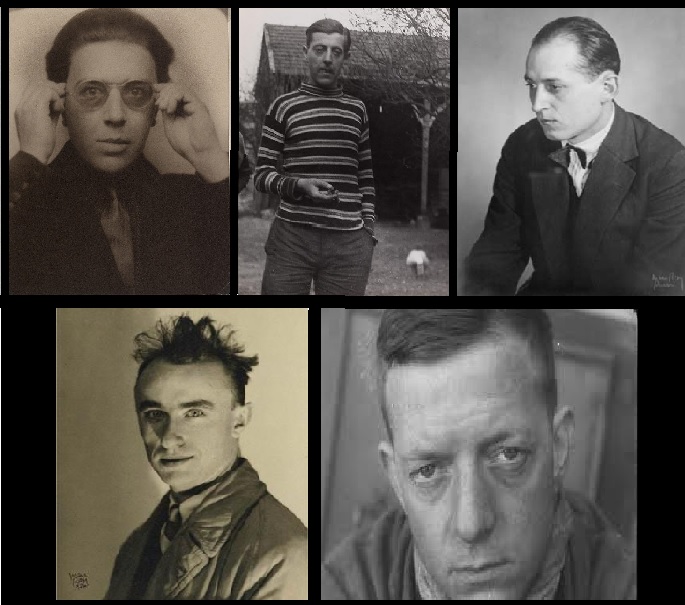
Participants in the first “official” Exquisite Corpse exercise in 1925: (clockwise from left) Andre Breton, Jacques Prévert, Benjamin Péret, Marcel Duhamel, Yves Tanguy.
I divided the writers into teams randomly, and then selected each team’s “batting order” randomly as well. I also decided to participate in each group myself. I was hoping to experience the exercise from each position, and while I got to be in the middle and at the end, I never got to lead off (and I didn’t adjust the random order in my favor).
Q: What are your thoughts on the completed exercises? Were there any things which surprised you? Any things that precisely met your expectations?
A: I think the exercise went well. People seemed to enjoy participating, and everyone completed their work in a timely manner. I was a bit worried about it becoming unwieldy, but it was surprisingly cohesive, at least in process. I think the pieces came out well, too. The various paragraphs are divergent in style, as one would expect, but there’s still a coherence to them, and they read well.
I am pleasantly surprised by the talented writers who chose to join me for this project. When I put out the call, I did not know who would respond, but, considering this was basically a shot-in-the-dark, it’s amazing to me how many really strong writers chose to join me in this endeavor. I am grateful to them all.
Q: Tell us a little bit about yourself, when you’re not invoking the serious games of the surrealists, and about your past and future writing projects?
A: I write everything from serious literary fiction to comics, formal poetry to science fiction and fantasy and almost everything in between. My first published work was a short story back in 2002, and I’ve been publishing pretty consistently ever since. I’ve had recent pieces in Ahoy Comics, Love Letters to Poe, and Flying Ketchup Press, among others, and I am currently working on two novels as well.
I am a teacher by profession, but I am currently on a childcare leave. I am also an experienced martial artist with a blackbelt-level rank in multiple styles.
You can find out more about me by visiting my flowpage.
Q: Do you have any plans for future surrealist activities?
A: You know, when I first chose my social media moniker, @TheSurrealAri, it was a bit of a joke. At the time, twitter was relatively new, and there were many fake celebrity accounts. “Real” celebrities would often choose handles that began with @TheReal before their name to differentiate themselves from the fake accounts that were taken (and held unless the celeb paid an exorbitant price). I came into that environment and said, I’m not going to be “The Real Ari,” I’m going to be “The Surreal Ari.”
Over time, however, I’ve come to embrace the surreal moniker. The surrealist project, which involves accessing the subconscious mind through art, meshing the real and dream worlds, and a heavy use of symbolism actually meshes with much of what I do pretty well. Some of my recent writing has had a decidedly surrealist bent.
Q: Has your experience with the Cadavre Exquis project catalyzed broader realizations or observations?
A: Only that there is a great value to working on art for art’s sake. Not everything has to be commercial and/or marketable. This was a weird project, one no one got paid for, and one that was definitely unconventional and weird, and yet each of the the writers who participated got something out of it, had fun doing it, and connected with like-minded artists whom they may not have known before. There is a value in the strange and the uncomfortable (a very surrealist thought) and it is fun to try something new. Too often today, art is treated as a business, but there is a value to making art that goes beyond the commercial. Make art; get messy; be weird. You’ll grow in ways you couldn’t possibly have imagined.
Q: How can my readers find the completed Cadavre Exquis pieces from the project?
I’m honored that my story “Pioneer House” has been voted Best Sci-Fi/Fantasy Short Story of 2021 in the annual Critters Readers’ Choice Poll. My heartfelt thanks to all the fans and friends who made this possible.
Set in the ‘80s and early ‘90s, “Pioneer House” brings big Stranger Things energy to a classic weird-fiction tale inspired by Lovecraft’s “Strange High House in the Mist.” It is my third published story to be set in Junzt County, a fictional Texas Hill County country that is my answer to Lovecraft’s Arkham.
Told through the eyes of Essie Parr, an archetypical ‘80s small-town Texas girl who dreams of escaping the narrow confines of her small town and the life that seems foreordained for her there, “Pioneer House” is story of her closest friend, Gavin Sadler. One of those sublime creatures who is in the world but not of it, possessing an uncannily broad vision even as child, Gavin finds an unlikely kindred spirit in Pioneer House, a local landmark wrapped in mystery. The structure becomes Gavin’s true passion and obsession.
Gavin was an extraordinary person in an ordinary world. I think he felt connected to Pioneer House, with all its mystery, wonder, and terror. It was a window to something beyond the banality surrounding him. His nature wouldn’t let him choose otherwise. I doubt he even wanted to.
Essie Parr, Pioneer House
And what about Pioneer House, the ‘strange, high house’? In the 1830s, when the non-native settlers first arrived in what would become Junzt County, Pioneer House was already there. The Georgian-style mansion, two and half stories tall, with its steeply-sloped roof, wrap-around porch, and diamond-paned windows, sits empty atop Brockenburg, a lonely granite dome towering over the surrounding hills.
The Brockenberg Lights
As Gavin and Essie dig deeper into the riddle of Pioneer House, they discover a legacy of ghost lights, anomalous fog, strange electrical effects, and unexplained disappearances. Along the way, they confront high school bullies, gatekeeping librarians, janitors with mysterious pasts, and an enigmatic man donning the attire of centuries past – building toward a climatic encounter with the ultimate threshold guardian, Pioneer House itself.
Behind the Story
Junzt County originated as the setting for a Call of Cthulhu campaign I ran in 2014. I wanted a fictional setting in a region I know well (in this case, the Texas Hill Country) that I could populate with people, places, and folklore that felt authentic in the same way Arkham feels authentic. While, over time, I found Junzt’s County’s own distinctive flavor and heartbeat, my earliest strokes of world-building following strongly in Lovecraft’s footsteps. Inspired by the eponymous dwelling in Strange High House in the Mist, Pioneer House became one of the first data points to appear in my mental map of Junzt County. But, other than a name and image, Pioneer House took years to flesh itself out in my mind – the details, the history, the enigmas.
Enchanted Rock, the inspiration for Brockenberg.
Brockenburg, the granite dome that is home to Pioneer House, is based on Enchanted Rock, a real-world geological formation in Gillespie and Llano Counties, Texas. Of course, having the chance to remake it in accordance with genre conventions, I made it bigger, lonelier, weirder.
When I began writing fiction in 2016, I realized Junzt County made a very natural setting for a certain kind of story. To date, I have about ten Junzt County stories published, penned, or in progress. While the original Call of Cthulhu campaign that birthed the region was set in the ‘80s, the Junzt County stories’ settings range from post-Civil War to the present day.
The ‘80s also felt right for “Pioneer House,” contemporary enough that most of its elements of childhood and adolescence would feel familiar to readers, yet enough removed from the present to allow it a certain dreamlike or fairytale quality. On a more pragmatic level, technology available in the 80s and early 90s allowed some interesting narrative possibilities…but not so many possibilities as to make the protagonists’ task too easy.
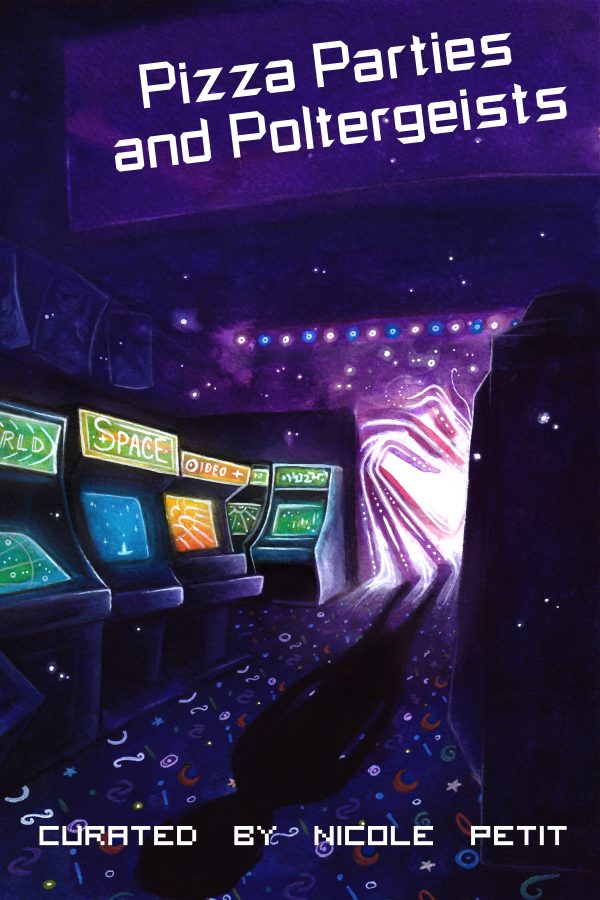
Currently, Pioneer House is available in “Pizza Parties & Poltergeists,” an anthology of ‘80s-themed supernatural and horror stories from 18th Wall Productions. Later in 2022, it will be rereleased as part of a collection of Juznt County stories, also from 18th Wall (I’m very grateful for their ongoing support for my Junzt County endeavors). In addition to “Pioneer House,” the collection will contain two previously published stories: “Totmann’s Curve” (now expanded to novel-length) and “So Lonesome I Could Die.” It will also feature three new stories: “The Eyeteeth,” “Family Style,” and “Everybody Needs a Friend.”
(TL, DR: Check out the Kickstarter for That Which Cannot Be Undone, an exciting anthology of Ohio-themed horror upcoming from Cracked Skull Press)
Note from JB: Although I’ve lived most of my life in Texas, my earliest years were spent in Ohio – born in Columbus and toddling around Mansfield. I remember feeling overwhelmed and unnerved by the imposing Romanesque edifice of the Ohio State Reformatory (not that, as a four year-old, I was using phrases like “imposing Romanesque edifice”), still in operation at that time.
Then there are odd bits from my family’s history, more than a few of them touched by the mysterious or the horrific. My maternal great-great grandmother, the automatic writer – a devout Methodist fearful her hand was possessed by the devil himself. My paternal great-grandfather, hanged by his brothers and sisters from the barn door (supposedly because he’d gone to bat and then refused to play the field in one too many games of cornfeild baseball — but I’ve always suspected there is more to the tale), his father returning from town and cutting him down in the nick of time.
Several years ago, I had the pleasure of being involved with Soteira Press’ Horror USA project. Since then, I’ve had an appreciation and affection for state-themed horror anthologies. Combined with the personal history outlined above, I was delighted to discover Cracked Skull Press’ That Which Cannot Be Undone project. They were kind enough to make the time to talk with me about the upcoming anthology.
Q: Cracked Skull Press is a new publishing house. Tell me a little bit about the press, its team, and how it all came together.
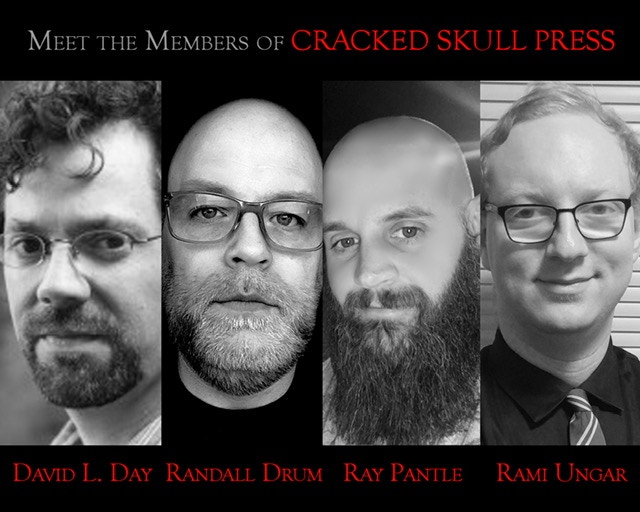
A: Cracked Skull Press is comprised of Ohio-based horror authors David Day, Randall Drum, Ray Pantle, and Rami Ungar. The press was formed because each team member shares a desire to promote horror literature and raise awareness of lesser-known talent within the horror community. The team came together through shared connections in the (horror) writing community.
Q: Your first publication, scheduled for release in October of this year, is an anthology of Ohio-themed horror stories entitled That Which Cannot Be Undone. Tell me how the idea for that anthology came about and what the title means in this context.
A: We wanted our first anthology project to feature horror authors who were born in, or currently live in, Ohio, and it made sense that Ohio should be the setting for each story. We had several concepts in mind, but what really resonated with us was the theme of “that which cannot be undone.” We feel this provides our contributing authors a lot of space to exploit a theme that does not put in place any limitations. In this instance, the theme also makes for a compelling title for the collection.
Q: What are some of your favorite bits of Ohio folklore and urban legend (ghost stories, cryptids,creepypastas, eerie locations, whatever) which inspire you and that you might be hoping will make an appearance within the anthology?
A: Ohio has no shortage of dark legends and equally creepy locations. Legends such as the melon head children–disabled children who were experimented on and now live in the woods outside of the Cleveland area–have provided inspiration for many tales destined to frighten and mystify readers.
Moonville Tunnel
David: I have a special love for The Moonville Tunnel and The Ridges, both in Southeast Ohio. I spent several years living in Athens while in school at Ohio University, and have visited both locations on several occasions. I’ve never had any kind of supernatural experience, but the mood and tone of both places are very evocative.
Rami: I’ve been to several haunted locations in the state, and I experience stuff all the time. My own story takes place at the Ohio State Reformatory, which I can attest to is haunted to the brim. And the Bellaire House in southeast Ohio has a really nasty feel to it. Anyone who goes there is likely to come away a little changed. And there are so many more worthy of writing stories about! Hopefully we’ll see some of them in the anthology.
Ohio State Reformatory (Mansfeild Reformatory)
Q: You already have some excellent authors lined up for the anthology, tell me a little bit about them and, if you’re willing, maybe a few hints about what we’ll see from them in That Which Cannot Be Undone.
A: Ohio has a grand literary tradition and we’re fortunate to have so many wonderful horror authors who made themselves available for our first collection. While we can’t provide a full bio for each author here, we do have several Bram Stoker Award-winners, such as Tim Waggoner, Lucy Snyder, Gary Braunbeck, and Gwendolyn Kiste. We do not yet have the submissions from our contributors, so we can’t provide any insights to their stories.
Q: This year, Michigan beat the Buckeyes 42-27. Can your authors come up with anything more terrifying than that?
A: Challenge accepted!
“Ohio has no shortage of dark legends and equally creepy locations.”
Q: The Kickstarter for That Which Cannot Be Undone has some really unique incentives, especially at the higher levels. Tell us a little bit about that.
A: We are really grateful for all of our contributors who have helped us create some very special rewards and incentives for pledging. Many of them have promised signed copies of their work, such as Tim Waggoner’s novelization of the recent movie “Halloween Kills.” But our favorite might be the Baphomet Bash reward, where you and a plus one can come to our release party in October and hang out with the authors who made this anthology possible. Talk about a horror fan’s dream!
Q: Has Cracked Skull started looking beyond That Which Cannot Be Undone? If so, what’s on the horizon for you?
A: Our focus right now is doing everything we can to put together the highest quality collection of stories we can, with equally high quality put into the production of the anthology. Beyond this first collection, we anticipate our future in publishing to include collections, novels, and more in print and online.
Q: It takes so many things to bring an anthology like this together, what’s been the key to success for That Which Cannot Be Undone?
A: We are grateful for the support we have received from our friends, families, and most of all, our backers on Kickstarter. We hope they are as excited as we are about “That Which Cannot Be Undone” and the future of Cracked Skull Press.
Q: How can my readers engage with Cracked Skull Press online?
A: At this time, Cracked Skull Press can be found on Facebook,Twitter (@CSkullPress) and Instagram (@crackedskullpress). Our online presence will expand later this year.
Check out the Kickstarter for That Which Cannot Be Undone, and look for more great things in the future from Cracked Skull Press.
It was true pleasure to moderate a panel of delightful guests such as Julie Barret, Tim Morgan, and Sue Sinor for the FenCon “Alternative History” session.
It’s funny, I spent a week preparing for this panel and telling people I’d never published AH – before realizing I had. But, because of the filters of perception, it took me until the night before the session.
In 2019, I have the honor of contributing to Defending Earth: The Adventures of Sarah Jane Smith, a charity anthology of Dr. Who stories revolving around the eponymous companion, raising money for cancer research in memory of the late, great Elisabeth Sladen. My contribution, Swinging Londons, involves the space-time around London becoming dangerously unstable, shifting into alternate versions of itself every couple hours. Sarah Jane and the Doctor have to navigate their way through a panoply of Londons, some delightful, some demented, some dangerous, as they attempt to identify and halt the disturbance.
So, as it turns out, I’m going into moderating this panel significantly more qualified than I thought.
The Greatest Hits of All Time(s)
So, let’s talk about a couple of AH titles that have really influenced me both as a writer and a reader.
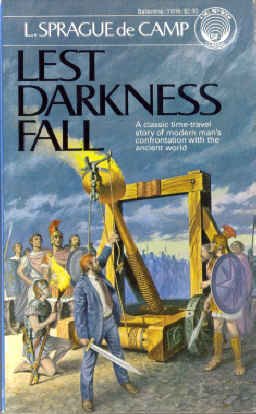
Lest Darkness Fall: “Rome Never Falls,” is one of the most hackneyed, cliché divergence points in AH. And yet this 1939 classic from L. Sprague de Camp doesn’t suffer for it in the least. There are several reasons for that. First, its focus is on why and how the Empire is preserved. Second, it takes as its starting point the late Roman Empire, when Gothic influence is already strong and a variety of Christian sects battle via polemic (and occasionally via pommel) in the streets, which is a very different beast from the “Salad Days of the Caesars” Rome that dominates AH. Third, while technically retro, its tone of innocence and clear-eyed optimism feels fresh and novel and against a genre that is often gritty and pessimistic. Finally, of course, with a 1939 publication date, the cliché that Rome Never Falls later become doesn’t really apply to Lest Darkness Fall (except, perhaps, for being such a brilliant book that it spawned countless imitators). (Bel NEMETON)
The Difference Engine: Often considered the first great Steampunk novel, or at least the first to successfully marry critical acclaim with commercial success. Some purists reject the idea of Steampunk and subset of AH because it often utilizes (or at least implies) variant physical laws rather than a possible (in not plausible) divergence point. The Difference Engine offers neat refutation of that argument for at least some steampunk. Its divergence point is a simple matter of a plausible invention that did not work in our world being designed just a little bit better: specifically, what it Charles Babbage’s “analytical engine” had worked, thus creating an effective mechanical computer in the 19th century. The Difference Engine’s world is understated, looking much like the Victorian Era we knew rather than the self-aware, over-the-top aesthetic that has come to characterize much of steampunk. For all that, I find the question of “what if the Victorians had the same ability to collate, process, and analyze data that we do?” much more provocative and far reaching than “What if airships were everywhere?” (And, no, I’m not hating on airships – they’re awesome).
Harry Turtledove: Okay, normally when I hear an author described as “The Master of” anything, I role my eyes and take it with a grain of salt. But the “Master of Alternate History” earns his stripes. Most of his oeuvre could justly claim a place on a list of The Best of Alternative History. His Worldwar series and Timeline-191 series are remarkable achievements in AH, rivaled only by Eric Flint’s 1632 series. Turtledove’s Crosstime Traffic AH series, while well-crafted YA, pulls no punches either intellectually or emotionally.
To cite a lesser known but fully worthy stand-alone title. Ruled Britannia is tale of intrigue, occupation, and … theatre, in an England where Spanish Armada was victorious and Britain is now a Spanish possession. The tale unfolds largely through the eyes of each power’s greatest dramatist, William Shakespeare and Lope de Vega. As characters, they are wonderful and their interactions with each other are delightful to behold.
Anatomy of an Alternative History
Every AH has two components.
The Divergence Point, is the moment at which the world’s history begins differing from our own.
The Affect (not the Effect) is the world which results from changes accumulating and compounding since the divergence point which the author wishes to portray in their story.
Stories about the Divergence Point itself, merging Divergence Point and Affect into a Singularity, are certainly possible: Lest Darkness Fall and Turtledove’s How Few Remain are examples that immediately come to mind.
The two main approaches to developing Alternate History stories are derived from the relationship of these components.
Approach #1: the author starts be selecting a Divergence Point and then extrapolates out the Affect.
Approach #2: the author already knows the Affect they want a retro-engineers a divergence point that plausibly brings it to pass. All my AH work, published or allegedly in progress, has used this approach.
Running Out of Steam?
From my perspective, steampunk has become to AH what zombies have become to horror. While there is still really good, ground-breaking work being done in the genre, it has become something of a “default setting,” leading to a field crowded with unimaginative offers retreading the same well-worn tropes. Some of the most exciting work I see being done in the genre mines the potential of settings and times away from the clichés of Victorian Britain, the American West, etc. For example, the Antics of Evangeline, by Madeleine D’Este, uses the very Steampunk-friend but underutilized setting of Melbourne, Australia at the height of the Australian gold rush as the setting for a series of fresh-feeling YA steampunk novellas.
“Missed it by that much.” Babbage’s analytical engine.
I like steampunk, but I still don’t entirely understand why it became such a phenomenon. I am curious whether any of the AH “baby punks” (atomic punk, clock punk, deco punk, diesel punk, steel punk, stonepunk, etc.) can or will become a literary and cultural phenomenon akin to steampunk. Personally, I hold out hope for clockpunk and diesel punk because I like the aesthetic (Brenden Carlson’s Night Callis an excellent recent example of diesel punk, with noir-ish nods to Blade Runner, American Gangster, and the Untouchables). Also, in the interest of full disclosure, I’ve been toying with ideas for a clockpunk series. Want a teaser? It…get ready for it…involves Da Vinci (wasn’t I complaining about over-worn tropes just a paragraph ago?)
And continuing on that theme, what of the three tired old monarch of divergence points: Confederates Win, Nazis Win, and Rome Never Falls? Given that, in addition to being cliché, two of them are potentially problematic if handled improperly, is there still a future for them in AH. For at least two of them, I think the answer is yes.
Amazon Prime’s adaptation of Phillip K. Dick’s Man in the High Castle shows there is still a public appetite for examining the grim consequences of Axis Victory. I am, however, more interested in the possible future for the other two.
We are seeing a reckoning and frank reexamination of the history of race and racism in America. The stories we tell ourselves about the Civil War is perhaps the fulcrum of the debate. Some intriguing work has already been done in the area. After his stand-alone novel Guns of the South (arguably as much a character study as an alternative history), Harry Turtledove’s Timeline-191 takes a brutally frank look at the consequences of a Confederate victory, extrapolating it to an absolutely dystopian conclusion in the modern day. But I feel the current reexamining and awakening opens even more possibilities for AH on this theme. There will no doubt be some AH “Lost Cause” apologies offered in the mix, but I hope the vast majority of new works will reflect the more honest accounting we are seeing emerge.
With America’s place in the world changing, and seemingly changing very fast, Rome Never Falls store have a new relevance. As a generation of US global hegemony seems to be fading into a world where America is just one superpower among several, I wonder if we are going to see a flurry of new “Eternal Empire” AH. And I wonder how many of these will be the vessel for some a kind of thinly-veiled FTFY narrative about American’s changing stature; and how many will be genuine if allegorical examinations of the choices available to us, and their consequences.
The Paradox of Alternate History
While ostensibly about the past, AH is really about the present in future. When authors chose divergence points and design effects, we are really commenting about what we believe is significant in the present, and broadcasting our hopes and fears about the future. Moving toward the close of 2021 and the birth of 2022, what trends do I see for AH in the near future?
First, yes, lots of pandemic and disease stories. Look for a plague (ha-ha) of Black Death stories, but also some potentially cannier AH outliers about the 1917 flu, the plague of Justinian, malaria, cholera, maybe even one where the 1970s Swine Flu outbreak proved as bad as few experts predicted. Oh, and if anyone wants to write a story was St. Vitus’s Dance was actual contagious disease…I will read the hell out of that.
And, of course, look for widespread use of themes of alienation, political and social division, unrest, and tyranny.
A lot of great AH…on either side of this wall.
I would love to see a move away from political, military, and technological divergence points toward a greater embrace of social and cultural divergence points. Some of this can already be seen at work, Apple TV’s For All Mankind, while using the space race as the inciting event, is really an AH about gender roles, inclusivity, and diversity. But my poor little music journalist heart is always asking “Okay, but what does this alternate history sound like? Does it have a good beat? Can you dance to it?”
But my biggest wish for AH would be a broader and deeper range of voices contributing to the genre. Even when the divergence point or effect are not explicitly Western (as with Kim Stanley Robinson’s Years of Rice and Salt or Harry Turtledove’s Through Darkest Europe, AH authors remain overwhelmingly of European descent and predominantly male. It would hard to refute allegations that the genre skews Eurocentric. All genres benefit from increasing the range of voices among their authors, but I believe such diversity would be especially valuable (and is especially needed) for AH.


















/pic3244583.jpg)



 Jon Black Writes