OVERDUE: The Unofficial Playlist

Long before I wrote fiction, I was a music journalist and music historian. Those origins bleed through to my present in my fondness for creating playlists to accompany my published works as well as inviting my guest bloggers to do the same for their creations. Over the years, I’ve discovered such playlists have a remarkable ability to viscerally convey the style of a story and encapsulate an author’s influences and approach in a way that words do not match.

A playlist for Overdue: Mystery, Adventure, and the World’s Lost Books, presented a challenge in this regard, but also an opportunity. While Overdue contains my latest work, the novella-length “Provenance,” it is an anthology. Alongside my story are nine other, very different stories by nine other excellent, very different authors.

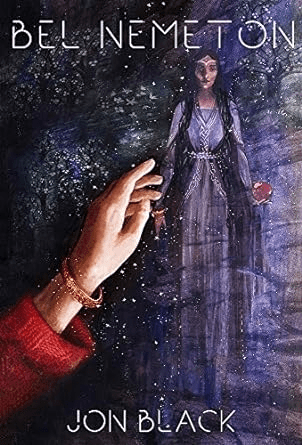
In short, Overdue is an anthology of stories about quests to recover history’s lost and forgotten books – a concept that seems to have resonated with authors and readers (both of whom tend to be bibliophiles). The anthology is set in a shared-universe joining together my Bel Nemeton series with the world of M.H. Norris’s All the Petty Myths.

The stories in Overdue run from Mythos horror to romance and from supernatural techno-thriller to YA coming of age. For this post, I reached out to my co-authors, inviting them to contribute a track or two or three about their story for this unofficial playlist and say a few words about each selection: was it something reflective of the plot, the characters, the tone, the setting, or even just something they listened to while writing the piece?

Authors, of course, are busy creatures. Not all of them had the time to respond to my request (though, to my great delight, most did). In those cases, I have taken the liberty of including tracks I think fit the story, and why. Where appropriate, I have noted when the selections and commentary are mine and not the author’s.

“On with the playlist…

One of the great advantages of doing a playlist in a format like this is the ability to link to videos which are visually interesting as well as presenting the music. Where multiple links for a track were available, as long as the audio quality was acceptable, I went with the most visually compelling. This allowed me to include some real gems: in addition to music videos (official or fan tributes), we have televised performances from KEPX studios in Seattle and the seminal 1970s music program Burt Sugarman’s Midnight Special. We also have some amazing live performances from Prague, Gdansk, and two shows from London’s celebrated old Wembley Arena.

So, that’s the setup. Now, to paraphrase the late, great Casey Kasem, on with the playlist…

WICKER MAN, by M.H. Norris (selections and commentary courtesy of the author)

1) “The Promise of Action,” by Joseph LoDuca

It’s from The Librarians soundtrack. this was an album that I had on a lot while writing and working on this collection because for me, it captured the feel I wanted. Helped keep me in the spirit.

2) “The Jurassic Park Theme: 65 million years in the making” by The Piano Guys

It’s screamed Rosella at me since they released it. This is her style of music.

WHOLLY HOLY by Kara Dennison (selections and commentary are my own)

3) “Parsifal, Act II” composed by Richard Wagner, arranged/performed by Giorgio Ravoti

Wholly Holy is the quest not only for the legend-shrouded Kyot’s Parzifal, which Wolfram von Eschenbach claimed as the source for his own work, but for the Grail itself. As such, a selection from Wagner’s Parsifal seemed a natural inclusion. But rather than watching a bunch of overly-dressed musicians sitting in a concert hall, I thought we’d do something a little different. Who knew Wagner did such good prog rock/space rock?

4) “Return to Innocence” by Enigma

Enigma’s distinctive blend of electronica, ambient, and new age sounds inevitably pairs well with stories, such as Wholly Holly, which contain elements of the fantastical, allegorical, and magical realism. In this case, however, I find a more direct connection. The song’s progression, especially when expressed in tandem with the imagery of its offical music video, very much parallel’s Faye’s own journey from innocence to disillusion to wonderment.

PERPETUAL HAPPINESS by Heidi J. Hewett (selections and commentary are my own)

5) “Such Reveries” by Duncan Sheik

Yes, Perpetual Happiness is a globe-trotting adventure about the search for a lost volume of the Yongle Dadian. But what really makes the story work, and makes it special, is the relationship between its protagonists, Doctors Carl Rosenstein and Hyacinth Button. So much of the backstory of that relationship plays out in Carl’s memory: what their shared past means for their present and their future, what who she is means for who he is, and vice-versa. Sheik’s song of picturesque, powerful moments in a relationship, seen only through memory, felt like a perfect fit.

6) “Forever Young” by Alphaville

As Perpetual Happiness begins, there is no doubt that Carl is feeling his age: physically, mentally, and emotionally. While not so obvious at the outset, perhaps so is Hyacinth. Throughout the story, memory and present offer juxtapositions of youth, age, and the blessing and curses of each. At the same time, the lost volume of the Yongle Dadian dangles the tantalizing possibility of immortality or at least extending lifespan. All those threads are woven together in Alphaville’s new wave classic.

LOREDANA’S CHALLENGE by Liam Hogan (selections and commentary made with author’s guidance)

7) Main theme from The Good, the Bad, and the Ugly by Ennio Morricone

When Liam suggested something from Morricone for its “instrumental, Italian western vibe,” the hipster in me wanted to go anywhere but the obvious place. But my mind kept coming back to Morricone’s best known piece. Its signature eight note refrain has become musical shorthand for showdowns at high noon. Loredana’s showdown, a battle of wits between chef and critic unfolding in a once grandiose restaurant in the Alps now fallen on hard times, is of a very different sort from that of a Spaghetti Western. But, nonetheless, a showdown it is.

8) “The Marriage of Figaro” composition by Mozart, libretto by Lorenzo Da Ponte

A lovely diegetic selection. Throughout the story, we are periodically made aware of an offscreen dishwasher with a fine baritone voice, literally heard but not seen. It’s one of those little touches which makes Loredana’s Challenge not only so compelling but feel so genuine.

THE BOOK OF THE WAYS by RC Mulhare (selections and commentary courtesy of author)

9) “Meet Me In The Alleyway” by Steve Earle

I listened to the soundtrack to HBO’s True Detective: Season One on repeat while writing my piece (also some elements of the series rubbed off onto the story, particularly the Maybe Magic, Maybe Mundane nature of the plot, even the climactic scene in my piece gave a tip of the hat to the climatic scene at Carcosa in the penultimate episode of TD: Season One). This gritty, Tom Waits-esque blues piece jumped out at me. The lyrics fit the general air of wheeling and dealing over occult stuff, plus the genre fit Jake Booker like a chambray shirt.

10) “Madness Is My Destiny (Orchestral Version)” from Dreams in the Witch House: A Lovecraftian Rock Opera.

I consider this one the main title/end credits theme for “The Book of the Ways”. I finished principal writing on this piece during breaks at the H.P. Lovecraft Film Festival when the Lovecraft Arts and Sciences hosted them at the Rhode Island School of Design in Providence, Rhode island. This piece kept playing as trailer music for a preview that played before their short films blocks and it wriggled its way into my mind.

Check out RC’s full playlist for “The Book of the Ways.”

BRING THE FIRE by Michael O’Brien (selections and commentary courtesy of author)

11) “Revolution Industrielle” by Jean-Michel Jarre

This is an electronic instrumental piece. The work speaks to me of labor and creation, and the progression of our mechanisms from clockwork and steam to digital pulses and video. I find it a profoundly moving piece because our technology has always been extensions of ourselves, and it fits my story in the way it reflects the hacker’s and maker’s desire to make physical laws do things they’ve never done before.

12) “Atom Bomb” by Fluke

Wildly different from the previous choice, this is a bass-heavy track about a woman with the plans and means to dominate the entire world. The unnamed woman is clever, charismatic, and determined, with access to resources beyond the imagination of an ordinary person. While this obviously doesn’t directly reflect Naomi – she just wants to dominate the 5v5 ladder in the latest season of Overwatch – my brain does make the connection. [JB Note: There were two excellent options for the video here. While one spoke a little more to me, I went with the one that seemed to speak to the author’s aesthetic and interests]

UNDER COVER by Sean M. O’dea (selections and commentary courtesy of author)

This wonderful rap medley is poured over a country western beat like spicy honey over a flaky biscuit and I think it represents both the cultural confluence that is Houston, Texas and has the right tenor in terms of lighting up an explosive action scene.

14) [Middle Act] “The Influencers” by Bootsy Collins (featuring FANTAAZMA, Snoop Dog, Dave Stewart, Wiz Khalifa, & Westcoast Stone)

This is a tough one as a secret team of eclectic operatives gallivants across ancient continents in search of a book that is equal parts danger and magic. Nothing says eclectic gallivanting like Bootsy!

15) [Final Act] “Beaty Beats” by Beats Antique

This one was on repeat as I wrote the volatile final scene in a mythical city beneath the Arabian desert between cultists, foreign mercenaries, and tech-savvy secret operatives. “Beaty Beats” captured all these variables. A song that is definitively Middle Eastern laid over a downtempo, electronic foundation and infused with a little hip-hop. It’s a song that makes me want to curl up with a smoking hookah and a thrift store copy of 1,001 Arabian Nights.

CLUE TO THE PAST by Karen Thrower (selections and commentary courtesy of author)

16) “Fate Has Smiled Upon Us” by Marc Streitenfeld, from the Robin Hood soundtrack

I always liked this song, the title would remind me how lucky Lawrence was to be able to find the manuscript in the first place, and make it out alive!

17) “Trespasser,” Dark Solas Theme, by Trevor Morris

Nice, dark, perfect for Hazel on her own quest to destroy the formula.

18) “Chevaliers De Sangreal,” by Hans Zimmer, from The Davinci Code

This song plays at the end of the movie when Tom Hanks character realizes where she is, and when he kneels on top of her tomb it’s this really special moment,(at least to me) and I always felt like finding the manuscript was Lawrence’s special moment, worth the reverence that Tom Hanks portrays in that scene, the thing he had hoped existed and finds it truly does.

PROVENANCE by Jon Black (selections and commentary courtesy of author)

19) “Opportunities (Let’s Make Lots of Money)” by Pet Shop Boys

This song is all about not doing it the right way. It’s about cutting corners and ignoring rules (and laws) to go straight for the main chance and the big score. That’s something the two protagonists and even many of the secondary characters of Provenance can relate to: Cassidy and Hierbabuena’s masterwork forgeries. Jake Booker’s shady treasure hunting past. Even Jen Gerson’s ambition to become one of the world’s foremost linguists, without decades of playing academic games and without a doctorate, differs from the others more in goals and tactics than spirit. I had hoped I might find an alt-country cover of “Opportunities” as a nod to Jake Booker. Perhaps its just as well I could not, PSB’s Wembley performance is so delightful.

20) “Heroes” by David Bowie (with Queen, Mick Ronson, and Ian Hunter)

This is a diegetic selection, literally the song playing on the car radio in the final scene of Provenance as Cassidy and Jen drive into the unknown, questing for the real Sefer Bohem. Both Jen and Cassidy have within them the raw material to be heroes but, up to this moment, their limitations, quirks, and foibles have held them back. Provenance leaves the question unanswered: will their mutual idiosyncrasies cause the nascent partnership to explode in a hot mess or, working together, will each finally unlock their potential to be heroes?

IN THE HEARTS OF LADS by Fio Trethewey (selections and commentary courtesy of author)

21) “Hocus Pocus” by Focus

I was introduced to by the film Baby Driver. Yes, whilst the film itself has aged poorly due to quite horrendous acts by the actors, the soundtrack was able to lit a fire underneath me and “Hocus Pocus” was no exception. It’s upbeat rock anthem felt very much like the boys zooming away out of danger, whether that’s whilst they’re being chased down in Bristol, or dealing with the goons across the United States. It never failed to get me in the mood to write these lads.

22) “Song 2” by Blur

This has a more personal connotation for me. When I was a young student I had a wonderful teacher, and the day we left our school with university in our sights and out of his care he gave us all a CD. This was a playlist of about 20 songs, all of which were songs of his that he grew up with or had a special connection to. The first song was this one. Without fail whenever I listen to it, I feel like a teenager again with the world before me. It really was a good fit for the playlist. [JB note: There were several good options for video on this one, but I was unable to resist the dialback to the old Wembley Arena a full decade after the earlier video]

23) “The Goonies” theme by Dave Grustin

This is a little different to the other two. A orchestral 80s tune that is a softer instrumental, that builds into epic horns and slows back down again. If you’ve not seen The Goonies, you may have been living under a rock but as that was one of the original inspirations for the story it would be remiss not to talk about it. In case you don’t know, it’s an 80s adventure film by Steven Spielberg about a group of kids who are trying to find missing pirate treasure – whilst being chased by a family of murderous thieves. 

When I listen to the song, not only does it also make me feel young again, but I feel the musical beats connects the emotional paths of the boys that they are going through. My story is about four very different boys, who find themselves connected by the internet, connected by their fears and dreams and are able to go on their own grand adventure together. Grustin’s music is able to weave a musical theme for us does make me feel connected to Duncan, Hobbs, Lucas and Austin when I listen to it and make me wonder how these boys are doing now, 7 years later! 

Check out Fio’s full playlist for “In the Hearts of Lads.”

Overdue: Mystery, Adventure, and the World’s Lost Books, from 18th Wall Productions, is now available in paperback, Kindle, and other eBook formats.

Check out OVERDUE, a Bel Nemeton/All the Petty Myths shared universe anthology

It is with great pleasure that I announce Overdue: Mystery, Adventure & The World’s Lost Books, the new anthology from 18th Wall Productions – an anthology of stories revolving around the quest for history’s lost or legendary books.

And, when I call Overdue “my latest work,” I mean that in three different ways…

…yes, it contains my near-novel-length story, “Provenance.”

…it also marks the first time I am receiving an editing credit, having co-curated the anthology with the ever-excellent M.H. Norris (and an occasional silent but steady hand lent by 18th Wall’s CEO James Bojaciuk).

…but what really makes this special for me is the concept behind Overdue: a shared-universe anthology bringing together the world of my Bel Nemeton series with the world of M.H. Norris’s All the Petty Myths. So, all the stories in Overdue have some element of my handiwork: a fragment of my world, sometimes my characters. And that was something really special for me.

I was incredibly flattered when M.H. approached me with the idea of a shared universe anthology – and very excited by how supportive 18th Wall was about the idea. But it was a bit of our journey to get from the “hey, wouldn’t it be neat if…” kernel of an idea to a finished anthology. While Bel Nemeton and All the Petty Myths have many similarities, they also have differences. M.H. and I put our heads together to see what we could make out of the similarities: quirky, cerebral protagonists and an obsession with history – whether that “history” is the relatively recent urban folklore of All the Petty Myths or the dusty old manuscripts from Bel Nemeton’s 6th century historical-fantasy Arthurian Britain.

We imagined the three principal modern-day protagonists of the shared universe teaming up to launch an initiative to recover, discover, or rediscover the world’s lost, forgotten, or rumored books. That framework would give authors the opportunity to use their imaginations to create such books or to weave actual works of history or legend into their tales. It also created opportunities for a wide range of protagonists: archaeologists, historians, linguists, anthropologists, antiquarians, and book scouts – all, more or less, on the up and up. But it also left space for mercenaries, morally ambiguous archaeologists, treasure hunters, gentleman and gentlewoman rogues, warlords, and even the street kid who got lucky (or unlucky) and snatched the right backpack. If anyone really wants to nerd-out, you can read the full submission call here.

Page from a surviving volume of the Yongle Encyclopedia (in Overdue‘s “Perpetual Happiness” by Heidi Hewett, readers may encounter a previously lost volume)

The Overdue curation team was floored by the response – not just the quality of the submissions we accepted, but the sheer diversity of the nine stories we accepted: “Wicker Man” by M.H. Norris, “Wholly Holy” by Kara Dennison, “Perpetual Happiness” by Heidi J. Hewett, “Loredana’s Challenge” by Liam Hogan, “The Book of the Ways” by R.C. Mulhare, “Bring the Fire” by Michael O’Brien, “Under Cover” by Sean Michael O’dea, “Clue to the Past” by Karen Thrower, “Provenance” by Jon Black, “In the Hearts of Lads” by Fio Trethewey

Within the parameters of the shared universe, our authors wove tales that count as Mythos horror, neo-Gothic, supernatural techno-thriller, Arthurian magical realism (no, not mine, surprisingly), fine-dining intriguing, clock-punk-adjacent YA slipsteam, YA coming of age, and even romance-adventure.

Ubar, in present day Oman, may have been the real-world inspiration for the fabled Iram of the Pillars. Visit Iram’s ruins in Overdue’s “Under Cover” by Sean M. O’dea.

That being said, I’m also very pleased with my own contribution, “Provenance.” In one important way, it is unique from the other stories in the anthology. While spelling out that difference would probably be an unwelcome spoiler, the story’s title gives at least a bit of hint. Fans of the Bel Nemeton series, and my work in general, will likely appreciate the story for several reasons. It sheds some light on Jake Booker’s shady pre-Bel Nemeton past. It gives me a chance to write “linguistics-porn” about a language family other than Celtic, and it includes some Easter eggs establishing that the Bel Nemeton series, Gabriel’s Trumpet, and my Junzt County stories all take place in the same world. (I also need to give a very grateful shout-out to Jeremy Brett and Alexandra Hubbard for serving as authenticity readers on “Provenance.”)

That was one of the greatest joys of Overdue for me: seeing what other authors -including some who are better-known, or just plain better- did with worlds and characters I had created. (Interesting observation: our authors have many different interpretations of Myths’ Dr. Rosella Tassoni and Nemeton’s Dr. Vivian Cuinnsey. But everyone sees Nemeton’s Jake Booker the same way!)

Overdue: Mystery, Adventure & The World’s Lost Books is available in Kindle and paperback on Amazon and multiple eBook formats through 18th Wall.

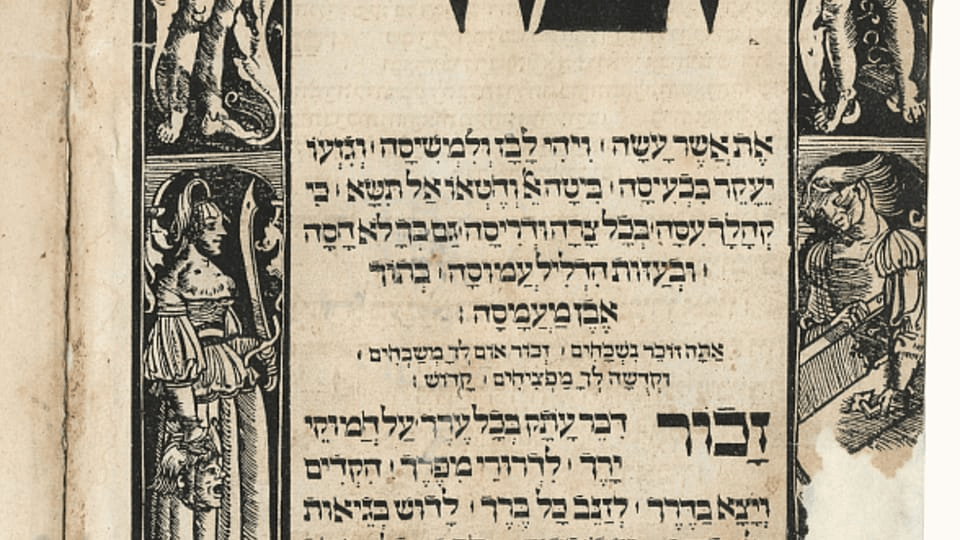
Hebrew text printed in 16th century Prague, evocative of the fictional Sefer Bohem in Overdue’s “Provenance” by Jon Black.

Uncovering the Dreamquest Beast

(For fans and friends voting in the Critters Readers Poll, you can scroll down to instructions at the bottom of the post)

Discover the story behind the strange obsession of Camelot’s strangest knight.

Two volumes of “Camelot vs. Cthulhu?”
You know you want it.

As an author, the two things I hang my proverbial hat on are Arthurian mythology (via my Bel Nemeton series) and Mythos-infused historical fiction. So, when 18th Wall Productions put out a call for “Camelot vs. Cthulhu” stories for an upcoming anthology, I knew I had to be involved.

As it turns out, 18th Wall got so many quality submissions that the resulting anthology, Shadows Over Avalon, encompasses two volumes, both edited by the ever superb Nicole Petit. Volume I focus on tales of traditional Lovecraftian cosmic horror, and it’s filled with names who do not disappoint, such as Simon Bucher-Jones, Edward Erdelac, and Josh Reynolds. Volume II channels Lovecraft’s other side, stories of shifting perceptions and realities, fantastical journeys, and dreams. There, you will find my novella “The Dreamquest Beast” along with stories by worthy authors such as Georgia Cook, Kara Dennison, Lukasz Furmaniak, Sophie Iles, and C.L. Werner.

“The Dreamquest Beast” is a non-canonical story set in my Bel Nemeton universe (leading my beloved wife to observe “So, you’re writing your own fanfic now?”).

Taking place a generation before the start of Bel Nemeton, when Arthur is an infant and Merlin still known as “The Wanderer,” northern Britain bakes under an unending drought unlike any in memory. As brave warriors and shield maidens take up the quest to discover what afflicts the land and set matters to right, the would-be champions invariably fail and fall. After the quest claims his much loved older brother, Prince Pelinyr (or “Pellinore” in more contemporary renderings) of Damnonia becomes the unlucky 13th to take up the challenge.

“So, you’re writing your own fanfic now?”

My wife (who, and I say this not only because it’s true but also because she may be reading this, is my biggest fan)

On the surface an unlikely hero, Pelinyr has all his life been plagued by nightmares and strange occurrences surrounding his dreams. In this desperate endeavor, he is joined by his friends: the gregarious Prince Cynfarch of Gorre, the clever Prince Tuadel of Alclud, and Jana, Pelinyr’s childhood playmate, now a shunned sorcerer and seer haunting a cursed Roman amphitheater. Together, the four will cross the wild frontier into the kingdoms of the dreaded Saxons before descending through a black tower without name or builder into the land of dreams themselves.

Once in the Dreamlands, the challenges and dangers only grow. The company will meet gods, battle monsters, take caravans into deadly jungles and endless deserts, pour over tablets written in unearthly tongues, and solve riddles that are a matter of life of death for the companions and for millions back in the waking world.

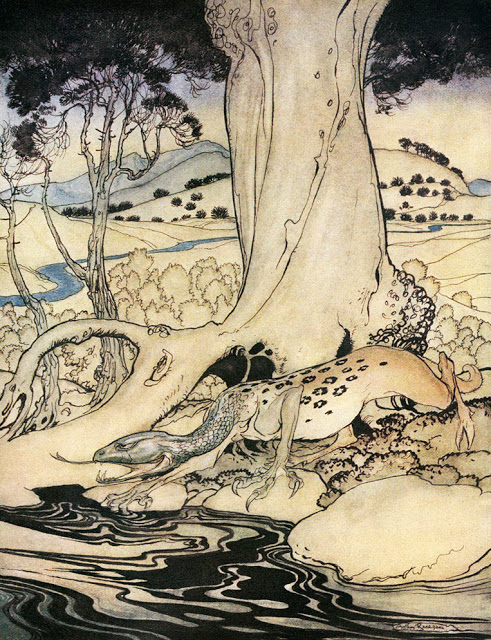
The Questing Beast drinks from a river (perhaps the good, strong Adamandara) – illustration by Arthur Rackham (1917)

Pelinyr has always been one of my favorite members of the Round Table as well as, to me, one of the most fascinating. Along with Galahad and Percival, he is one of the knights that is “touched” in a way Arthuriana usually reserves for its Druids/Magicians/Whatever you want to call them. For Galahad and Percival, that mania is clearly religious in nature. With Pelinyr, however, its source is never clearly defined. Certainly, it seems to be connected with the “Questing Beast,” the strange creature which he is sworn to follow but which only he can see – but whether the beast is a cause or effect of Pelinyr’s madness is unknown.

This characterization of Pelinyr is surprisingly consistent throughout Arthuriana: from Malory’s Le Morte d’Arthur, where it is implied he is afflicted by his relation to the Fisher King, to the eccentric and slightly senile figure of T.E. White’s Once and Future King.

This aspect of Pelinyr has been incorporated into my Bel Nemeton series. Pelinyr is a minor yet significant figure in the second book, Caledfwlch. The book opens with a friendly duel between Arthur and Pelinyr, as Merlin looks on and frets about Pelinyr’s instability manifesting during the combat. And Caledflwch ends with, in a fit of inspiration, Pelinyr being the one who finds the true name of Arthur’s new blade and becoming the first significant British noble to pledge fealty to Arthur.

So, the idea of “Dreamquest Beast” (a kind of titular portmanteau of Arthuriana’s “Questing Beast” and Lovecraft’s “Dream Quest of Unknown Kadath”) as a thought-experiment exploring how Bel Nemeton’s Pelinyr “got that way” and the origins of the Questing Beast was extremely appealing. Like many previous authors, scholars, and artists, I connect the Questing Beast with the mythical creature known as the camelopardus or camelopardalis. Additionally, I thought it would fun to take two of the foils from Caledfwlch (both based on historical 6th century British rulers), make them Pelinyr’s boon companions in “Dreamquest,” and explore the roots of their own transitions from friend to foil.

I am Cameleopardus
From the Serpent, Master of Cunning, comes my Head.
From the Leopard, Lord of Fleetness, is taken my Body
From the Lion, King of Bravery, are drawn my Haunches
From the Hart, Emperor of Virtue, are given my Feet.
And from Sacrifice, I take Breath and Mind and Life

The Riddle of the Questing Beast, from “Dreamquest Beast”

As a writer, I’ve dropped elements of Lovecraft and the Mythos into my stories dozens of times. Doing it with “Dreamquest,” perhaps because I was cutting from the whole cloth of the Dreamlands rather than picking and choosing an element or two for what was essentially my own world, was different. I felt a tremendous sense of pressure, even obligation, to be “good enough” and “get it right.” For all that, it was enormously exciting, one of the most exciting things I’ve done as an author, both to be able to use my favorite elements of the Dreamlands and to add more than a few things of my own.

I also peppered “Dreamquest Beast” with Easter eggs, weaving in nods and shout-outs to stories, myths, and legends from Herodotus to Jim Henson, which also play with the dreamlike, the surreal, or the radically fantastic. Likewise, I endeavored to keep things fresh by occasionally using established Mythos creatures without naming them or renaming them in accordance with cultures involved in the stories (such as using the Saxon “barrow wights” for Lovecraft’s ghouls).

Play along at home! Use this card to track the Easter eggs, shout outs, and obscure references I’ve tucked into “Dreamquest Beast.”

As part of giving “Dreamquest Beast” a distinctive and appropriate atmosphere, I also played with the language of the story. For those of you familiar with my other work, no part of “Dreamquest” is quite in my usual authorial voice. In the first and third acts, taking place in the waking world of 6th century Britain, I have leaned hard into the conventions of epic poetry. For the second act, occuring in the Dreamlands, I have attempted to channel the distinctive language Lovecraft used in the Dream Cycle.

I am very gratified that “Dreamquest,” despite only being released in December, has already been nominated for “Best Science Fiction or Fantasy Short Story of 2022” in the Critters Readers Poll. For fans and friends interesting in supporting me, I’ve included directions for voting below:

  • Go here
  • Scroll down until you find “The Dreamquest Beast / Jon Black / 18th Wall Productions and then tick the circle
  • Scroll down again and enter your name and email address in the appropriate fields
  • Jump through their “I’m not a bot” hoop by looking at the random book cover they show you and entering the name of its author in the appropriate field 
  • Click “Submit Vote”
  • You’ll get a confirmation email sent to you, click the link in the email to confirm your vote.

“The Dreamquest Beast,” part of Shadows Over Avalon: Volume II from 18thWall Productions, is available in paperback and ebook formats.

Diving into The Green Muse

This month sees the release of my first Mythos story, “The Green Muse” part of the innovative anthology The Chromatc Courtedited by Peter Rawlik and published by 18th Wall Productions.

The Chromatic Court by [Rawlik, Peter, Morgan, Christine, Pulver Sr., Joseph S., Mackintosh, Paul StJohn, Lai, Rick, Black, Jon, Grant, John Linwood, Barrass, Glynn Owen, Harris, Micah S.]The Chromatic Court is anthology of horror/dark fantasy anthology exploring the connection between color, art, and the powerful entities of the Cthulhu Mythos, drawing especially heavily on the feel flavor, and weird meanace of Robert W. Chambers’ The King in Yellow.

As someone who has been a fan of the  Mythos since college, I’m very excited about this story, and very excited to talk about it. So, I thought I’d play Q & A with myself by sharing the author interview compiled by my publisher.

… also, I may be the first person in the history of the universe to quote Ralph Wiggum while discussing the Cthulhu Mythos.

Q) Tell us about your story?

Johannes Chazot’s Illustration for “The Green Muse.”

A) Set in the fertile artistic and literary scene of 1910s Montmartre, The Green Muse chronicles the journey of Drieu Gaudin, a novice reporter at Paris’ top arts and culture newspaper. His editor, a man of very traditional artistic sensibilities, assigns Drieu to report on the murders of several Cubist painters. Seeking to unravel the mystery behind the artists’ bizarre deaths, Drieu is challenged not only by one of Frank Belknap Long’s most celebrated creations but by encounters with the Parisian avant-gardes’ leading lights: Picasso, Modigliani, Guillaume Apollinaire, and Max Jacob.


Max Jacob waits to encoutner readers in “The Green Muse.”

Q) What is your favorite part of your story and why?
A) This project was a labor of love for me. For a very long time, Paris’ artistic scene in the early part of the 20 th century has captivated me and inspired voracious reading on the topic. The greatest joy of The Green Muse was breathing life into the enchanting world of 1910s Montmartre. Within that broader answer, it was especially gratifying to shine some light on poet Max Jacob, a figure unfortunately and undeservedly less well known than the other historical artists who appear in the story. Spoiler Alert: it was also exciting to expand on the fascinating yet under-explored mythology of the Hounds of Tindalos.


Q) Every story in The Chromatic Court details a noble,  a powerful Mythos entity, and the art form they hold sway over. What is your entity’s art and what drew you to it? 
A) As anyone familiar with my work is likely aware, music is my greatest passion among the arts. Painting, however, runs a close second. This is especially true of painting from this particular time and this particular place; as artists began grappling with the question of what the invention of photography meant for painting. Movements such as Cubism and Fauvism arose from attempts to answer that critical and vexing question. As Picasso observes in “The Green Muse…”

“Painting is dead. At least painting as you know it. Photography killed it. But, in death, painting is free. Our quest is figuring out where it goes from here.”


“Iä! Iä! Cthulhu fhtagn!”

Q) In The Chromatic Court, every Mythos entity and their art is also tied into a specific color. What is your noble’s color, and why?
A) As revealed in the title, green. I could point out the relevance of green to the absinthe which features so prominently in the era and in the story, but as Ralph Wiggum says, “The rat symbolizes obviousness.” Less explicitly but more importantly is that color’s connection with envy, specifically the jealousy Montmartre’s artist feel for each other’s success, talent, and romantic prowess. In various forms, jealousy is a driving force for the main characters of “The Green Muse,” Drieu and Cara, as well as some of its historcial figures,  like Picasso.

Q) How do you approach writing Mythos fiction, particularly when it’s a mix of the Cthulhu Mythos and Chambers’ Yellow Mythos?
A) For me, the most important element of successful Mythos fiction is believably but compellingly conveying the protagonist’s mental journey from the comforting illusion of everyday life to the sub-rosa Mythos reality beneath. When blending Lovecraft and Chambers, the challenge is balancing the Outer Gods’ concrete if alien terrors with the latent and more diffuse menace of The King in Yellow.

Read Chapter One from “The Green Muse.”