Most people know Willis Conover (1920 – 1996), if they know him at all, as one of the great impresarios of jazz: co-founder of the Newport Folk Festival, jazz DJ on the Voice of America for decades (and one of the reasons Eastern Europe’s vibrant jazz scene managed to survive the Cold War), a collector who owned more than 60,000 (no, there’s not an extra zero in there) recordings at the time of his death.
Even when I was writing a lot of music journalism, jazz was never a special passion of mine (oh sure, enough of a passion for me to bring that enthusiasm to Gabriel’s Trumpet, but not the kind of visceral connection I have with blues, country, or punk). So why, you might rightly ask, is Willis Conover showing up on this blog?
Before of all of that, Willis Conover had another life. As a teenager in 1930s Maryland, he got into science fiction (or “scientifiction,” a portmanteau of Gernsback’s still in wide use at the time) and, to a lesser extent, fantasy (then spelled with a “ph” as often as an “f”). Deeply into. With the same methodical thoroughness he would later apply to studying jazz and collecting jazz records, he began studying science fiction and collecting both pulps and fan magazines. At the age of 16, he began publishing a fan magazine of his own, The Science Fantasy Correspondent. In an era when many fan magazines made modern ‘zines look like papers-of-record, Correspondent stood out for the quality of both its production and content.
Cover Images from the Willis Conover Collection: University of North Texas
In fact, Correspondent drew the attention of a certain Weird Fiction author from Providence who contacted Conover, telling him how much he liked the publication. The ensuing correspondence between Conover and Lovecraft would continue throughout the rest of Lovecraft’s life and has been compiled into Lovecraft at Last: The Master of Horror is His Own Words, a complete (or nearly so) collection of their letters. Lovecraft’s friendship and patronage opened doors for Conover to correspondence and friendship with other authors, publishers, and major figures of 1930s fandom.
The public aspects of Conover’s enthusiasm for science fiction and fantasy faded after a couple of years, excluding a secondary period of activity in the 1970s, as his focus turned toward his meritorious service to jazz. He never, however, ceased his correspondence or collecting.
So, why am telling you this?
Unsurprisingly, Conover’s papers ended up at the University of North Texas, one of the country’s better jazz schools (yes, really, look it up), which happens to be located in the town where I live. Among that collection’s 300 boxes, primarily of Conover’s jazz records, interviews, correspondence with musicians, and so forth, are 30 boxes, more or less, connected to his earlier enthusiasm.
Even with briefest examinations of some of those boxes, I am left wondering to quote Pinhead (“We have such sights to show you.”) or Roy Batty (“I’ve seen things you people wouldn’t believe”).
To give a little teaser, inside one obscure Lovecraft volume in the Conover collection, I found the following inscription:
(Photo: Jess Tucker)
To Willis – so you can complete your collection of Lovecraftiana! All the best –
Arthur Clarke
I had no idea Arthur C. Clarke was even a fan of Lovecraft. Compared with that, For Willis Conover, with the hope that we may have an immersive moment or two. Cordially, August Derleth, seems rather prosaic.
Over the coming months, and even years, I expect many of my posts here to focus on things I’ve encountered (I hate the phrase “discovered” when used in connection with archives. The items were, after all, there all along – often listed plainly on the finding aid) in that collection. Things that have inspired me, surprised me, or broadened my horizons. Hell, I might even do some actual research.
One of the SF fan magazines from Conover’s collection.
I’ve spent the past week scrutinizing two boxes containing 175 discrete issues of 46 different science fiction and fantasy fan magazines from the 1930s — full of fiction from names you know, editorials and non-fiction from names you should know, and amazing art that while not always masterful is powerful and evocative — as well as related materials. I would expect my next few Conover-related posts to focus on those.
And just so nobody goes away disappointed, Willis Conover did have a few secrets. One of the first things I encountered was a letter from a young woman who wrote to Conover while both of them were in the army during Word War Two. Her salutation to him was “Daddy Dear,” and the letter gets more interesting from there. It’s not the only thing like that I’ve found…
(Special thanks to Maristella Feustle, Music Special Collections Librarian, and Jess Tucker, University Archivist, both at the University of North Texas, for facilitating my access to the Willis Conover collection)
If you’re a fan of scifi, fantasy, horror, mystery, or any other corner of speculative fiction/genre fiction, don’ forget to vote in the annual Critters Readers Poll – a reckoning from fandom of the most interesting, most exciting, or just plain best offering from indie publishers during calendar year 2023.
VOTING ENDS 6:00 a.m. (Eastern USA time) MONDAY, JANUARY 15. WHAT ARE YOU WAITING FOR?
A great honor for me
I’m a little sad that, because of publishing schedules, I didn’t have any eligible titles come out in 2023 (hold on to your proverbial hats, 2024 should more than make up for that). My successes in the Critters’ Poll over the years have been very important for establishing my career as a writer, both critically and commercially. But, even without yours truly, some amazing works have received nominations this year.
As a way to get really easy blog content, I thought I’d talk about some of the nominees I vote for (and why).
For Best Mystery Novel:Radcliffe by Madeleine D’Este, from Deadset Press. If you’re someone I talk about books with or if you follow my blog (where she’s a regular guest poster, including the excellent “official playlists” for her titles), you’re already familiar with Madeleine. She writes Australian-focused fiction, often with a supernatural element, and has true gift for stories exploring the intersection of quirky personalities and bizarre locations. Radcliffe, the story of eccentric residents of a lonely apartment on the outskirts of Melbourne, is her superlative work in that regard. (She’s also an upcoming 18thWall Productions author!)
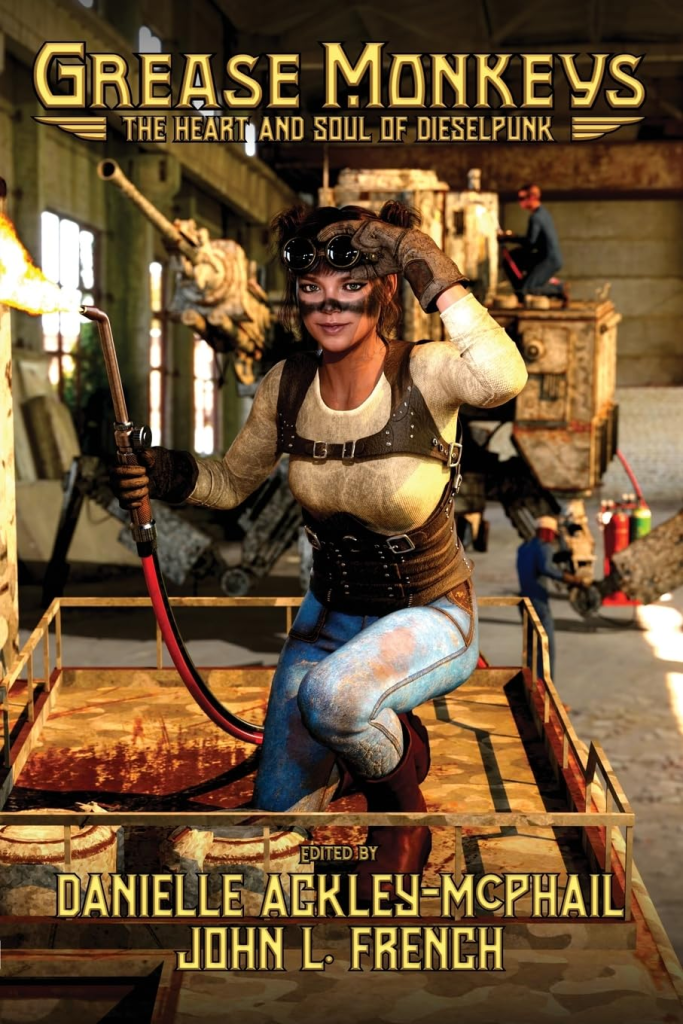
For Best Steampunk Short Story: “The Falcon and The Goose” by David Lee Summers, in the anthology Grease Monkeys: The Heart and Soul of Dieselpunk from eSpec Books. Summers is southwestern author whose work does several things I adore: including weaving historical events into his fiction and using historical figures in cameos or even not-so-cameos. “The Falcon & The Goose” pits one of the turn-of-the-last-century’s greatest rail engineers against two of its most notorious outlaws in a life-or-death rail vs. airship race.
For Best Anthology: the aforementioned Grease Monkeys: The Heart and Soul of Dieselpunk from eSpec Books. Among all the various [x]punk genres, Cyberpunk and steampunk are favorites (and I may have some interesting things to say about clockpunk in a year or two), but Dieselpunk has a special place in my heart. But, like all the other [x]punks, Dieselpunk has style-over-substance problem. By focusing on the folks who make the technology go, “Grease Monkeys” sidesteps that problem and delivers an anthology of solid stories about the nuts, bolts, and grease of a different reality.
Additionally, all other things being equal, anything from Third Flatiron Publishing is usually going to have both the quality and the spin to get my vote.
Anyway, those are my thoughts. Go vote! And I’ll see you on the nomination list next year. 😉
(A novel in an anthology? My story, like the TARDIS itself, is bigger on the inside than the outside)
This month sees the release of Defending Earth, a charity anthology of Sarah Jane Smith stories raising money for researching cancer (which killed SJS actor Elisabeth Sladen in 2011). My contribution, “Swinging Londons,” rapidly mushroomed beyond the original concept, ultimately reachng 42.5K words.
Why/how did this piece grow so long. Part of it is simply that “Swinging Londons” was hella fun to write. But there’s more than that, “Swinging Londons” isn’t just a story for me … it’s a labor of love.
I first discovered Dr. Who on KERA, the Dallas Public Television station, in the late 80s. At time, this was something that branded me as a nerd even among nerds. Nevertheless, it was a revelation … a vision of sci-fi so much more expansive and full of possibility than anything I had encountered previously. My favorite Doctor was (and remains) John Pertwee, especially those episodes with Sarah Jane Smith and “Swinging Londons” is very much an homage to those episodes.
It also proves that, even when writing sci-fi, I am incapable of breaking his historical fiction addiction or my fondness for cameos by real-life historical figures.
As much as I’d love to toot my own horn about the role of “Swinging Londons” in Defending Earth, I need to credit the real heroes … curator/editor Mary-Helen Norris and artist/illustrator Sophie Iles.
So, obviously, I’m very excited about this piece. For all the of Dr. Who fans out there (and, dare I hope, fans of Jon Black), I’ve copy/pasted a Q&A about “Swinging Londons” from the press kit for Defending Earth.
Q) Which Sarah Jane story (any medium) is your favorite, and why?
Sladen in 2003
A) My favorite Sarah Jane story is Planet of the Spiders (Sladen/Pertwee) with Pyramids of Mars (Sladen/T. Baker) a very close second. Of course, these are among the finest stories in Dr. Who cannon in their own right. They also present Sarah Jane at her best and most compelling: smart, pragmatic, determined, inquisitive, and, above all, humane.
Q) Tell us about your story?
A) In “Swinging Londons” the space-time surrounding that great city has become dangerously unstable, swinging rapidly between alternate possible versions of itself. As UNIT cordons off London and struggles to prevent dragons, Black Shirts, Mole People and other threats from spreading to the rest of Britain and the world, Sarah Jane and the Doctor travel into the heart of the disturbance seeking its cause. After she and the Doctor are separated, Sarah Jane must navigate dozens of alternate Londons while searching for the Time Lord, acquiring a strange companion of her own, and encountering someone she never expected…all before the small matter of saving her London by ending the instability.
Q) What is your favorite part of your story and why?
Yeah, you wonder why this picture is here …
A) While the story allowed me to delve deeply into my historical fiction and alternative history addictions, the true joy of writing “Swinging Londons” came from exploring the relationship between Sarah Jane and the Doctor: specifically, the complicated and sometimes ambivalent emotions even an exceptional human would experience having a best friend and companion who is not only effectively immortal but possesses abilities which often seem to knock at the door of omniscience and omnipotence.
Q) Why do you love Sarah Jane?
A) While Sarah Jane is an ideal “everyman” to bring viewers along on adventures in time and space with the Doctor, she is so much more than that. The adjective “plucky” is, admittedly, cliché when referring to British heroines of a certain time period. That doesn’t mean it’s not a perfect characterization of Sarah Jane. With her resourcefulness, common sense, perseverance, and compassion Sarah Jane epitomizes how, in a universe full of ostensibly much more formidable creatures, humans manage not only to survive but thrive.
A Short Selection of Press for Defending Earth and/or “Swinging Londons”





 Jon Black Writes