Flash (Fiction) in a Pan

Last month at MileHiCon in Denver, I got drafted into the “flash fiction chopped” competition after a couple of scheduled contestants pulled no-shows.
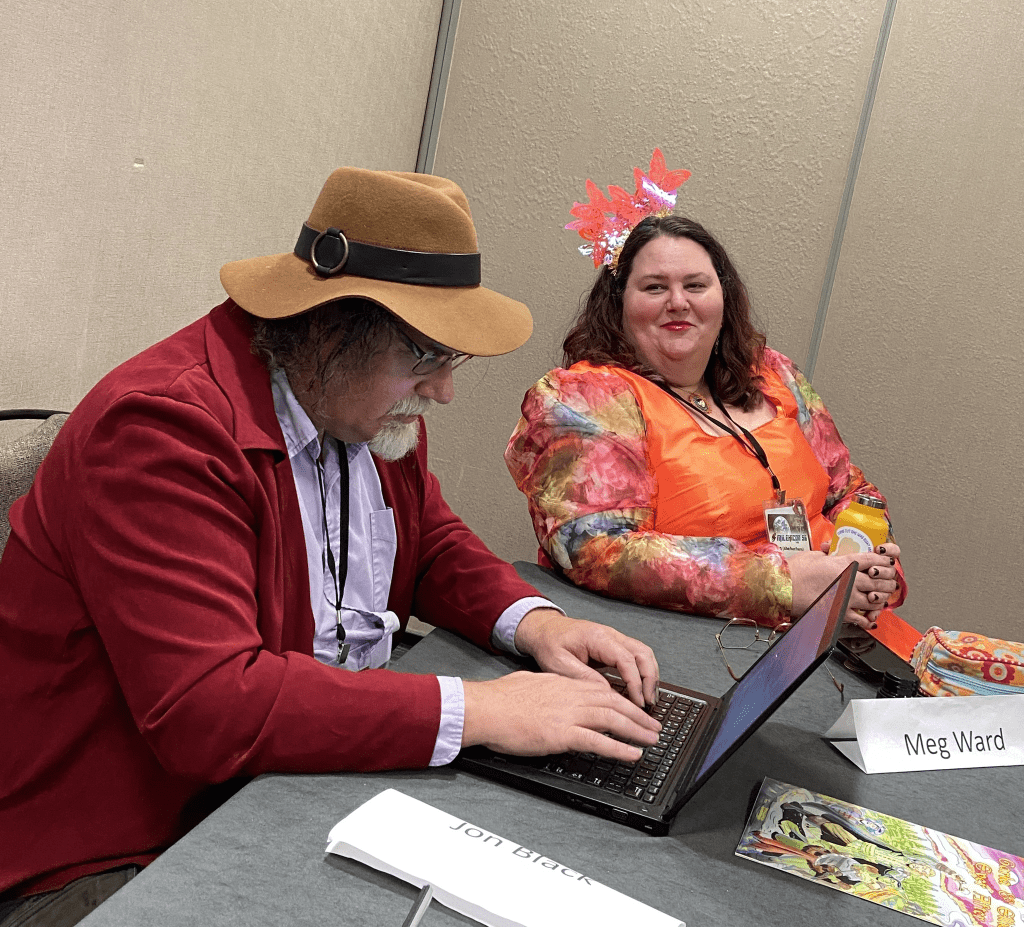
Action Shot: Me, mid-story, chronicling a romance between a dog and a lighthouse…as you do (Photo: HC Werner)

The rules were simple. The audience, improve-style, supplied the contestants with a protagonist, a location, and a complication. The competing authors then had eight minutes to write a story incorporating those elements. Afterward, each author read their story aloud and the audience voted one of the authors “off the island.” Lather, rinse, repeat until only one author remained.

As it turns out, I was that author.

I’ve gotten way more interest on social media about this than I expected, so I thought I’d share my flash fic compositions with anyone who was interested enough in the initial post to check them out. [In the interest of full disclosure, I have done some very basic clean-up on the selections to correct spelling, punctuation, and the occasional omitted article.]

To give this all a pretense of substance, I’ve also added a short section at the end, discussing some of the lessons I’ve taken away from this session which may be useful to those of you who find yourselves in similar competitions.

(CAVEAT: For those of you who may be encountering my writing for the first time through this post, these selections are not representative of my published writing)

ROUND ONE

Protagonist: The Haunted Woman

Location: Evergreen, Colorado

Complication: Stuck in Traffic
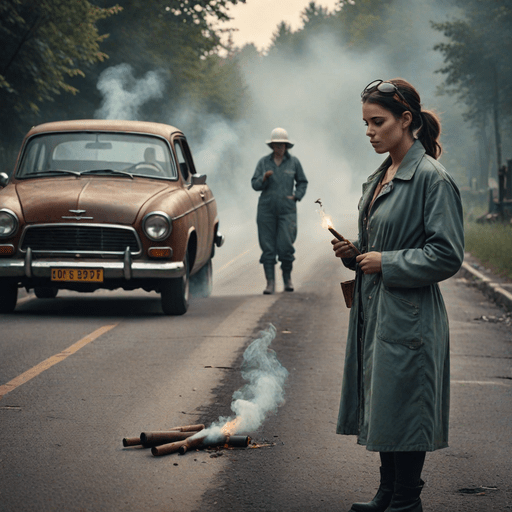
Julia, the haunted woman, presumably (Image: Not HotPot AI’s best work).

Julia had gotten use to ghosts. She had seen them childhood, since an unfortunate accident involving a vending machine and a tarot deck. But ghostly road construction, outside was something new. Up ahead, just outside of Evergreen, Colorado, she could see the construction workers, or rather see through them, as the road was shut down and a truck loaded with used furniture and a VW microbus idled in front of her.

The other drivers were freaked out, their reactions ranging from catatonia to panic and praying. But Julia was the haunted woman. This being old hat, she flagged down the ghost who seems to be in charge. “What’s going on” she asked?

“Road ghosts,” the ghost in charge explained, as it that explained everything.

“Road ghosts?” Julia repeated.

“What did I call them when I was alive?” the ghost took the ghostly cigar out of his mouth, and looked thoughtful. “Pot holes. He paused. “Think about it, pot holes are basically the ghosts of a road. They have their own stories, their own lives, their own pathways to becoming to ghosts.”

“That’s great,” Julia said, “but I’m really trying to get to some town in Colorado the author has heard of.” And then, because the author hadn’t finished his story, a giant machine came out of the sky moved Julia and the rest of the cars past the construction.

ROUND TWO

Protagonist: A sentient attack drone

Location: A deserted beach

Complication: Too many spiders.

BOB (Big Old Bomb) talks with The Spiders. (Image: HotPot AI)

Big Old Bomb, BOB for short, the sentient attack drone, was enjoying its first vacation since the supreme court (not our currently supreme court, obviously,) ruled that AI entities, devices, automata and machines were covered by the same labor laws, including a minimum of two week’s vacation, as everyone else.

A standard query search had indicated humans often liked to vacation on beaches, so BOB thought it would start there. The same search indicated that the combined presence of red tide and medical waste would reduce prices. That seemed to have worked, the prices were low. And the beach was restful. It was, in fact, deserted. BOB had taken long walks by itself. It had read Sartre. It had argued with strangers, including other sentient attack drones, on the internet.

By the fourth day, BOB was bored. It decided to checked out the small beach-side cabaret, the only other place that seemed to be inhabited. A jazz quartet was followed by a flamenco dancer, who was followed by a woman playing the euphonium while reciting limericks in dead languages. The compere then announced the headliner, a rock act. The singer had spiky orange-ish hair, pale skin, and elaborate face makeup. His backup band, the Spiders, were nowhere to be found. “But where are the spiders?” BOB asked and went to go look for them,

He found them all behind the cabaret smoking. The Spiders, too many Spiders, an excess of Spiders, in fact. “Why aren’t you at the gig?” BOB asked.

“Our singer is impossible,” one of the Spiders said, “Always making love with his ego.” So BOB became the Spiders’ new lead singer. And the rest, as they say, is rock ‘n’ roll history.

ROUND THREE

Protagonist: A dog

Location: A lonely lighthouse.

Complication: a burnt bundt cake

A love story for the ages (Image: HotPot AI)

It was the kind of love story you remember you entire life, a classic love story, between a dog who happened to be a conductor of the Philadelphia Philharmonic orchestra and a lonely light house. Of course the lighthouse was lonely, it was a lighthouse, it’s hard to meet people when you’re a lighthouse. Except lighthouse keepers, but they’re the bad boys of recluse and hermit set, all moroseness, all tragedy and posturing … no long walks on the beach, no poetry.

So the light house decided to put its presence out there, like a beacon. Its profile, its dating profile, was very visible, especially to ships traversing the coast at night. But it also reached the wall of the living room of the room where the dog lived. The dog barked out its response, but the lighthouse could not hear. The only people who could hear were the dog’s owners. Damn it, Princess. Go to sleep! they said.

The beacon returned, again the dog professed its love. Again, came the cry, Damn it, Princess go to sleep!!

Again, the beacon returned. Again the dog professed its love. Damn it, Princess go outside!!!

And so her owners let Princess outside. The dog ran, in obligatory slow motion, with soft lighting, a wind machine blowing its fur. You know the scene, you’ve seen it a million times. You can even hear the sound track, take a moment, in your mind, to pick out the perfect song.

“Shit!” the author said, his authorial voice full of conflict, “there was supposed to be a burned bundt cake in here somewhere.”

So, what did I learn?

I want to be clear, I don’t think I won “flash fiction chopped” because I was churning out the highest quality prose at the front table. In fact, I think this was distinctly not the case. In that case, why did I win? What was I doing that put me over the top of competitors who were actually putting out better writing? What can you learn from my experience that might help you if you find yourself in a similar situation? I think there are three things to note here.

Read the Room

Sitting down at my laptop, my impression was that we had an audience in the mood for goofy fun rather than stirring prose. This seemed confirmed when, after the first round, the audience voted to eliminate the author who had written (in my opinion) the best, tightest story but one that was played absolutely straight. If you want to win, write what your judges want.

Performance Matters

Something I realized, which I think some of my competitors missed, is that those four words, “read your selections aloud,” changed everything. That made the competition at least as much about showmanship as authorship.

A Weak Ending is Better Than No Ending

The first thing I did, after writing the opening paragraph, was to write a conclusion. I think having an ending, even if not a very good or even germane one, made my stories feel tighter than some others that were actually better written but stopped abruptly when our eight minutes were up.

Q&A With Madeleine D’Este

Most of my readers will be familiar with Madeleine D’Este, a frequent guest poster who is always happy to feed my hunger for ‘official playlists’ for authors’ new works. With Madeleine riding high on her recent mystery novella, Radcliffe, with one award, another nomination outstanding, and great buzz, I thought it was time to invite Madeleine to join me for a deep-dive Q&A.

Q: Thanks for joining us. Most of my readers are familiar with you, but I don’t think I’ve ever asked a “background” question. Tell us about Madeleine D’Este. Who are you?

A: I’m a writer, reviewer and podcaster from Melbourne who spent her formative years in Tasmania. To date, I’ve written steampunk, historical fantasy, supernatural mysteries and psychological horror. I like to write dark complex women, the paranormal and a juicy plot twist. When not writing, I knit socks, I run and I read…a lot.

I started writing seriously about ten years ago, despite always wanting to be a writer. Before that I’d dabbled, done a bunch of courses, completed Nanowrimo a number of times and got distracted by career crap, until I decided I HAD to do it. And I’ve been lucky enough to be nominated for an Australian Shadow Award (in 2019) and an Aurealis Award (in 2023).

Q: Your novella Radcliffe, has been nominated for an Aurealis Award, congratulations. I know there’s already been some buzz about Radcliffe, including the award for Best Mystery Novel in the international Critters Readers Choice competition. So, tell us about Radcliffe?

A: Thank you, it’s super exciting. Radcliffe is a gothic tale of a weird building full of weird women during a Melbourne heatwave. When Tamsin follows a Voice telling her that ‘death is coming’ to the doors of a tumbledown apartment building named Radcliffe, she knows she has to save someone. But who?

Q: Radcliffe is really driven by its six characters, whom I find wonderful and horrible all at once. Tell us a little bit about each of them and how they took shape in your mind along with the story itself?

A: Wonderful and horrible’ … I’m so glad!

Accountant Tamsin is a seeker – someone who’s life has been dull, full of spreadsheets and Netflix, until one day she hears a voice. No one believes her but she is determined that she has been given a gift.

The other residents of Radcliffe are Bunty, Cecily, Riko, Defne and Gail. Retired ballerina Bunty is flamboyant but sometimes confused. After a life of drama, is she manifesting more strife to keep boredom away? Student Cecily is curious but with the false confidence of youth. Bunty’s granddaughter, she takes a clinical interest in the weird women of Radcliffe. Musician Riko is stand-offish and carries a burden of shame. Bunty dislikes her, but why? Unpredictable photographer Defne finds solace from her disappointing divorce in making grotesque art. Romance writer Gail is rarely seen and her background is the source of wild speculation by the other residents. But when the police come looking for her, is the gossip true?

Tamsin takes a flat in Radcliffe to try to find which of the complicated women ‘death is coming’ for.

The opulence of gold-rush era Melbourne.

Q: Radcliffe showcases your gift for settings which are simultaneously quirky and believable. You’ve done this on scales as large as the steampunk Melbourne of Antics of Evangeline and Women of Wasps and War’s Duchy of Ambrovna to as small as the single eponymous building of Radcliffe or the high school of The Flower and the Serpent, somewhere in between is the rural Victorian town of Ludwood in Bloodwood. I’m curious about your process for conceptualizing settings and bringing them to life.

A: The ‘place’ is always a main character in my writing and it gets as much attention as all the people. Ever since reading The Hobbit or The Little White Horse by Elizabeth Goudge as a child, I’ve adored lush descriptions of the surroundings, and I enjoy writing them too. I’ve also made a conscious effort to take existing tropes and put them into an Australian setting e.g. vampires in the Victorian bush (Bloodwood), steampunk in Marvellous Melbourne (Antics) and gothic in an inner city rundown building during a heatwave (Radcliffe).  

Q: I’ve been reading your work since lucking into a copy of The Flower and the Serpent. In that time, I’ve noted some recurring themes, motifs, and tropes in your work. Can you talk about some of these?

A: You might be able to answer that better than I can! I tend to write about women seeking redemption, with a burning desire to prove themselves and people who struggle to fit in. The return of sins of the past is a recurring theme, and I always love to add in descriptions of food. And all my works contain some type of folklore or Fortean element from alchemists to mummies to witches, sigils, demons, vampires and auditory psychics in an Australian setting.

Q: I have a fondness for your YA series, The Antics of Evangeline. In addition to its other qualities, Melbourne during the Victorian gold rush is such a natural setting for steampunk, I can’t believe I’d never seen it done before. Talk a little bit about Antics and how it fits into your overall body of work.

A: Evangeline started out as an ‘amuse bouche’ when I was writing something more serious (which is now languishing on old hard drives). Inspired by Kim Newman’s Anno Dracula and Gail Carriger, I wanted to bring steampunk to my home city with a thick layer of silliness and adventure. Evangeline is a seventeen-year-old ex-urchin, acrobat and inventress during the Gold Rush days of Melbourne. Along with her father, the Professor and her best friend Mei, she faces off against an Alchemist, a Bunyip and other foes. And she loves cake.

Q:  Compared with much of your work, I see relatively little discussion of The Women of Wasps and War. Yet this is a very powerful, if unsettling, story and one that explicitly voices some themes of your work which are usually a little more implicit. To give that novel a little more spotlight, talk to us about it.

A: Women of Wasps and War is a historical fantasy novel, inspired by a true story following WW1, where a group of women were disappointed when their horrible husbands came back from war. And so they took justice into their own hands. This is my most political piece to date.

Agata, the Duchess of Ambrovna, was never meant to take the throne. In a land where men rule, her sole purpose was to smile and curtsey. However, when war left her land leaderless, the Fatherhood religion begrudgingly allowed a first; a woman to rule. Now the war is over the men have returned more arrogant and cruel than ever, and the Duchess is shoved back into a life of needlework and silence.

But with her new thirst for justice, Agata is reluctant to allow her country to return to its old ways. Without her position of power, Agata and her circle of women look to the taboo wisdom of the Wasp Women for answers. But this ancient knowledge comes with consequences, and with death and treachery on the horizon, Agata must decide whether it is worth the risk. 

Q: I know you contribute to the speculative fiction community in ways other than writing. Let’s hear about your involvement there.

A: As I mentioned I love to read and I host a weekly (very short) book review podcast on Art District Radio called ‘Dark Mysteries’, focusing on crime, thrillers and mysteries (with the occasional horror snuck in).

From 2017-2020, I hosted and produced ‘Write Through The Roof’, a podcast for writers who want to improve their craft where I interviewed a bunch of interesting writers on their process and works. You can find both podcasts on most podcasting platforms.

Writers, Ernest Hemmingway and Madeleine D’Este have bad news for you about first drafts…

Q: What advice would you give to young authors, just now starting out – especially those who look at your work and say, “I’d like to do something like that.”

A: Unfortunately, it’s a lot of hard work and there’s no short cuts. I’d suggest to work out what motivates you. For example, are you a nerdy Capricorn like me who is internally motivated? Then you can set yourself targets e.g. 500 words per day. Or are you someone who needs to work with others? Then you might benefit from a writing group or regular write-ins to keep you on track.

And just write. Oh, and remember ‘first drafts are always shit’. I think Hemingway said that.

Q: What are you currently working on?

A: I have three works-in-progress at the moment, in various stages of polish; a dual timeline historical fiction (shock horror with nothing supernatural!), a psychological thriller set in a commune and an ‘undercover cop in a cult’ thriller.

Q: How can my readers find you?

A: Check me out at www.madeleinedeste.com or on Bluesky at @madeleinedeste.bsky.social
