Essential to the Mythos: Robert Bloch & Mysteries of the Worm

What are we talking about when we imagine a Mythos with no Cultes de Goules or De Vermis Mysteriis? Where Nyarlathotep is just one more faceless, alien outer god – not a singularly sinister entity that truly sees humanity and, at times, seems almost human itself? We are talking about a Mythos without Robert Bloch.

Despite having considered myself “into the Mythos” for more than 30 years now, Robert Bloch was not an author I had read much of or knew much about (see “A Little More on Robert Bloch” below). Recently, at my local used book store, I picked up a copy of the 2nd edition of Mysteries of the Worm, Chaosium’s collection of Bloch’s cosmic horror and Mythos stories. Those stories sufficiently impressed me to do a deeper research and reflection drive. That, in turn, left me sufficiently impressed to put together review of Mysteries of the Worm combined with a short essay on Bloch and his contributions to the Mythos.

Most of the stories in Mysteries of the Worm qualify as Lovecraft Pastiche. That term, “pastiche” (and especially “Lovecraft Pastiche”) is typically used dismissively. Here, that is not my intent. These are stories that are both excellent and enjoyable, but executed in imitative homage to Lovecraft, rather than what we came to know as Bloch’s genuine authorial voice.

It is true that Bloch lacks the raw, weird power of Lovecraft’s imagination. At the same time, for all the idiosyncratic charm of Lovecraft’s writing, though it may be heresy, I argue Bloch is better than Lovecraft at constructing stories and using words. If this collection is pastiche, it is delightful pastiche. That being said, the most memorable stories in Mysteries of the Worm tend to be ones where, among the homage, we can still occasionally hear Bloch speaking as Bloch.

A Little More on Robert Bloch
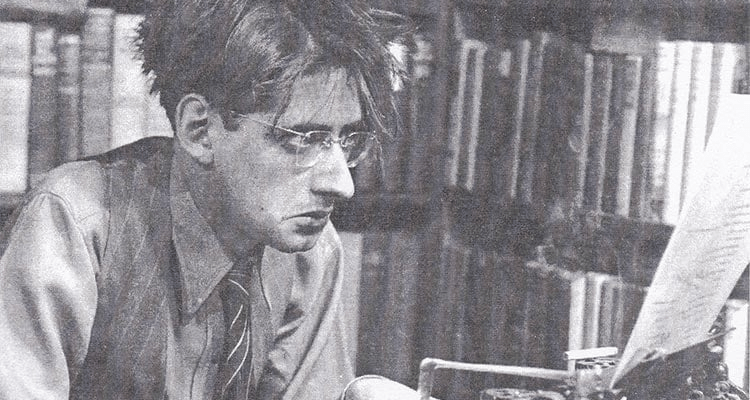
“Mysteries of the Worm”-era Robert Bloch hard at work.

Robert Bloch (1917-1994) is familiar to most Mythos readers for two reasons:
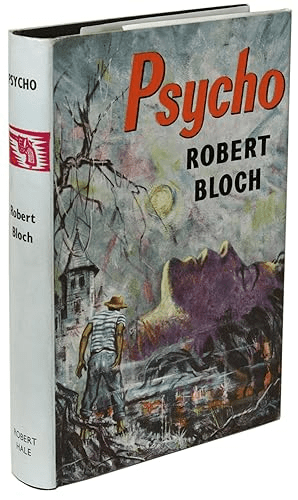
First, he wrote the novel Psycho upon which Hitchcock’s movie was based (not, as is sometimes reported, the screenplay itself). This launched a successful Hollywood career and made Bloch one of the few early Mythos authors to enjoy mainstream success during his lifetime. This recognition included (and, yes, I totally cribbed this from Wikipedia) the Hugo, Bram Stoker, and World Fantasy awards. He served as president of Mystery Writers of America and was a member of the Academy of Motion Picture Arts and Sciences.

Secondly, Bloch was the author of the well-known “Shambler from the Stars” a 1935 tale in which, with Lovecraft’s permission, a New England “mystic” clearly intended to be Lovecraft, meets a gruesome end. Lovecraft returned the favor in 1936’s “The Haunter of the Dark,” killing off the story’s protagonist Robert Blake. Dedicated to Bloch, “Haunter” is the only story Lovecraft ever dedicated to a specific individual. Both “Shambler” and the third story in this cycle, Bloch’s 1950 “The Shadow from the Steeple,” are included in Mysteries of the Worm. “Shadow” ties up loose ends from Lovecraft’s “Haunter” while giving readers a chilling glimpse of what Outer God Nyarlathotep is up to in the atomic age.

Through teenage explorations of Weird Tales magazine, Bloch became a great fan of Lovecraft and the two began corresponding in 1933. As he did for many others, Lovecraft became a mentor to Bloch in both the craft of writing and the business of writing.

As an author, cosmic horror in a Lovecraftian vein is something to which Bloch would periodically return throughout his life. But, beginning about the time of Lovecraft’s death in 1937 (a loss which hit the young Bloch very hard) he began moving away from cosmic horror, especially Mythos horror, as a staple of his output. This process was largely complete by the mid-1940s. Among the many kinds of tales Bloch spun in a career spanning more than half a century, he excelled at, and indeed helped establish, the genre of crime horror. While Psycho arguably meets the criteria of crime horror it is “Yours Truly, Jack the Ripper” which is Bloch’s superlative accomplishment in this regard.

To consider Bloch, as a complete person, a “Mythos author” requires squinting and looking from exactly the right angle. Bloch was not a Mythos author or, more precisely, not only a Mythos author. But Mysteries of the Worm shows why an understanding of the Mythos, especially a literary history of the Mythos, is incomplete without a working knowledge of Bloch’s work and contributions.

Essential Contributions

Mysteries of the Worm certainly can be approached and enjoyed simply as a collection of Mythos and cosmic horror. But for scholars, completionists, and serious fans, the collection has additional value. Mysteries of the Worm highlights exactly how extensive Bloch’s contributions to the Mythos are.

Of the multitude of Mythos tomes, there are four I consider tier-one both for their evocative power and for their ubiquitous and enduring presence in Mythos fiction over the decades: The Necronomicon (of course), Cultes de Goules, De Vermis Mysteriis, and Unaussprechlichen Kulten. We can thank Lovecraft for the first of those, and Howard for the last. The other two, however, are Bloch’s creations.

Prop De Vermis Mysteriis used in the film Doctor Glamour, built by Rev. Marx.

De Vermis Mysteriis (“Mysteries of the Worm”) and its diabolic author, Ludvig Prinn, first appear in Bloch’s story “The Secret in the Tomb.” Cultes des Goules makes it first appearance in “The Suicide in the Study,” and comes with a much more interesting backstory. The tome’s author, Comte d’Erlette, is not entirely fictional. Rather he is a Tuckerization and alter-ego of fellow Lovecraft Circle member August Derleth (Derleth/d’Erlette).

Depending on who is telling the tale, the unhinged Comte was either a gentle or not-so-gentle dig at Derleth’s rather aristocratic airs. While, strictly speaking, beyond the scope of this article, I can’t resist running down the rabbit hole of the Comte’s literary history a little further. Lin Carter later doubled-down on Bloch’s Tuckerization by ascribing to the Comte the same controversial “war in the heavens” division among Mythos entities utilized by Derleth himself. Derleth, however, may have had the last laugh by using his alter ego in two stories of his own, “Adventure of the Six Silver Spiders” and “The Black Island.”

Nephren-Ka (Image: Miskatonic University, really)

Traditionally, creation of Nephren-Ka, the cursed Pharaoh of Ancient Egypt, whose name was struck from monuments by the priesthoods of his more benign successors, has been ascribed to Lovecraft’s “The Haunter of the Dark” Lin Carter tells us this is not exactly so. According to Carter, Bloch’s story “Fane of the Black Pharaoh,” though not published until 1938, had been written prior to “Haunter in the Dark” and that Lovecraft had already seen, and been impressed by, Bloch’s manuscript prior to writing “Haunter.”

It is Bloch’s extensive use of the Pharaoh which solidifies the connection between Nephren-Ka and Nyarlathotep. Some have interpreted Nephren-Ka as a worshiper or even high priest of Nyarlathotep. Others have seen the Pharaoh as nothing less than an avatar of the Outer God. (I wonder how a greater awareness of Bloch’s take on Nephren-Ka might have influenced my own borrowing of the Pharaoh for my novella “The Dreamquest Beast,” had I been more cognisant of the connection at the time I was writing).

Nyarlathotep, from the 2001 short film of the same name (based on the Lovecraft story of the same name).

Nyarlathotep is, in several ways, distinct among the Outer Gods of the Mythos. First, he is the only one consistently presented as having a mind and personality in the sense that humans understand those concepts. Second, he is the only Outer God with a genuine and specific interest in humanity, albeit a perverse and malefic one. A case can be made that these unique aspects of Nyarlathotep begin with Bloch’s connection of Nyarlathotep and Nephren-Ka.

About the Collection

It’s ghouls a go-go in Robert Bloch (Image: HotPot AI)

Every author has their pet elements which they return to again and again, whether they are consciously aware of it or not. As Mysteries of the Worm makes plain, Bloch is no exception. He is clearly fascinated by Ancient Egypt. Egypt at the time of the Pharaohs, or its trappings transported to other times and places, feature in six stories in the collection, including some of those aforementioned stories which have been so essential in creating Nyarlathotep as we know him. It also seems, of all Lovecraft’s core creations, the idea of ghouls really grabbed Bloch’s imagination. Three tales in Mysteries of the Worm feature ghouls, or creatures so like ghouls as to make no difference.

Many of the collection’s stories feature the elements or flavor of pulp coexisting alongside cosmic horror. These pulp elements are not as pronounced as with Robert E. Howard or Clark Ashton Smith, but sound a frequent beat in Mysteries of the Worm nonetheless.

One thing which separates Bloch’s Lovecraft pastiche from the genuine article is the greater diversity in backgrounds and personalities of the protagonists present in Bloch’s work. This is to the collection’s benefit, helping stories feel more individual and distinct and less like copy/paste templates.

I have not endeavored to comment on every story included in Mysteries of Worm. Rather, I have singled out for mention those which either help illustrate broader trends and patterns in Bloch’s work or are singularly notable for their own merits (or, in one case, lack thereof).

“The Grinning Ghoul” in June 1936 Weird Tales.

The collection’s beginning is dominated by those tales which are the most strongly Lovecraft pastiche. As discussed earlier, this is not necessarily to their detriment. For the most part, this is good pastiche. The strongest examples, however, serve up their homage with at least a slight twist. “The Faceless God” feels like a Bloch doing a pulpy riff on “Under the Pyramids.” For all its essential Nyarlathotep lore, it is less of a Mythos story than dark pulp with a Mythos macguffin. “The Grinning Ghoul” is very much in the vein of “The Statement of Randolph Carter.” If Carter had the stones to follow Harley Warren into the depths. “The Brood of Bubastis” has the shape and feel of Lovecraft’s “The Rats in the Walls,” but combines an Egyptian twist with outre ideas of prehistoric population migrations which even Robert E. Howard would have envied.
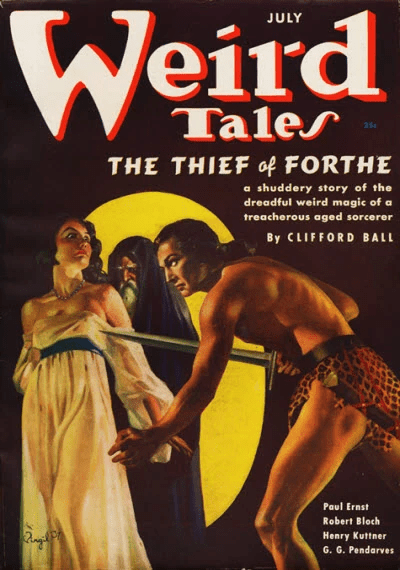
“Creeper” in July 1937 Weird Tales.

If I had to pick one story in this collection to ‘vote off the island,’ it would be “The Creeper in the Crypt.” There is so much not to love here. A ghoul story that is less effective than Bloch’s similar offerings. A flat and weak point-of-view character who is mostly a passive observer to the story’s events. An ineffective homage to Lovecraft by setting the story in an Arkham that feels nothing like Arkham. Some unfortunate ethnic stereotypes (while common enough in the Lovecraft Circle, something Bloch usually manages to avoid). Yet the story is not without interest as an early example of Bloch’s combining crime fiction with horror, even if not a particularly successful one.


Two stories in Mysteries of the Worm stood out to me for feeling ‘out of time’ with their publication date (coincidentally, in both cases, 1937).
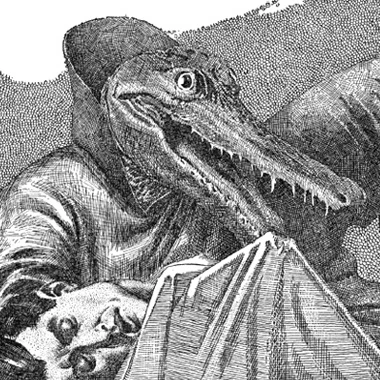
Sebek, by classic pulp illustrator Virgil Finlay.

“The Secret of Sebek” is another of Bloch’s Pharaonic Egypt-adjacent tales. This time, however, the setting in New Orleans during Mardi Gras and a secretive masquerade ball of rich weirdos which, of course, conceals a far darker purpose. “Secret” feels far more modern than its publication date. In fact, it feels tailor-made for adaptation as a 1970s giallo film.

“The Mannikin” is a curious story which, at once, looks both forward and back from its 1937 publication date. The set pieces put into place at the story’s beginning are pure Gothic, far more Poe than Lovecraft. The story’s ultimate resolution, however, is very modern. Strip away those set-dressing elements I mentioned, and it is easy to imagine “The Mannikin” as an X-Files episode. Indeed, at the risk of some oblique spoilers, it has significant commonalities with the well-known second-season X-Files episode, “Humbug.”

Mysteries of the Worm presents two of Bloch’s most celebrated short stories, “The Shadow from the Steeple” and “Notebook Found in a Deserted House.”

“Steelple’s” Shining Trapezohedron by Red-Vanguard on DeviantArt.

“Shadow from the Steeple” completes the trilogy begun by Bloch with “The Shambler of the Stars” and then answered by Lovecraft’s “The Haunter of the Dark.” Bloch’s final installment, however, postdates the first two offerings by a decade and half. Published in 1950, it takes classic cosmic horror, very unsettlingly, into the world of nuclear power and the military-industrial complex. Its presentation of a disturbingly human Nyarlathotep, eagerly using those tools and others to bring maximum woe to humanity, is a further example of how much Bloch has influenced our perception of this Outer God.

“Notebook found in a Deserted House,” channels the paranoia and uncertainty of an isolated protagonist as the agents of the Mythos slowly circle in, epitomized in Lovecraft’s “Whisperer in Darkness,” better than almost any cosmic horror story, save the aforementioned HPL tale. Bloch’s literary device of writing in the style of his protagonist, an uneducated farm boy named Willie Osbourn, has been widely acclaimed. Here I admit to being in the minority, I find it distracting (in much the way I find Lovecraft’s occasional attempts at ‘rustic’ dialogue and accents distracting). That may diminish the tale’s impact for me, but certainly does not dissipate it.

Mysteries of the Worm also contains three standout stories which are not as well known as “Notebook” or “Shadow.”

“The Unspeakable Betrothal” is a shining jewel in this collection. Therefore, it is remarkable that Bloch himself considered the story something of a disappointment. For me, “Unspeakable Betrothal” stands out for two reasons. First, excepting Robert E. Howard, it is one of the few examples of a member of the Lovecraft Circle writing a strong, compelling woman with agency (and the protagonist, to boot). Second, it intriguingly explores the questions “What if the otherworldly entities of the Mythos aren’t truly evil or malevolent, what if they are simply alien in the most profound sense of the word?” and “What what if those alien entities tried tried to form a genuine connection with an, admittedly very unusual, human?”

Sure, AF #9 had “Unspeakable,” one of Bloch’s best stories … but it’s really hard to compete with whatever’s going on with that cover.
But is it Cosmic Horror? A man with cameras.

I’ve seen more than a few stories by multiple authors attempting to explore the intersection of photography with the Mythos. Excepting one unfinished, unpublished story shown to me by its author, I had found all of them unsatisfying. Until Bloch’s “The Sorcerer’s Jewel,” which explores that theme with a heavy dose of pulp added to its cosmic horror. Bloch manages to pack in a rich backstory and some truly memorable secondary characters in a fairly short story. I think it is this ability to both sell the reader on the world and make them care about the characters that allows “The Sorcerer’s Jewel” to succeed where so many other stories built around the same premise have failed.
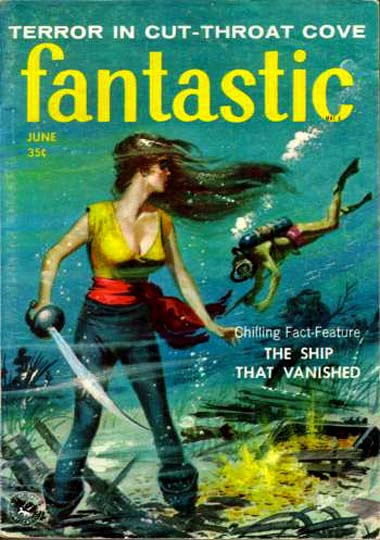
Making the Cover: “Terror in Cut-Throat Cove” in the June 1959 Fantastic.

“Terror in Cut-Throat Cove,” the collection’s true stand-out, is also its final selection as well as one of its longest. It delivers Cosmic horror wrapped in pulp that, if not precisely crime horror, is most certainly noir horror. In every way, “Terror” plays to Bloch’s strengths. Unlike some of the other selections in Mysteries of the Worm, in “Terror” Bloch has selected a protagonist which allows the author’s intelligence and broad knowledge to shine through. Originally published in 1959, at a time when Bloch’s career as a screenwriter was still a couple years in the future, nevertheless all those skills enabling Bloch to find success in Hollywood are admirably displayed in “Terror.” Reading the story, it is impossible not to see the screen adaptation unfolding in your mind. “Terror’s” three principal characters are incredibly well detailed, with their interactions and conversation as much character-driven as story-driven (sadly, a rarity even in the best Mythos fiction) and reeking (in the best possible way) of noir rather than cosmic horror. Yet, “Terror” is undeniably cosmic horror. But unlike the Lovecraft pastiche which dominates the collection’s early selections, with “Terror in Cut-Throat Cove,” Mysteries of the Worm concludes with cosmic horror in Bloch’s own voice.

(As a note to interested readers, Chaosium has since released a third edition of Mysteries of the Worm, expanded to include tales not present in the two previous editions)

Uncovering the Dreamquest Beast

(For fans and friends voting in the Critters Readers Poll, you can scroll down to instructions at the bottom of the post)

Discover the story behind the strange obsession of Camelot’s strangest knight.

Two volumes of “Camelot vs. Cthulhu?”
You know you want it.

As an author, the two things I hang my proverbial hat on are Arthurian mythology (via my Bel Nemeton series) and Mythos-infused historical fiction. So, when 18th Wall Productions put out a call for “Camelot vs. Cthulhu” stories for an upcoming anthology, I knew I had to be involved.

As it turns out, 18th Wall got so many quality submissions that the resulting anthology, Shadows Over Avalon, encompasses two volumes, both edited by the ever superb Nicole Petit. Volume I focus on tales of traditional Lovecraftian cosmic horror, and it’s filled with names who do not disappoint, such as Simon Bucher-Jones, Edward Erdelac, and Josh Reynolds. Volume II channels Lovecraft’s other side, stories of shifting perceptions and realities, fantastical journeys, and dreams. There, you will find my novella “The Dreamquest Beast” along with stories by worthy authors such as Georgia Cook, Kara Dennison, Lukasz Furmaniak, Sophie Iles, and C.L. Werner.

“The Dreamquest Beast” is a non-canonical story set in my Bel Nemeton universe (leading my beloved wife to observe “So, you’re writing your own fanfic now?”).

Taking place a generation before the start of Bel Nemeton, when Arthur is an infant and Merlin still known as “The Wanderer,” northern Britain bakes under an unending drought unlike any in memory. As brave warriors and shield maidens take up the quest to discover what afflicts the land and set matters to right, the would-be champions invariably fail and fall. After the quest claims his much loved older brother, Prince Pelinyr (or “Pellinore” in more contemporary renderings) of Damnonia becomes the unlucky 13th to take up the challenge.

“So, you’re writing your own fanfic now?”

My wife (who, and I say this not only because it’s true but also because she may be reading this, is my biggest fan)

On the surface an unlikely hero, Pelinyr has all his life been plagued by nightmares and strange occurrences surrounding his dreams. In this desperate endeavor, he is joined by his friends: the gregarious Prince Cynfarch of Gorre, the clever Prince Tuadel of Alclud, and Jana, Pelinyr’s childhood playmate, now a shunned sorcerer and seer haunting a cursed Roman amphitheater. Together, the four will cross the wild frontier into the kingdoms of the dreaded Saxons before descending through a black tower without name or builder into the land of dreams themselves.

Once in the Dreamlands, the challenges and dangers only grow. The company will meet gods, battle monsters, take caravans into deadly jungles and endless deserts, pour over tablets written in unearthly tongues, and solve riddles that are a matter of life of death for the companions and for millions back in the waking world.

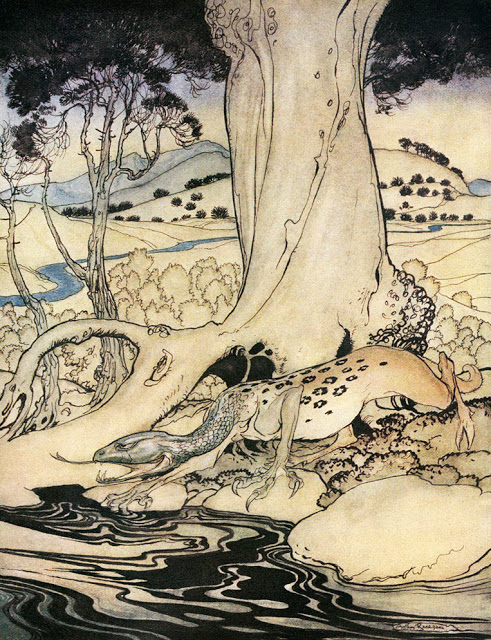
The Questing Beast drinks from a river (perhaps the good, strong Adamandara) – illustration by Arthur Rackham (1917)

Pelinyr has always been one of my favorite members of the Round Table as well as, to me, one of the most fascinating. Along with Galahad and Percival, he is one of the knights that is “touched” in a way Arthuriana usually reserves for its Druids/Magicians/Whatever you want to call them. For Galahad and Percival, that mania is clearly religious in nature. With Pelinyr, however, its source is never clearly defined. Certainly, it seems to be connected with the “Questing Beast,” the strange creature which he is sworn to follow but which only he can see – but whether the beast is a cause or effect of Pelinyr’s madness is unknown.

This characterization of Pelinyr is surprisingly consistent throughout Arthuriana: from Malory’s Le Morte d’Arthur, where it is implied he is afflicted by his relation to the Fisher King, to the eccentric and slightly senile figure of T.E. White’s Once and Future King.

This aspect of Pelinyr has been incorporated into my Bel Nemeton series. Pelinyr is a minor yet significant figure in the second book, Caledfwlch. The book opens with a friendly duel between Arthur and Pelinyr, as Merlin looks on and frets about Pelinyr’s instability manifesting during the combat. And Caledflwch ends with, in a fit of inspiration, Pelinyr being the one who finds the true name of Arthur’s new blade and becoming the first significant British noble to pledge fealty to Arthur.

So, the idea of “Dreamquest Beast” (a kind of titular portmanteau of Arthuriana’s “Questing Beast” and Lovecraft’s “Dream Quest of Unknown Kadath”) as a thought-experiment exploring how Bel Nemeton’s Pelinyr “got that way” and the origins of the Questing Beast was extremely appealing. Like many previous authors, scholars, and artists, I connect the Questing Beast with the mythical creature known as the camelopardus or camelopardalis. Additionally, I thought it would fun to take two of the foils from Caledfwlch (both based on historical 6th century British rulers), make them Pelinyr’s boon companions in “Dreamquest,” and explore the roots of their own transitions from friend to foil.

I am Cameleopardus
From the Serpent, Master of Cunning, comes my Head.
From the Leopard, Lord of Fleetness, is taken my Body
From the Lion, King of Bravery, are drawn my Haunches
From the Hart, Emperor of Virtue, are given my Feet.
And from Sacrifice, I take Breath and Mind and Life

The Riddle of the Questing Beast, from “Dreamquest Beast”

As a writer, I’ve dropped elements of Lovecraft and the Mythos into my stories dozens of times. Doing it with “Dreamquest,” perhaps because I was cutting from the whole cloth of the Dreamlands rather than picking and choosing an element or two for what was essentially my own world, was different. I felt a tremendous sense of pressure, even obligation, to be “good enough” and “get it right.” For all that, it was enormously exciting, one of the most exciting things I’ve done as an author, both to be able to use my favorite elements of the Dreamlands and to add more than a few things of my own.

I also peppered “Dreamquest Beast” with Easter eggs, weaving in nods and shout-outs to stories, myths, and legends from Herodotus to Jim Henson, which also play with the dreamlike, the surreal, or the radically fantastic. Likewise, I endeavored to keep things fresh by occasionally using established Mythos creatures without naming them or renaming them in accordance with cultures involved in the stories (such as using the Saxon “barrow wights” for Lovecraft’s ghouls).

Play along at home! Use this card to track the Easter eggs, shout outs, and obscure references I’ve tucked into “Dreamquest Beast.”

As part of giving “Dreamquest Beast” a distinctive and appropriate atmosphere, I also played with the language of the story. For those of you familiar with my other work, no part of “Dreamquest” is quite in my usual authorial voice. In the first and third acts, taking place in the waking world of 6th century Britain, I have leaned hard into the conventions of epic poetry. For the second act, occuring in the Dreamlands, I have attempted to channel the distinctive language Lovecraft used in the Dream Cycle.

I am very gratified that “Dreamquest,” despite only being released in December, has already been nominated for “Best Science Fiction or Fantasy Short Story of 2022” in the Critters Readers Poll. For fans and friends interesting in supporting me, I’ve included directions for voting below:

  • Go here
  • Scroll down until you find “The Dreamquest Beast / Jon Black / 18th Wall Productions and then tick the circle
  • Scroll down again and enter your name and email address in the appropriate fields
  • Jump through their “I’m not a bot” hoop by looking at the random book cover they show you and entering the name of its author in the appropriate field 
  • Click “Submit Vote”
  • You’ll get a confirmation email sent to you, click the link in the email to confirm your vote.

“The Dreamquest Beast,” part of Shadows Over Avalon: Volume II from 18thWall Productions, is available in paperback and ebook formats.

Welcome to Junzt County, Texas, Population: Weird

Lovecraft has Arkham…

King has Castle Rock…

Campbell has his unique take on the Severn Valley…

Invariably, those who write horror seem to want their own creation they can revisit time and time again. I am no different. This August, my creation, Junzt County, comes out and takes a walk in “Totmann’s Curve,” a 35,000 word novella included as part of Sockhops & Séances, an anthology of horror set in the 1950s, from 18th Wall.

Texas Hill Country

If you ask me, the part of Texas best suited for rich, atmospheric horror is neither the broken deserts and vast plains of the lonely west nor the impenetrable pine forests and swamps of the “boy, you got a pretty mouth” east. Rather, it is the rolling hills, shadowy valleys, and dark-fairytale woodlands of the Hill Country. Stretching about 100 miles west from Austin and San Antonio, many groups, most notably Germans and Eastern Europeans, settled there … each bring their own traditions, folklore, and whispered fears about what haunts the dark. The place feels old, older than anywhere in Texas has any business feeling.

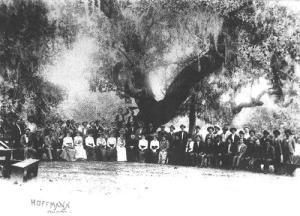
Spme of the Hill Country’s German settlers cut loose and clown for the camera.

So, that’s where I brought Juntz County to life, lovingly populating it with it everything needed for my macabre purposes. Brockenberg, the legend-shrouded vast granite dome rising over county’s center.  Goethe College, an ivy-covered institution established by scholars fleeing an academic schism at the University of Gottingen (and bringing the more, um, unusual parts of its library with them).  Koenigsburg State Hospital, mysteriously burned in the 1980s and many of its patients never accounted for. Thale, a tiny village deep in the hills, perpetually surrounded by ill-rumor and tragedy. And, of course, burger joints, honky-tonks, auto shops, local radio station KJZT, and all the other infrastructure of “normal” everyday life.

Here’s the kicker, originally I created Junzt County not for narrative fiction but table-top roleplaying. It came to life for a Call of Cthulhu campaign I ran the better part of a decade ago, pitting a party of college students all enrolled in the same local folklore class against a mysterious amulet, the supernal forces tied to it, and the (obligatory) cultists trying to recover it. It was a great campaign (thanks, especially, to some great players) and, even at the time, I grasped the location’s potential as a setting for fiction.

Western Swing, Hill Country Style

Before there was “Totmann’s Curve,” there was “So Lonesome I Could Die.” My first published Junzt Country story, in the anthology Descansos, was a musically-themed Texas Gothic ghost story set during the Great Depression. While “Totmann’s Curve” is an entirely self-contained, stand-alone narrative, anyone who has read “So Lonesome I Could Die” will discover several Easter Eggs revealing what has become of some of the earlier story’s characters … and hinting at the resolution to one of its biggest mysteries.

Koenigsburg hot-rodders park on the town square before going for a burger and a malt (actually, Kerrville, Texas)

What of “Totmann’s Curve,” then? It’s a faced-paced 1950s tale of ghosts, teenage hot-rodding, and evil sorcerers serving dark entities. After the tragic deaths of two teens during an illegal road race, increased police attention forces the local hot-rodders to move their activities farther into rural parts of the county. At first, the new race route seems perfect. But the roads have a history of their own … and fender-benders caused by a pretty blonde ghost wearing a white wedding dress are only the beginning of the racers’ troubles. Something in the deep hills is very unhappy about the kids being there.

Oldsmobile “Rocket 88” belonging to Hot-Rodder Jack “Jockey” Groce, Junzt County Historical Society Museum

Can good-natured all-American hot-rodder Sam Granger, his gearhead friend Joe Tegeler, egg-headed cousin Eleanor, the ghostly dreamboat Helene, and the rest of their gang figure out what’s going on in time to save the Saturday races … and their own skins? That is the question.

Are there other Junzt County tales? Yes. A half-dozen, scattered across a variety of time periods, are in various stages on completion. But three others, one set in the ‘40s, another in the ‘80s, and a third in the present are already finalized and resting in my computer, awaiting only a sympathetic publisher.

Sockhops and Seances, from 18th Wall, is available here.

Diving into The Green Muse

This month sees the release of my first Mythos story, “The Green Muse” part of the innovative anthology The Chromatc Courtedited by Peter Rawlik and published by 18th Wall Productions.

The Chromatic Court by [Rawlik, Peter, Morgan, Christine, Pulver Sr., Joseph S., Mackintosh, Paul StJohn, Lai, Rick, Black, Jon, Grant, John Linwood, Barrass, Glynn Owen, Harris, Micah S.]The Chromatic Court is anthology of horror/dark fantasy anthology exploring the connection between color, art, and the powerful entities of the Cthulhu Mythos, drawing especially heavily on the feel flavor, and weird meanace of Robert W. Chambers’ The King in Yellow.

As someone who has been a fan of the  Mythos since college, I’m very excited about this story, and very excited to talk about it. So, I thought I’d play Q & A with myself by sharing the author interview compiled by my publisher.

… also, I may be the first person in the history of the universe to quote Ralph Wiggum while discussing the Cthulhu Mythos.

Q) Tell us about your story?

Johannes Chazot’s Illustration for “The Green Muse.”

A) Set in the fertile artistic and literary scene of 1910s Montmartre, The Green Muse chronicles the journey of Drieu Gaudin, a novice reporter at Paris’ top arts and culture newspaper. His editor, a man of very traditional artistic sensibilities, assigns Drieu to report on the murders of several Cubist painters. Seeking to unravel the mystery behind the artists’ bizarre deaths, Drieu is challenged not only by one of Frank Belknap Long’s most celebrated creations but by encounters with the Parisian avant-gardes’ leading lights: Picasso, Modigliani, Guillaume Apollinaire, and Max Jacob.


Max Jacob waits to encoutner readers in “The Green Muse.”

Q) What is your favorite part of your story and why?
A) This project was a labor of love for me. For a very long time, Paris’ artistic scene in the early part of the 20 th century has captivated me and inspired voracious reading on the topic. The greatest joy of The Green Muse was breathing life into the enchanting world of 1910s Montmartre. Within that broader answer, it was especially gratifying to shine some light on poet Max Jacob, a figure unfortunately and undeservedly less well known than the other historical artists who appear in the story. Spoiler Alert: it was also exciting to expand on the fascinating yet under-explored mythology of the Hounds of Tindalos.


Q) Every story in The Chromatic Court details a noble,  a powerful Mythos entity, and the art form they hold sway over. What is your entity’s art and what drew you to it? 
A) As anyone familiar with my work is likely aware, music is my greatest passion among the arts. Painting, however, runs a close second. This is especially true of painting from this particular time and this particular place; as artists began grappling with the question of what the invention of photography meant for painting. Movements such as Cubism and Fauvism arose from attempts to answer that critical and vexing question. As Picasso observes in “The Green Muse…”

“Painting is dead. At least painting as you know it. Photography killed it. But, in death, painting is free. Our quest is figuring out where it goes from here.”


“Iä! Iä! Cthulhu fhtagn!”

Q) In The Chromatic Court, every Mythos entity and their art is also tied into a specific color. What is your noble’s color, and why?
A) As revealed in the title, green. I could point out the relevance of green to the absinthe which features so prominently in the era and in the story, but as Ralph Wiggum says, “The rat symbolizes obviousness.” Less explicitly but more importantly is that color’s connection with envy, specifically the jealousy Montmartre’s artist feel for each other’s success, talent, and romantic prowess. In various forms, jealousy is a driving force for the main characters of “The Green Muse,” Drieu and Cara, as well as some of its historcial figures,  like Picasso.

Q) How do you approach writing Mythos fiction, particularly when it’s a mix of the Cthulhu Mythos and Chambers’ Yellow Mythos?
A) For me, the most important element of successful Mythos fiction is believably but compellingly conveying the protagonist’s mental journey from the comforting illusion of everyday life to the sub-rosa Mythos reality beneath. When blending Lovecraft and Chambers, the challenge is balancing the Outer Gods’ concrete if alien terrors with the latent and more diffuse menace of The King in Yellow.

Read Chapter One from “The Green Muse.”